REVIEW · SPLIT
Split and Trogir Half Day Tour from Split (with port pickup)
Book on Viator →Operated by Croatian Trails · Bookable on Viator
Two cities, one short coach ride. I like how this air-conditioned coach keeps you comfortable while you connect Split with Trogir UNESCO, and I also like the tight guided hits at Diocletian’s palace and Trogir’s major religious sights. The main drawback is time: you’ll see a lot in a few hours, so expect walking and quick stops rather than lingering.
For cruise days, I really value the clear Croatian Trails meet-up approach near the ship terminal gates, and I like that the experience changes from facts to story with guides such as Tina or Sandra. You’re not stuck reading plaques; you’re getting context as you move through the old streets.
In This Review
- Key highlights worth your attention
- A Half-Day That Actually Fits a Cruise Stop
- How the Pickup and Ending Work in Split
- Diocletian’s Palace: Fast Orientation, Big Roman Impact
- Getting to Trogir by Coast: The Ride That Sets the Mood
- Trogir Old Town UNESCO Walk: Churches Plus Venetian-Era Style
- Saint Domnius Cathedral Complex: Mausoleum to Bell Tower
- Kula Karmelengo: A Fortress Stop With Performance-Era Purpose
- Prokurative and St. Lawrence’s Cathedral: Small Stops, Clear Payoff
- What You’ll Learn from the Guide (and Why Names Matter)
- Price and Comfort: Is $78.61 Worth It?
- Walking, Weather, and Energy Level Reality Check
- Who This Tour Suits Best
- Should You Book This Split and Trogir Half Day Tour?
- FAQ
- How long is the Split and Trogir half day tour?
- What is the price per person?
- What does the tour include?
- Are entry fees included for the sights?
- Is food or drinks included?
- Where do cruise passengers get picked up?
- Where does the tour end?
- Is the tour offered in English?
- Is there a lot of walking?
- What happens if I cancel or if my ship is late?
Key highlights worth your attention
- Air-conditioned comfort: Relief on hot port days, with live commentary as you ride.
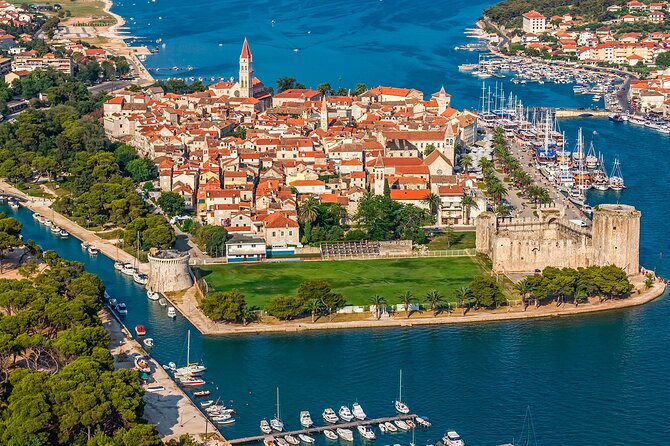
- UNESCO Trogir in a tight schedule: Romanesque churches plus Renaissance and Baroque Venetian-era architecture.
- Diocletian’s Palace orientation: You get the “why this place exists” before you wander on your own.
- Multiple view-and-photo stops: Bell-tower complex, coastal fortress views, and the Prokurative facade.
- Smallish group size: Up to 50 people, plus a guide who can keep the day flowing.
- Cruise-friendly ending in Split: Tour finishes in the city center; you’re then set up to walk or grab a taxi.
A Half-Day That Actually Fits a Cruise Stop
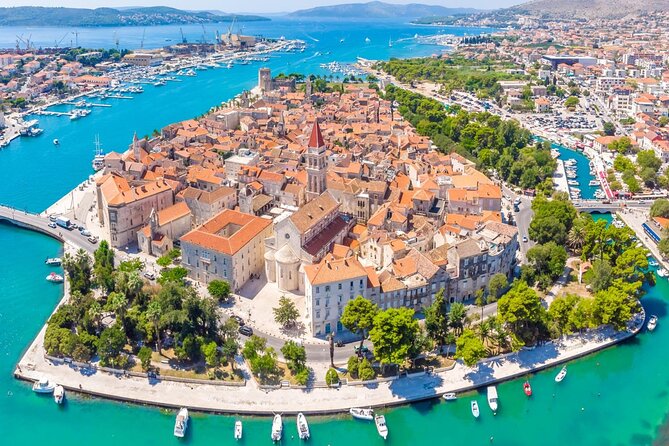
This is built for people who have limited dock time. You get a 4-hour loop that links Split’s Roman backbone with Trogir’s coastal old town, without making your day feel like a marathon.
The best part is the pace: guided time when it matters (palace and key landmarks) and some breathing room when you can just look, take photos, and reset your brain. It’s not meant to be “everything” about either city. It’s meant to give you a clean first pass that makes the rest of your time in Dalmatia better.
You can also read our reviews of more tours and experiences in Split.
How the Pickup and Ending Work in Split
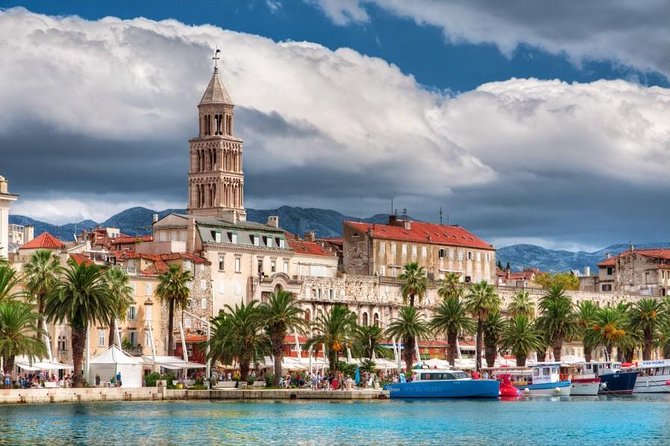
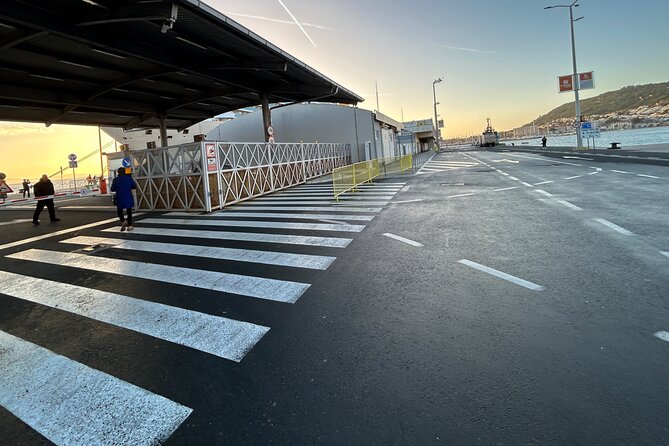
If you’re on a cruise, pickup is from the New Split Berth for cruise ships (Obala kneza Domagoja 16 area). The timing depends on when you disembark and when the ship tells you to be back, with the tour starting either 9:00 AM (for early arrivals) or 10:30 AM (for later docking windows).
At the terminal, the guide carries a sign reading Croatian Trails and meets at the entrance area next to the hop-on/hop-off red buses. The instructions are blunt for a reason: if you ask random directions, you can end up at the wrong gate, which is the last thing you want when ships are involved.
The tour ends in Split at Split Riva. There’s no included drop-off. The upside: you finish in the center. The trade-off: expect about a 20-minute walk back to the ship terminal if you’re heading there on foot. The guide can help you get a taxi if needed, which is a practical backup plan.
Diocletian’s Palace: Fast Orientation, Big Roman Impact
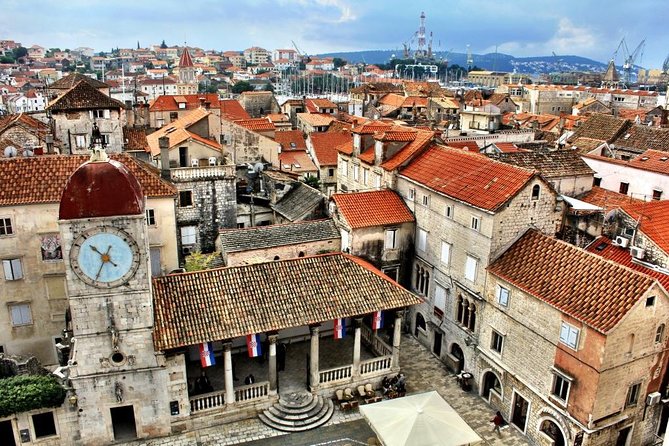
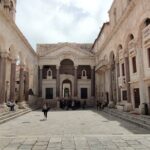
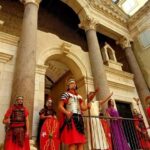
You start at the Palace of Diocletian, tied to the Roman emperor Diocletian and built around the turn of the 4th century AD. It’s not just a “cool ruin.” It’s also a reason Split’s old center looks the way it does today—about half the old town and city center grew out of this palace footprint.
You’re given roughly 20 minutes there as a guided stop. In that short window, the value is orientation: you learn how the palace worked as a powerful private world, then how parts of it became public streets and buildings as centuries rolled on.
Admission isn’t included for this stop. So I’d treat it like a place where it’s worth paying to get inside if the day’s schedule and your energy allow. Even if you’re mostly viewing from the outside, knowing the palace layout helps you read what you’re seeing.
Getting to Trogir by Coast: The Ride That Sets the Mood
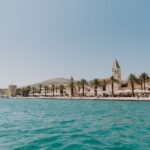
After Split, you take a short ride along the coast to Trogir. This isn’t just transport; it’s a mental shift from a lively city center to a smaller historic island-feel. The coach is air-conditioned, which matters more than people expect when the sun is beating down on stone streets.
The day’s commentary helps you connect what you’re about to see with what you just saw in Split. That “same region, different chapter” effect is part of why this half-day tour works: it doesn’t just stack sights. It explains how they relate.
You then get 1 hour in Trogir’s historic area. Admission for the Historic City of Trogir stop is listed as free, which is a nice bonus for a cost-conscious itinerary.
Trogir Old Town UNESCO Walk: Churches Plus Venetian-Era Style

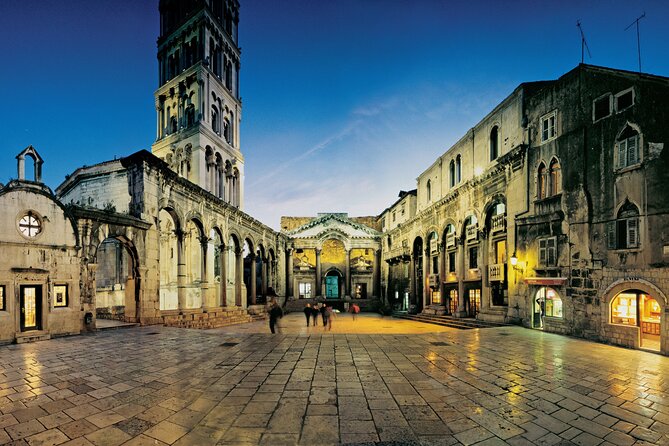
Trogir’s special mix is what you’ll feel as soon as you start walking. The town traces back to Greek colonists from the 3rd century BC, and the urban pattern has continued for about 2,300 years. That long timeline shows up in the architecture: Romanesque churches sit alongside standout Renaissance and Baroque buildings tied to Venetian influence.
With only an hour, I focus on two habits:
1) pick one main route and don’t crisscross too much, and
2) pause at street openings and look back the way you came.
That’s how you get your best photos without wasting time. Also, Trogir is compact enough that you can enjoy the details even if you’re moving with the group for part of the day.

Saint Domnius Cathedral Complex: Mausoleum to Bell Tower
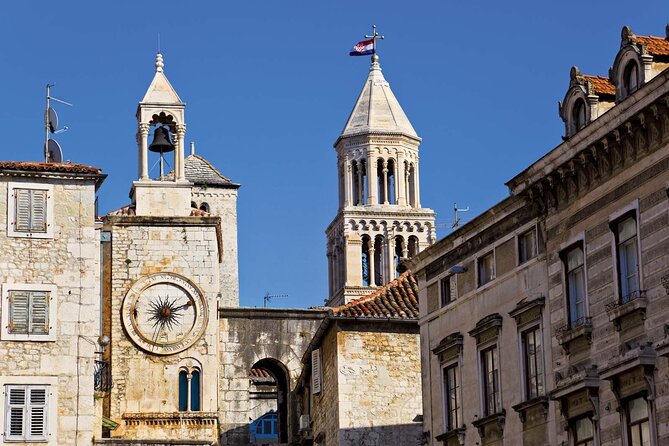
One of your key stops is the Cathedral of Saint Domnius. The tour explains it as a complex rather than a single building: it includes an imperial Roman mausoleum foundation, a church, and a bell tower.
You spend about 20 minutes here. Admission is not included for this specific stop, so it’s one of the “check the cost in advance” moments. The short time is still worthwhile because the guide’s context helps you understand why the site feels layered—older Roman structure elements under later church life.
It’s also the kind of stop where you’ll look up. The bell tower is part of what makes the place memorable, and a quick guided explanation makes the architecture easier to read.
Kula Karmelengo: A Fortress Stop With Performance-Era Purpose
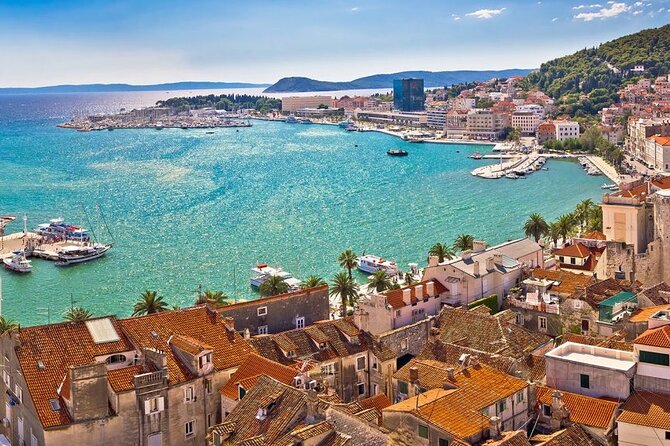
Next comes Kula Karmelengo, a castle built in the mid-15th century, tied to Marin Radoj and connected to older defensive structures on the site. One of the more interesting functional details is that it’s used as a performance location during summer months.
You get about 20 minutes here. Admission isn’t included, but even if you don’t go deep inside (if it’s not part of the included viewing), the setting helps you understand how the town protected itself while still living around the fortifications.
If you like history that explains daily life—not just monuments—this stop does that. Castles weren’t meant for postcards; they were part of a working defense system.
Prokurative and St. Lawrence’s Cathedral: Small Stops, Clear Payoff
Two final stops round out the tour with shorter visits:
- Prokurative (about 15 minutes): This 19th-century structure is linked to Split’s officials and design inspiration from Italy, including a look-and-feel that resembles Venice’s St. Mark’s Square. It’s a good “bridge stop,” reminding you that Dalmatia’s architecture wasn’t frozen after the Roman era.
- Saint Lawrence’s Cathedral (about 15 minutes): This is a Roman Catholic triple-naved basilica in Romanesque-Gothic style. The construction spanned centuries, so the building reflects styles that succeeded each other in Dalmatia. Admission for this stop is listed as free.
These two stops are shorter by design, and that’s smart. After palace, UNESCO streets, and cathedral complex, you don’t want a day of only heavy buildings. Here, you get variety: civic/urban architecture in Prokurative, then a major church monument in Saint Lawrence.
What You’ll Learn from the Guide (and Why Names Matter)
The guides are a big part of why this tour rates around 4.8. I can’t promise you’ll get the same person, but the experience style is consistent: clear storytelling and a rhythm that keeps a half-day from feeling chaotic.
From the guide names you might encounter—Tina, Sandra, Hrvoje, Roko, Josipa, or Tia—you can expect a strong focus on tying the sites together. One moment might be about Diocletian’s power and the next about how Venetian-era influence shaped what you see in Trogir.
I also like that guides tend to adjust for the group’s needs. Several accounts highlight care for pacing and attention to what people need on hot days or during rain. That matters because a tour like this can get stressful if the guide treats it like a timed checklist only.
Price and Comfort: Is $78.61 Worth It?
At $78.61 per person, the value comes from what’s included rather than just the number. You get a professional guide, live commentary, an air-conditioned coach, and port pickup. For cruise travelers, port pickup alone can save you time and headaches versus trying to coordinate independently on a tight schedule.
Entry fees are not included across the board. Some stops are marked free, while others (like Diocletian’s Palace and the Cathedral of Saint Domnius, plus Kula Karmelengo) are not included. So I treat the price as a guided-and-transport package, then budget separately for the paid entrances that match your interests.
If you’re the kind of traveler who wants context as you walk—rather than just photos of famous facades—this price tends to make sense. If you mainly want to wander independently all day, you might question the cost. But for a first-timer wanting a structured sampler of Split and Trogir, it’s a reasonable way to buy time.
Walking, Weather, and Energy Level Reality Check
This is a moderate fitness tour. One account even calls it a Level 2 style effort. That fits the schedule: multiple city blocks, several short stops, and enough movement that you’ll want good shoes.
It runs in all weather conditions. So if rain hits (and it sometimes does along the Adriatic), don’t count on weather canceling things. Instead, dress for it. Even on dry days, bring something for the sun—because stone and midday heat don’t negotiate.
Also, the tour is offered in English and runs with a maximum of 50 travelers. That’s big enough to keep costs reasonable but small enough that you’ll still hear your guide without playing “guess the group” at every stop.
Who This Tour Suits Best
I’d steer you here if you:
- have a limited time window (especially cruise stop days),
- want a guided route that connects Roman, medieval, and Venetian-era influence,
- like seeing multiple landmarks without spending the whole day traveling.
I’d think twice if you:
- want a slow, sit-down, long-museum pace,
- hate walking or need long breaks between stops,
- prefer to choose entrances yourself day-of (because some entries are paid separately).
It’s also a good fit for travelers who want the “starter pack” version of Split and Trogir. After this, you’ll know where to return for deeper exploration.
Should You Book This Split and Trogir Half Day Tour?
Book it if you want a practical, guided snapshot that respects cruise schedules and still feels meaningful. The port pickup + air-conditioned coach combo is a strong value, and the route hits the major “you should know this” places in both towns.
Skip it only if your ideal day is unstructured wandering with no time pressure. This tour packs a lot into 4 hours, and even with guide storytelling, it won’t feel like a long leisure day.
FAQ
How long is the Split and Trogir half day tour?
It runs about 4 hours, depending on timing and traffic.
What is the price per person?
The price is $78.61 per person.
What does the tour include?
You get live commentary on board, a professional guide, port pickup, an air-conditioned vehicle, and all taxes/fees/handling charges.
Are entry fees included for the sights?
Entry fees are not included in general. Some stops are listed as free (like Historic City of Trogir, Prokurative, and Saint Lawrence’s Cathedral), while others are listed as not included (like Diocletian’s Palace, Cathedral of Saint Domnius, and Kula Karmelengo).
Is food or drinks included?
No, food and drinks are not included.
Where do cruise passengers get picked up?
The pickup is at the New Split Berth for cruise ships near Obala kneza Domagoja 16, with the guide meeting at the entrance area by the ship terminal gate.
Where does the tour end?
It ends in the city center at Split Riva. There is no included drop-off, and you should plan on about a 20-minute walk back to the ship terminal.
Is the tour offered in English?
Yes, it’s offered in English.
Is there a lot of walking?
It’s described as having a moderate physical fitness level, and the itinerary involves multiple short walking stops, so you should be ready for some walking.
What happens if I cancel or if my ship is late?
You can cancel up to 24 hours in advance for a full refund. If you miss the tour because of late or non-arrival of your cruise ship, refunds won’t be issued.