REVIEW · SPLIT
Diocletian’s Palace Small Group Tour in Split
Book on Viator →Operated by South Tours Croatia · Bookable on Viator
Split’s old city has layers, and this tour helps you read them fast.
This is a tight, well-run walking tour that gets you inside the Roman core without making you work for it. I love the free entry to major palace areas during the stroll, and I also like how the guide connects big architecture to everyday street life. One thing to consider: it’s only about 2 hours, so if you want to linger deep inside every corner (or add extra sights like the cathedral), you’ll need time beyond the tour.
You’ll choose from several departures in the day, so it’s easier to fit around your plans. The meeting point is at South Tours Travel Agency on Mrčelina 1, and the tour ends back there. With a cap of up to 99 people, it can feel lively, but the experience is still built around movement and quick explanations; guides like Luka, Sandra, or Jelena are the kind of people who tend to make history sound useful instead of distant.
In This Review
- Key highlights that matter
- Diocletian’s Palace in Split: a 2-hour plan that keeps moving
- From the Egyptian sphinx to the street-level maze of the old palace
- Peristyle square: where Roman acoustics turned into a stage
- Vestibulum and the palace courts: the big impression in small spaces
- Diocletian’s Cellars: seeing the fort under the neighborhood
- Golden Gate (Porta septemtrionalis): a Roman entry you can still walk through
- Guide tips, group size, and value of the $60 ticket
- Should you book this Diocletian’s Palace small-group walk?
- FAQ
- How long is Diocletian’s Palace the small group tour in Split?
- Where does the tour start?
- What language is the tour offered in?
- Are tickets included for Diocletian’s Palace sights?
- Do I need to print anything for the tour?
- Is the tour walking-heavy?
- How many people are on the tour?
- Are there multiple departure times during the day?
- What’s the cancellation policy?
Key highlights that matter
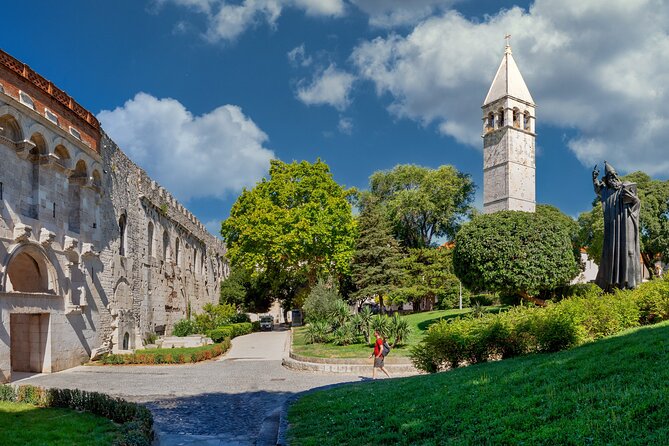
- Free access to Diocletian’s Palace sites included in the walk (with the cathedral ticket not included)
- Several departure times throughout the day, so you can match your pace
- A local guide who adds real-world context for Split’s streets, not just dates
- Peristyle focus, including why this central square is famous for its unusual acoustics
- Roman entry points like the Golden Gate (Porta septemtrionalis) you can still walk past
Diocletian’s Palace in Split: a 2-hour plan that keeps moving
This tour is built for orientation. In a short window, you get placed inside the right place: Diocletian’s Palace, the ancient mega-fortress in the center of Split, which still forms a huge part of the old town and today sits within the UNESCO World Heritage area.
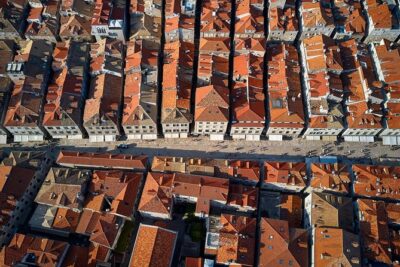
What I like about a 2-hour format is how it reduces decision fatigue. Split can feel like you’re walking in circles, especially when alleys braid together and every doorway looks historically important. Here, the route gives you a framework: you see the big public spaces, the defensive thinking, and the “under the city” areas that many people miss when they just wander.
Timing is also flexible. There are multiple departures during the day, and the tour uses a mobile ticket, which is handy if your phone is your main travel tool. Expect a walking pace that fits most visitors with moderate physical fitness, but you are moving for most of the time—this isn’t a sit-down lecture.
Also, keep expectations aligned. This is a guided overview. You’ll learn what each space was for, but you won’t have unlimited time to explore like you would if you were doing an all-day self-guided wander (especially if you want to add extra sites on your own). If you plan to come back later, you’ll know where to focus.
You can also read our reviews of more tours and experiences in Split.



From the Egyptian sphinx to the street-level maze of the old palace
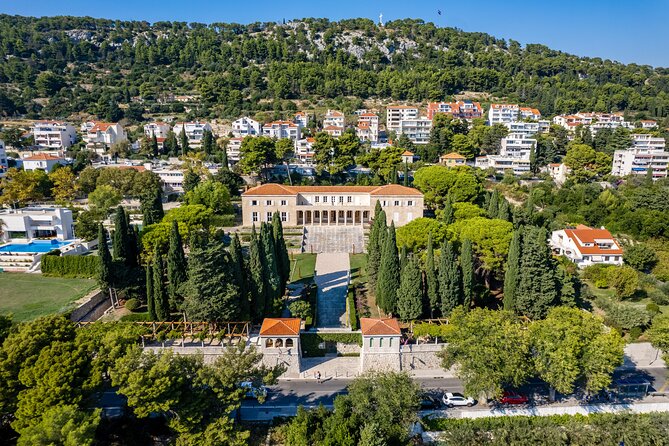
The walk starts where Split’s story becomes physical: inside the palace complex itself. Diocletian’s “palace” is often described that way, but it’s more accurate to think of it as a massive fortress layout. Around half of the complex was for Diocletian’s personal use, and the rest supported the military garrison. That mix is why the streets feel both grand and defensive at the same time.
One of the best parts of this area is the way the space forces you to slow down and look up, then look around, then look again. The palace isn’t one tidy postcard courtyard. It’s a labyrinth of narrow passageways and rooms that seem to fold into each other. You’ll pass a famous Egyptian sphinx statue and also see how older elements coexist with later construction—yes, you’ll spot structures from much later periods inside the same overall palace footprint.
This is where a good guide earns their pay. The goal isn’t memorizing trivia. It’s learning how to read what you’re seeing. Why are certain corridors narrow? Why do certain entrances feel ceremonial? How can a fortress turn into a neighborhood? In Split, the palace isn’t just something behind glass. It’s the container for Mediterranean everyday life—shops, apartments, and street scenes all living in a Roman framework.
A small downside is that the “maze” can be mentally tiring. If you hate getting turned around, you’ll still have turns and surprises here. The difference is that you’ll have someone interpreting it for you while you move, so you won’t feel lost in the wrong way.
Peristyle square: where Roman acoustics turned into a stage
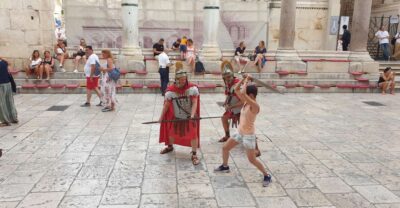
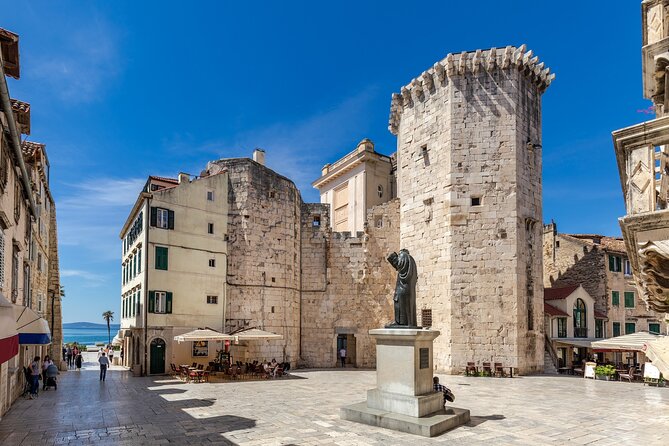
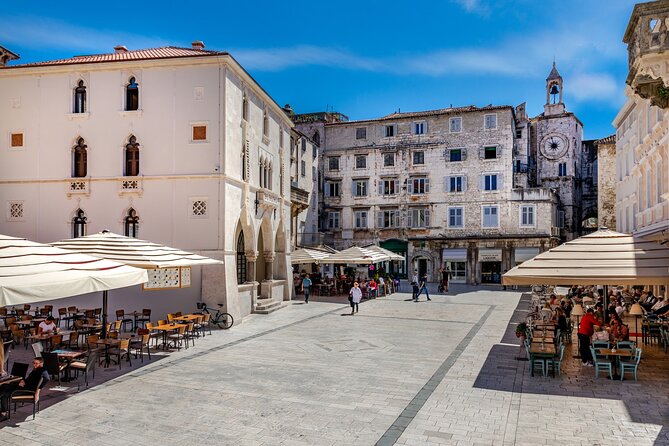
Next you’ll reach the Peristyle, the central square of the palace. This is one of the spaces that makes the whole site feel alive, even though it’s ancient stone. The Peristyle was intended as a ceremonial and public space connected to Diocletian’s worldview—he was celebrated as a living son of Jupiter—and it’s surrounded by the kinds of architectural cues that hint at temple influence.
Here’s what makes this stop more than a quick photo moment: the Peristyle’s unusual acoustics. Sound carries and changes in a way that makes it feel theatrical. The guide can point out how a space like this naturally fits performances and public readings—Roman society didn’t separate spectacle from politics. In the middle of the palace complex, the Peristyle is where the “power” of the site becomes social.
For your planning, this stop is also a nice break from the constant motion of tighter corridors. You get open space, and the guide can help you notice the geometry: how the square organizes the surrounding palace structures.
If you’re the type who loves atmosphere as much as facts, this is a highlight. Even if you don’t catch every detail the first time, you’ll remember how the place felt. That matters for Split, because the city keeps echoing the palace layout long after the tour ends.
Vestibulum and the palace courts: the big impression in small spaces
After the open square, the tour shifts into “monumental but compact” territory: the Vestibulum. Even though it’s relatively short compared with the palace’s larger public spaces, it still carries weight. From the outside it looks rectangular, but from inside the ground plan becomes circular—an intentional design choice that makes you feel how Roman architects thought in layers.
This stop is useful because it shows how transitions mattered. Roman sites often used entry zones to create a sequence: approach, threshold, and then reveal. The Vestibulum works like a threshold into an imperial mindset, not just a hallway.
Practical note: if you’re walking quickly, don’t rush this section. Small layout details can get lost when you’re moving through like it’s a museum hallway. Let your eyes pause on the shape change. That’s where “place reading” clicks.
This is also a good moment to ask questions. If the guide is handling English well (and the tour is offered in English), you’ll get better answers while you’re still inside the relevant space, not later back on the street.
Diocletian’s Cellars: seeing the fort under the neighborhood
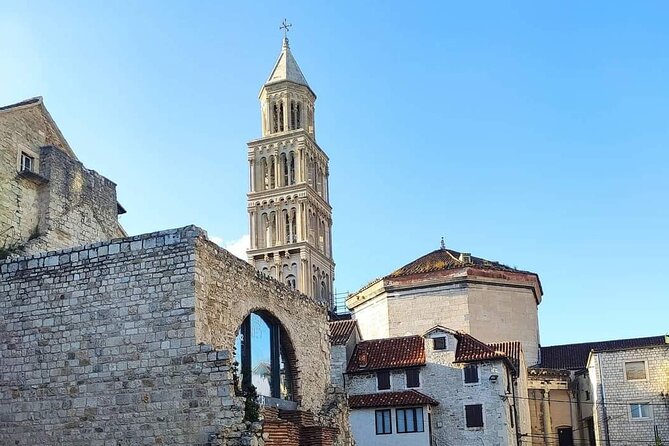
One of the most surprising parts of the palace complex is beneath it. The Diocletian’s Cellars are part of the palace substructures, and they’re among the best-preserved complexes of their type in the world. That preservation is a big reason Split’s historical core made the UNESCO list in the first place—because you can actually understand how the palace functioned, not just admire a facade.
This stop changes your view of Split. Instead of thinking only about grand imperial rooms and ceremonial squares, you start thinking like a builder and a planner. Substructures tell you about storage, stability, and how a fortress protected itself and supported daily operations.
Even if you’re not a “basements are cool” person, these cellars help explain the city above. The palace was never a single isolated monument. It was a working system. The guide can help you connect what you see underfoot with the layout choices you already noticed: why certain areas feel protected, why entrances are where they are, and how the palace became part of the modern city fabric.
This is also a place where you may appreciate the short duration. The tour doesn’t drag on and on here. You get just enough to understand what you’re looking at, then the tour moves you onward before you lose the thread.


Golden Gate (Porta septemtrionalis): a Roman entry you can still walk through
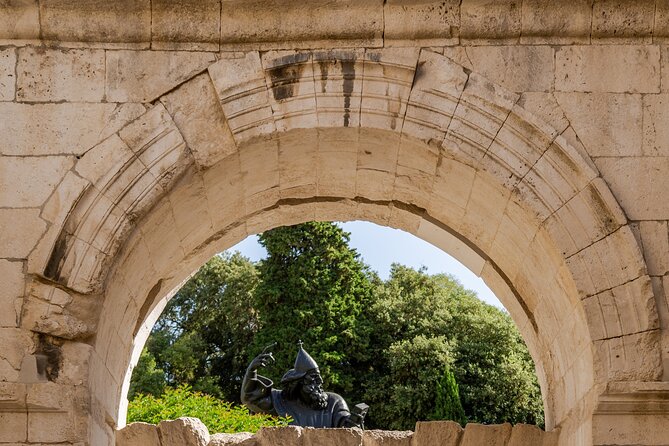
The last major stop is the Golden Gate, known in Roman times as Porta septemtrionalis (a northern gate in the original naming). This isn’t just a nameplate for a door. It’s a defensive-thinking entrance: built with a rectangular shape and double doors as part of the palace’s military tactics.
The guide can add the human detail that makes it feel less abstract: Diocletian walked through these gates on June 1, 305. That date anchors the stone in a moment, and it helps you understand that this wasn’t a decorative entry meant only for appearances. It was also a controlled point of access—security for an emperor in a fortress-city.
As a final stop, the Golden Gate is smart. You finish with something that connects movement, power, and architecture. After this, you’re better equipped to wander the rest of Split with your eyes open: you’ll start noticing other alignments and doorways with more meaning.
The downside? Because it’s near the end, you may feel tempted to race to get photos. Don’t. Spend a minute longer here. The gate is where the whole tour’s logic comes together.
Guide tips, group size, and value of the $60 ticket

Let’s talk value, because this is where many short tours either disappoint or surprise you.
At $60.21 per person for around 2 hours, you’re paying for a guided overview plus included access to multiple palace areas. The key value angle: you’re not just being told stories in the street. Several stops are covered by free admission tickets during the tour, and you also get professional explanation throughout. The only notable ticket gap is the cathedral, which is not included.
Is that worth it? For most first-timers in Split, yes—especially if you’re trying to get bearings fast. The palace is big, and without a route, you can spend a lot of energy just figuring out what you’re looking at. With a guide, you trade some flexibility for clarity. And clarity saves time.
Group size matters too. The maximum is listed as up to 99, so it’s not strictly tiny. Still, the experience is framed as a walking tour with stop-by-stop guidance, so you aren’t just herded through. In the guides you might meet, you’ll find a mix of styles, but several have been highlighted—Luka, Sandra, and Jelena—often for the same core skill: making history practical and keeping people engaged.
Also notice how the tour checks boxes beyond architecture. There are local streets moments and street-level context about everyday life in Split. That helps you see the palace as a living space, not an artifact.
If you like early-morning energy, you can also choose a departure time. Morning can help the streets feel calmer and make photos easier. Just remember the tour is still about movement, so dress for walking.
Should you book this Diocletian’s Palace small-group walk?
Book it if you want to:
- Get oriented quickly in Split’s old town
- See the palace highlights in about 2 hours
- Have an English guide explain the why behind the stone
- Benefit from included access to multiple palace areas
Skip it (or add extra time) if you:
- Want long stays inside buildings and museums beyond a fast overview
- Plan to make the cathedral a priority and want it included in one package
- Dislike walking through tight historic layouts where your route is never perfectly straight
For most people, I think this is a strong first-pick in Split. It gives you a map in your head—so your independent wandering afterward feels more like discovery and less like guessing.
FAQ
How long is Diocletian’s Palace the small group tour in Split?
It’s about 2 hours.
Where does the tour start?
The meeting point is South Tours Travel Agency, Mrčelina 1, 21000, Split, Croatia.
What language is the tour offered in?
The tour is offered in English.
Are tickets included for Diocletian’s Palace sights?
The tour includes free admission tickets for the palace-related stops listed during the walk. Tickets for the cathedral are not included.
Do I need to print anything for the tour?
No. You’ll use a mobile ticket.
Is the tour walking-heavy?
Yes. It’s a walking tour, and it’s recommended for people with a moderate physical fitness level.
How many people are on the tour?
The tour has a maximum of 99 travelers.
Are there multiple departure times during the day?
Yes. There are several departures available throughout the day.
What’s the cancellation policy?
You can cancel for a full refund up to 24 hours before the experience starts. If you cancel less than 24 hours before, the amount paid is not refunded.