REVIEW · SPLIT
Best of Split & Trogir: Private VIP Tour with Local Guide
Book on Viator →Operated by Discovery tours · Bookable on Viator
Split and Trogir in one guided sweep. This private VIP tour stitches together Roman power and Venetian-era charm, with a local guide helping you spot what matters fast—so you don’t just pass through sights.
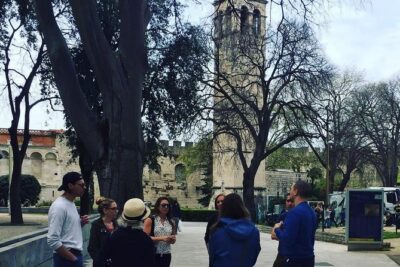
I love the way the guides bring the place to life. With guides like Kristina (who shares personal stories tied to local traditions) and Andrea (who helps you move through crowds without losing your place), the day feels organized and easy to follow.
The main drawback is simple: not every stop has tickets included. A few of the most memorable sights in both Split and Trogir can require paid admission, so budget time for that.
In This Review
- Key highlights you’ll actually feel on the ground
- Private VIP in Split and Trogir: what you’re really paying for
- Diocletian’s Palace Peristyle: the Roman crossroads that still feel central
- St. Domnius Cathedral: why this church matters from the 600s
- Grgur Ninski statue and the luck of the toe
- Temple of Jupiter: Roman grandeur tucked into Palace walls
- Diocletian Palace Substructures: see the palace from beneath
- Reaching Trogir’s UNESCO core: slower streets, sharper details
- St. Lawrence Cathedral and the styles that overlap
- Town Loggia and Palace Cipiko: civic life meets noble power
- Kamerlengo Fortress: the views that help your brain reset
- Time management and what to do with only 6 hours
- Price and value: $228.78 per person for a full circle of sights
- Should you book this Split & Trogir VIP tour?
- FAQ
- How long is the Best of Split & Trogir private tour?
- What is the price per person?
- Is pickup offered on this tour?
- Is this tour private?
- What languages is the tour offered in?
- Do I need a ticket for all stops?
- Are tickets free at the Peristyle of Diocletian’s Palace?
- Are tickets included for Diocletian Palace Substructures?
- Can I bring a service animal?
- Is free cancellation available?
Key highlights you’ll actually feel on the ground
- Private VIP pacing that keeps the focus on the details, not the chaos
- Local storytelling from guides like Kristina and Andrea that turns ruins into context
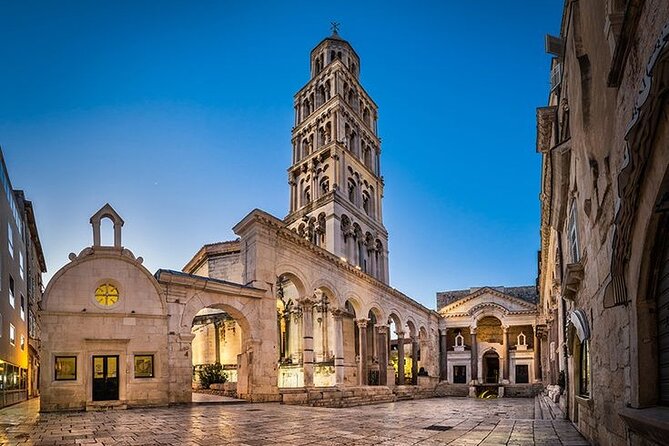
- Peristyle + St. Domnius in one smooth Roman-to-medieval flow
- Jupiter’s Temple and Grgur Ninski for myths you’ll remember (and a toe you’ll probably notice)
- Trogir UNESCO core with landmarks like the Loggia and St. Lawrence Cathedral
Private VIP in Split and Trogir: what you’re really paying for
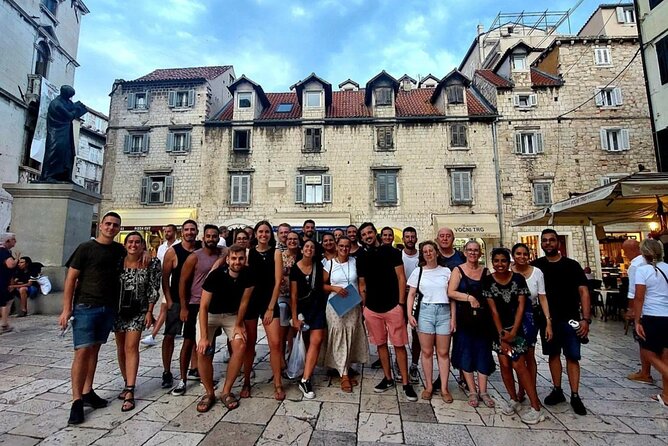
This tour is built for people who want the highlights without doing the hard work of figuring everything out themselves. You get a private setup, and pickup is offered, which matters in a port city where walking time can sneak up on you. The schedule is also efficient: you hit multiple major sites without the day turning into one long shuffle.
At $228.78 per person for about 6 hours, it’s not a “cheap and cheerful” outing. It’s closer to paying for a translator, teacher, and route organizer all in one. For me, that value shows up most at Diocletian’s Palace, where the layout is confusing if you don’t know what you’re looking at.
The tour runs in English, and you’ll use a mobile ticket. Since this is limited to your group, you’re less likely to feel rushed or stuck waiting for everyone to catch up. If you’re the type who wants your vacation time to feel purposeful, this format fits.
You can also read our reviews of more guided tours in Split

Diocletian’s Palace Peristyle: the Roman crossroads that still feel central
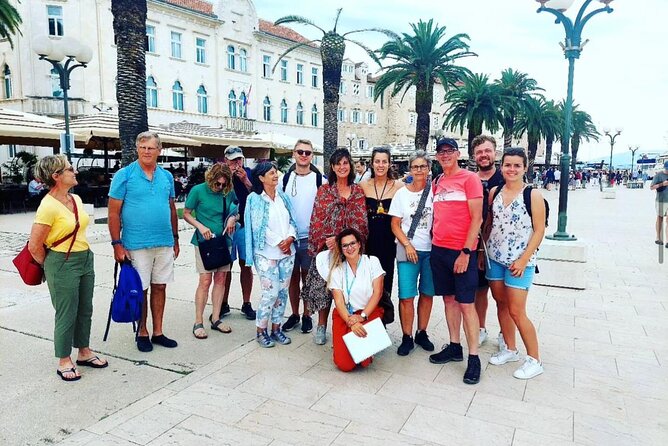
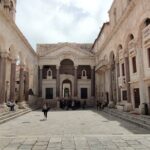
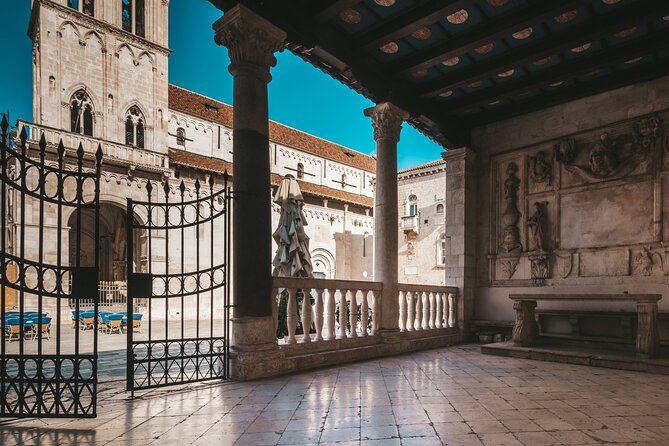
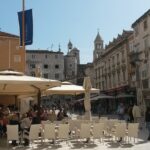
You start at the Peristyle of Diocletian’s Palace, a rectangular open court where two main roads meet inside the palace complex. Standing there, you can feel why it was meant to be the heart of the city—this wasn’t a random courtyard. It was a hub, designed for movement, attention, and power.
Look at the colonnades and pay attention to the geometry. The point isn’t to memorize architecture terms. It’s to understand that Split’s old layout grew out of a Roman plan that still shapes where people walk and gather.
Practical note: the Peristyle is listed as 15 minutes, and admission is free. That’s a good setup—short visit, high payoff, and you’re not stuck paying for a stop you’ll barely be able to experience.
St. Domnius Cathedral: why this church matters from the 600s
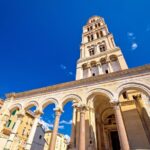
Next comes the Cathedral of Saint Domnius (Sv. Duje). It was consecrated around the turn of the 7th century AD, and it’s often described as the oldest Catholic cathedral in the world that remains in use in its original structure, with no near-complete renovation later. The bell tower is from the 12th century, which gives you a nice timeline in one view.
I like this stop because it’s not just “another cathedral.” It’s a place where you can sense continuity: a site that stayed active while the city around it changed.
You’re not going to spend hours here, since the visit is about 15 minutes, but it’s the kind of short stop where your guide can point out what most visitors miss: how the building’s age shows in its structure, and why that continuity is so rare.
Grgur Ninski statue and the luck of the toe
If you want a breather between heavy history, go to the Grgur Ninski statue. This is the 8.5-metre statue of Gregory of Nin by Ivan Meštrović. It’s a busy spot, and the detail your guide will likely highlight is right at ground level: the statue’s toe.
Rubbing the toe is said to bring good luck, and over time it has worn smooth and shiny from centuries (and probably many modern thumbs) of tradition.
This is one of those stops that works because it’s memorable without being complicated. You can laugh about it, take in the scale, and move on feeling like you actually learned something small-but-real about local custom.
Temple of Jupiter: Roman grandeur tucked into Palace walls
Then you’ll see the Temple of Jupiter (Jupiterov hram), dedicated to the Ancient Roman god Jupiter. It sits in the western part of Diocletian’s Palace near the Peristyle, built between 295 and 305 during the palace construction.
This stop makes a strong argument for why you need a guide. Without context, you might see it as a minor ruin tucked into a complex. With context, you understand its role: this was part of a sacred and political landscape inside the palace system, not a standalone relic.
Time stays tight here too—about 15 minutes—so your goal is to look, absorb the why, and keep your energy for what comes next.
You can also read our reviews of more private tours in Split


Diocletian Palace Substructures: see the palace from beneath
The day’s next big “wow” is the Diocletian Palace Substructures, often called the Cellars of Diocletian’s Palace or basement halls. These substructures sit at the southern end of the palace area, in what’s now part of the Stari Grad zone.
This is where you get a sense of the palace as an engineered machine. The substructures supported Diocletian’s private apartments above, and the complex is considered one of the best preserved of its kind.
Admission is marked as not included, so plan for paid entry here if you want to go in. The value is that the space shows you the palace logic from a different angle. You’ll stop thinking only about surface ruins and start seeing how the whole complex functioned.
Reaching Trogir’s UNESCO core: slower streets, sharper details
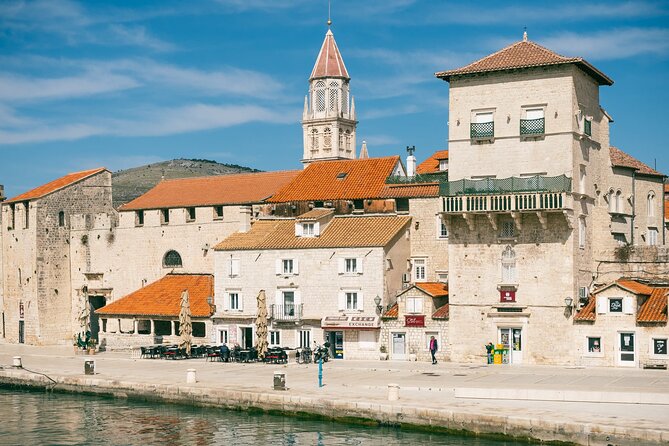
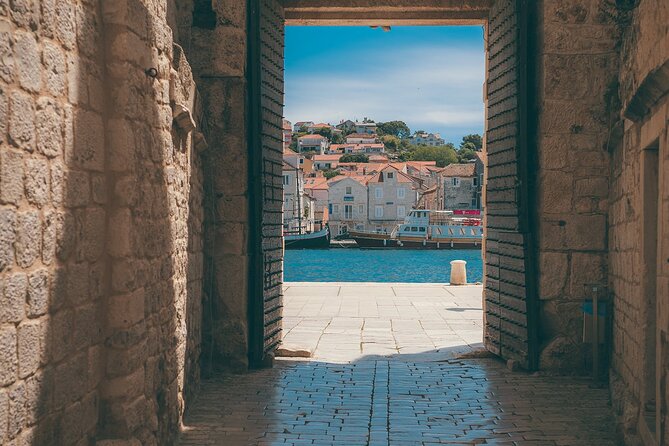
After Split’s Roman density, Trogir feels more human-scale. The key move here is timing and pacing: the tour gives you short visits that keep you engaged rather than overwhelmed. You’ll spend time in Trogir’s central historic area, which is part of UNESCO’s protected monuments.
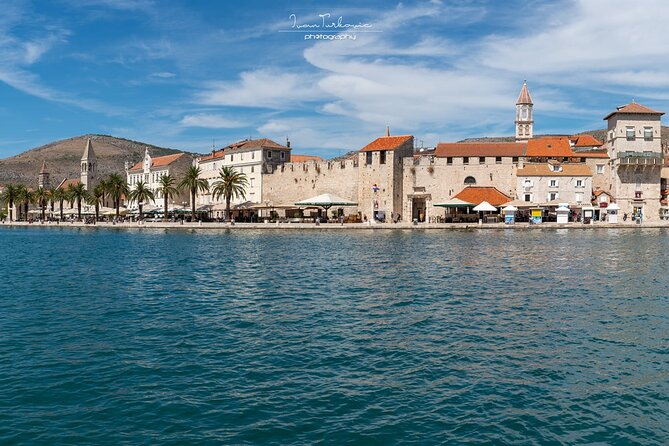
You start at the Central Square (John Paul II Square), a main open space in old town Trogir. It’s surrounded by landmark buildings like the Loggia and Clock Tower. This is a place where you can look up and realize how Venetian-style civic life shaped the city’s layout.
Your guide also points out small visual clues. For example, the Loggia—opposite the Cathedral—used to serve as a public courtroom, and it includes carved relief work. One detail that stands out is the Relief of Justice by Nicholas Florentino.
There’s also a practical seasonal issue: in summer, a coffee bar nearby can make some pillars harder to see clearly. That’s exactly the kind of heads-up that makes a difference—so you know where to aim your gaze.
St. Lawrence Cathedral and the styles that overlap
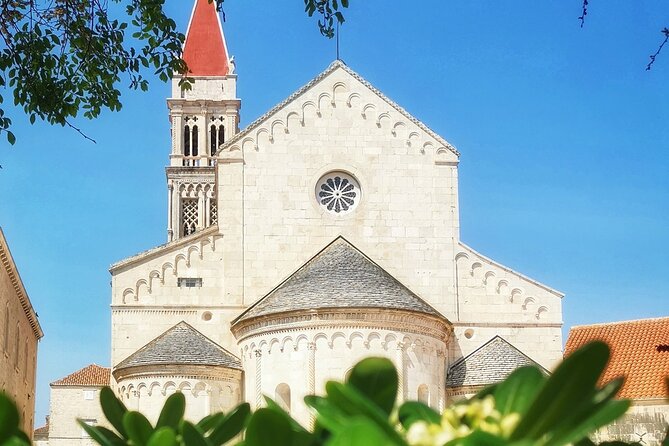
Then you’ll visit Saint Lawrence’s Cathedral (Katedrala Sv. Lovre). It’s a Roman Catholic triple-naved basilica built in a Romanesque-Gothic style, but the construction lasted several centuries. That long build time is why it shows multiple styles that succeeded one another in Dalmatia.
This is the kind of stop where your guide’s interpretation matters. If you walk in expecting one style, you might miss the story of change. With context, the building reads like a timeline you can walk around.
Admission for this one is not included, so factor that in. Expect about 15 minutes here, which is enough to get the big visual message if you keep moving with your guide rather than trying to study every stone like a detective.
Town Loggia and Palace Cipiko: civic life meets noble power
Trogir’s history isn’t only sacred buildings. You also get civic and residential power.
The Town Loggia was the public meeting place for medieval life in Trogir, where decisions were announced and legal matters discussed. It’s a reminder that government and everyday community life happened right in the open, in the center of town.
Next is Palace Cipiko (Čipiko Palace), described as the largest residential palace in Trogir and an example of Gothic-Renaissance architecture. It belonged to the influential Čipiko family, so you’re looking at wealth made physical.
Admission for both of these listed stops is mixed: the Loggia area is free, while Palace Cipiko is marked as not included. The practical takeaway is to stay flexible and follow your guide’s cue for what’s worth paying for and what’s best enjoyed from outside.
Kamerlengo Fortress: the views that help your brain reset
To close the Trogir segment, you’ll reach Kula Karmelengo (Kamerlengo Fortress). This 15th-century coastal fortress was built during Venetian rule to protect Trogir from naval attacks.
The big payoff is the view: old town spread out below, the marina, and nearby islands in the distance. If you’ve been walking through dense history, the fortress works as a mental palate cleanser. You stop absorbing details and start seeing the city as a working coastal system.
Admission is marked as not included, and the visit is about 15 minutes. That’s usually enough time to capture the overview and understand why fortresses were built where they were.
Time management and what to do with only 6 hours
Because the stops are short (often 15 minutes each), you’ll get the most out of this tour if you treat it like a guided highlight reel rather than a museum marathon. The structure helps you build a mental map: Roman palace core, major churches and myths, then Trogir’s UNESCO square-and-cathedral rhythm.
A few practical tips based on how this tour runs:
- Wear comfortable shoes. You’re moving through old stone streets and palace corridors.
- Bring something for sun or light rain. Coastal Croatia can change quickly.
- If you’re picky about photos, take them fast and then listen. Your guide will point out what makes certain angles worth it.
Also, one neat detail from the tour style: Andrea’s approach can include starting in Trogir first to help with crowd flow. That’s not something you need to guess about—just know that the day can be run intelligently rather than rigidly.
Price and value: $228.78 per person for a full circle of sights
Let’s talk value in plain terms.
You’re paying for:
- a private guide experience (so you’re not stuck in a big group)
- pickup offered, which can save you time and stress
- a route that connects the Roman spine of Split with Trogir’s UNESCO core
- context at every stop, including practical local details like the toe-rubbing tradition
At $228.78 per person, it’s best suited to couples, small groups, or travelers who dislike wasting time. If you’re the type who would otherwise spend half your day reading guidebooks and guessing logistics, this can be a smarter use of time.
Also, this tour tends to be booked far in advance on average, which is a quiet hint that it’s popular for a reason. If you’re planning high season, earlier booking is your friend.
Should you book this Split & Trogir VIP tour?
You should book this tour if you want:
- Roman-to-Venetian structure in one day
- a guide who explains what you’re looking at, not just where to stand
- a private pace with pickup offered
- English support and a mobile ticket system that keeps things simple
Skip it if you’d rather wander at your own pace for a longer time, or if you’re trying to minimize any paid admissions since some of the major sites listed are not included in ticket pricing.
If your goal is a smooth, organized day across two historic hubs—Split and UNESCO Trogir—this private VIP format is a strong fit.
FAQ
How long is the Best of Split & Trogir private tour?
It lasts about 6 hours.
What is the price per person?
The price is $228.78 per person.
Is pickup offered on this tour?
Yes, pickup is offered.
Is this tour private?
Yes. It’s a private tour/activity, and only your group participates.
What languages is the tour offered in?
It’s offered in English.
Do I need a ticket for all stops?
Not all stops include admission. Some stops are listed as free, while others are listed as admission not included.
Are tickets free at the Peristyle of Diocletian’s Palace?
Yes. Admission is listed as free for the Peristyle stop.
Are tickets included for Diocletian Palace Substructures?
No. Admission for the Diocletian Palace Substructures is listed as not included.
Can I bring a service animal?
Yes. Service animals are allowed.
Is free cancellation available?
Yes. You can cancel up to 24 hours in advance for a full refund.