REVIEW · SPLIT
Salona & Amphitheater – Private guided tour – Admission incl.
Book on Viator →Operated by Split Guide · Bookable on Viator
Rome’s ruins are quieter than you expect. This private guided tour in Solin (right by Split) takes you through the layers of Ancient Salona and finishes at the Amphitheatre Salona, where the stones still look like they belong to a crowd. Along the way, you’ll connect the Roman city to its later Christian life, so you don’t just see ruins—you get the reasons they matter.
What I really like is the mix of stops that keeps the story moving without feeling rushed. I especially enjoy the way the tour frames the life of St. Dominius, including the Manastirine cemetery link, and how the route jumps between Roman civic spaces and later sacred sites. I also like that the stops are structured as a steady walk—short visits at each place—so you can keep your energy for the big finale.
One caution: it’s an outdoor archaeological walk and you’ll want good weather. Also, most sites don’t list entry fees, but the Ancient Salona open-air museum entrance is noted as about 10 euros for adults (not included), so budget a little extra.
In This Review
- Key highlights you’ll care about
- Setting: Ancient Salona in Solin, just outside Split
- Your 2.5-hour plan (and how the timing works)
- Stop 1: Ancient Salona’s main entrance and open-air museum setup
- Manastirine: Roman necropolis turned Christian cemetery
- Tusculum: Don Frane Bulić’s office and meeting rooms
- Biskupska palača: the bishop’s palace and cathedral foundations
- Large urban spa: Roman baths as the city’s social hub
- Pet mostova: the five bridges and the industrial edge
- Porta Caesarea: the Roman town gate and chariot ruts
- Hram: forum remains, temple remnants, and an ancient theater thread
- Cemetery of the 16 sarcophagi: Ul. don Frane Bulića 91
- Kapljuc: basilica and necropolis, plus the five martyrs story
- Amphitheatre Salona: the preserved arena and the Venetian stone theft
- Price and value: is $203.50 per person worth it?
- Who this tour fits best (and who might want something else)
- Should you book the Salona & Amphitheater private guided tour?
- FAQ
- How long is the Salona & Amphitheater private guided tour?
- Is this tour private and only for my group?
- What language is the tour offered in?
- Are admission tickets included?
- Where does the tour start and end?
- What happens if the tour is canceled due to weather?
Key highlights you’ll care about
- Private group, English guide: Only your group goes with the guide, and you get personal pacing.
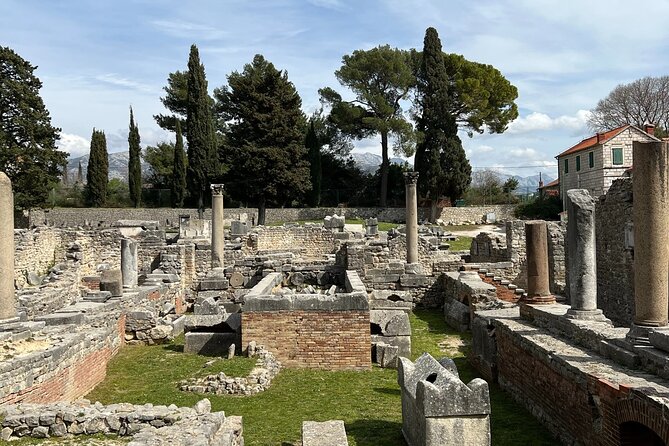
- Ancient Salona on foot: Start at the main entrance and work through the city’s Roman footprint.
- Big amphitheater payoff: A relatively well-preserved arena you can actually picture in use.
- Many stops are free to enter: Multiple sites along the route are marked as free admissions.
- Christian-era layers included: You’ll see cemeteries and basilica remains tied to early martyrs.
- Mobile ticket: You’ll use a mobile ticket for the tour.
Setting: Ancient Salona in Solin, just outside Split
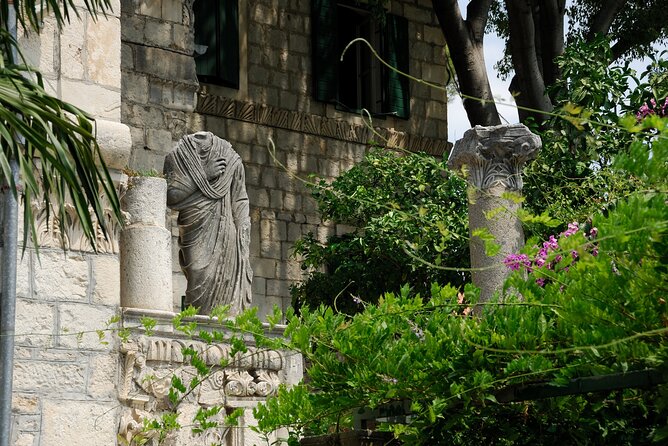
If you’re staying in Split and want more than one postcard view, Solin is a smart choice. Ancient Salona was a major Roman center, and the ruins here give you something you don’t always get in big cities: a clear sequence of how a place changed over centuries.
This tour is built for that kind of understanding. You move location to location, but the guide’s explanations help you “read” what you’re standing next to. One standout example from past tours: the guide Ivan has been praised for making the facts feel conversational and easy to follow.
The meeting point is at the Salona main entrance on Ul. don Frane Bulića 58, and the tour ends back at the same place. So you don’t have to worry about transport or timing at the finish.
You can also read our reviews of more guided tours in Split

Your 2.5-hour plan (and how the timing works)
The tour runs about 2 hours 30 minutes. Expect short stops that add up, rather than a single long lecture somewhere with bad lighting and your feet going numb.
Each location gets roughly 10 to 30 minutes, with the amphitheater taking the longer chunk. That pacing matters. It keeps you from zoning out at the smaller sites, and it gives you time to focus on what’s best preserved once you reach the main arena.
The tour is offered in English, and it’s a private experience—only your group participates. It also uses a mobile ticket and allows service animals. If you’re planning around daylight or heat, remember the tour is weather-dependent and requires good conditions.
Stop 1: Ancient Salona’s main entrance and open-air museum setup
You start right at the Salona main entrance on foot. Ancient Salona was a Roman metropolis with about 60,000 inhabitants, and it didn’t last forever. It was completely destroyed by the Avars in the 6th century, which is the kind of dramatic historical arc that makes the ruins feel urgent rather than academic.
From the entrance, you’ll get a general orientation before you start moving through the key areas. One practical note: the open-air museum entrance fee is about 10 euros for adults, and it’s listed as not included. Since you’re already paying for a private guide, I’d treat that museum fee as the main extra cost you might need to plan for.
Why this first stop works: you get your bearings fast. Instead of wandering through stones, you understand what to look for—civic space, burial areas, and the later Christian reuse of the landscape.
Manastirine: Roman necropolis turned Christian cemetery
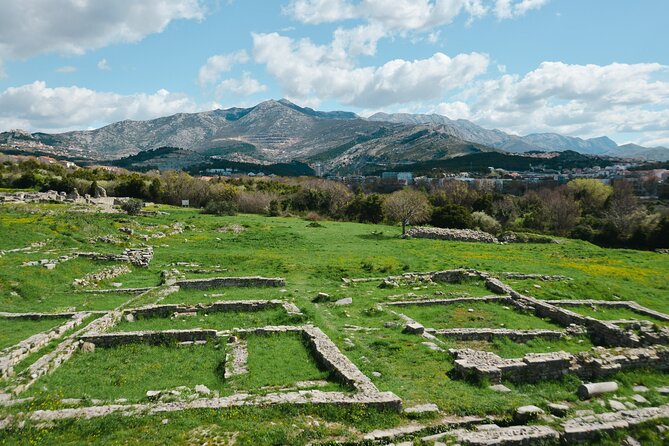
Next comes Manastirine, a place with a haunting continuity. It was already a Roman necropolis, and later it became a Christian cemetery.
Here you’ll hear how the site ties into Split’s patron saint, St. Dominius (the martyr and city patron). That detail matters because it’s not just “old graves.” It’s how a community keeps meaning in a place, even after the original Roman world collapses.
Time is short here—around 15 minutes—so don’t expect a full museum-style experience. Instead, treat it as a key checkpoint: the tour is showing you that the area didn’t stop being sacred after the Roman era. It just changed.
Tusculum: Don Frane Bulić’s office and meeting rooms
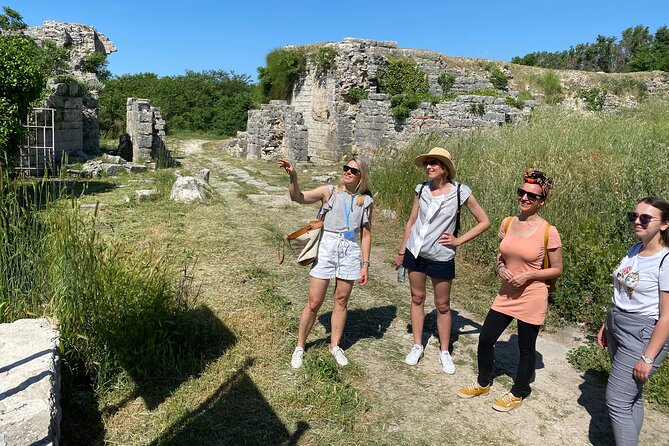
Then you reach Tusculum, connected to Don Frane Bulić, a well-known Split clergyman and archaeologist. Some rooms can be visited, so it’s a break from pure outdoor wandering.
What I like about this stop is that it adds a modern layer: you’re seeing not only ancient Salona, but also how people since the modern era have worked to study it. The name Don Frane Bulić becomes more than a footnote when you’re physically near the structures he shaped.
This is one of the “short and useful” stops on the route, about 15 minutes. If you enjoy archaeology and preservation stories (even brief ones), this will land well.
You can also read our reviews of more private tours in Split


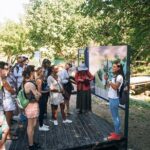
Biskupska palača: the bishop’s palace and cathedral foundations
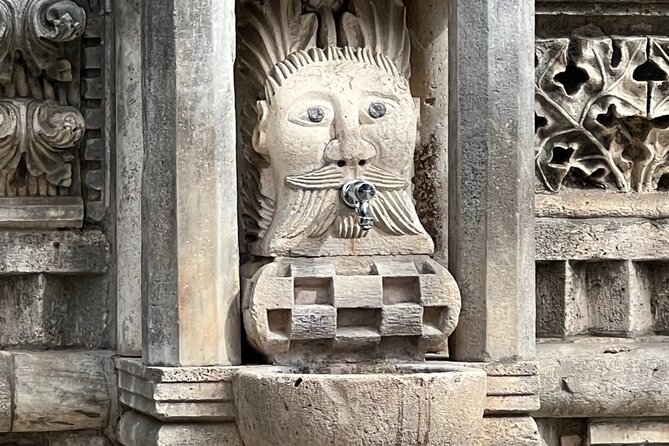
At Biskupska palača (Palatium episcopi), you’ll look at the bishop’s palace and the remains of two cathedrals from the era when Christians could practice their religion more freely.
Today, you mainly see foundation walls—not towering columns. But that can be a plus if you’re the kind of traveler who likes tracing outlines. With good guidance, foundations stop being “missing pieces” and start being a map for what was once there.
This part of the tour is listed as about 15 minutes, and the value is in how it ties earlier cemeteries to a later organized church presence.
Large urban spa: Roman baths as the city’s social hub
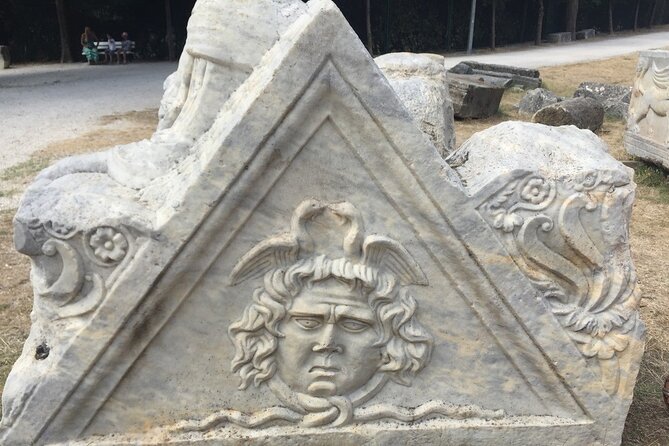
After the sacred sites, you get the civic rhythm with the large urban spa—Roman baths used for several hundred years.
Roman baths weren’t just about hygiene. They were a center for social and cultural life, which helps you picture daily routines in a way that battle dates alone can’t.
This stop is about 10 minutes. It’s brief, but it’s a helpful correction to the idea that ruins are only religious or political. Here, you see where people probably spent time, chatted, relaxed, and likely caught up on local news.
Pet mostova: the five bridges and the industrial edge
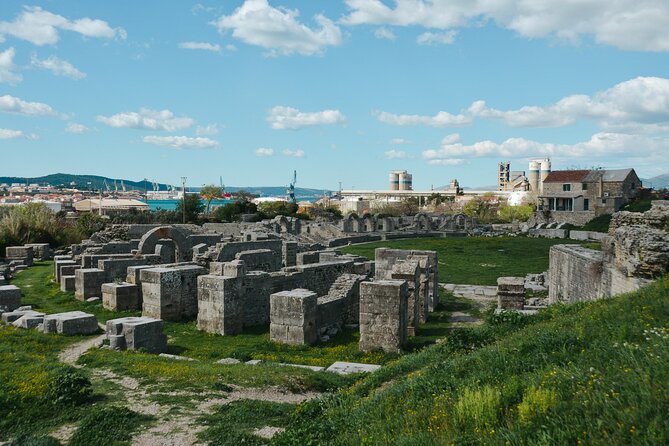
At Pet mostova—the “five bridges”—you’re shown remains that belonged to an industrial-type area outside the old city center.
The phrase “five bridges” sounds quirky, but it’s doing real work for your understanding of Salona’s layout. It suggests that the city wasn’t only grand downtown monuments. It had functional zones beyond the core, and the infrastructure still shows up even after centuries.
Expect about 10 minutes here. This is one of those stops where the guide’s narration turns scattered pieces into a coherent system.
Porta Caesarea: the Roman town gate and chariot ruts
Then you hit Porta Caesarea, the capital gate in Roman times. One reason this stop is memorable: the ruts of old Roman chariots can still be seen.
That’s the kind of detail that makes you feel like you’re reading something physical, not just hearing a story. You’re not imagining the gate from a textbook—you’re seeing where wheels traveled.
This visit is about 10 minutes. Quick, but high-impact. If you care about how transportation and daily movement shaped cities, this is a highlight.
Hram: forum remains, temple remnants, and an ancient theater thread
In the oldest part of the city, the tour shows you remains tied to the forum, a temple, and an ancient Roman theater.
This is where the tour’s structure pays off. After seeing gates, cemeteries, and baths, you now see the civic-religious mix that kept Roman cities running. Forums and temples aren’t just impressive; they reveal what mattered publicly.
Again, it’s around 10 minutes. If you want more time here, that’s a sign you should slow down afterward on your own and spend a second look—but the guided route gives you the right map first.
Cemetery of the 16 sarcophagi: Ul. don Frane Bulića 91
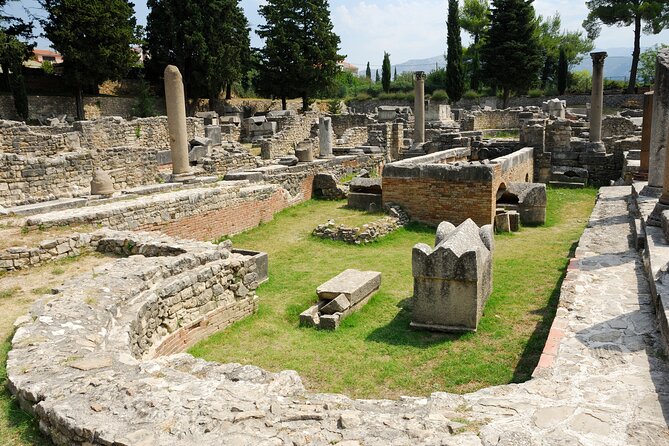
Next is the cemetery of the 16 sarcophagi near the road leading to the amphitheater. Roman cemeteries were built outside the city walls, and seeing that placement helps you understand how cities shaped space even after death.
This stop is listed at 10 minutes. It’s not meant to be emotional overload; it’s meant to connect. When you later stand in the amphitheater, you’ll remember that human stories weren’t confined to arenas and temples. They extended outward beyond the walls.
Kapljuc: basilica and necropolis, plus the five martyrs story
Near the road toward the amphitheater, you’ll visit Kapljuc, another basilica and necropolis. Here, you’ll learn about burials tied to five martyrs who died in the amphitheater at the beginning of the 4th century during Christian persecution by Diocletian.
This stop makes the amphitheater feel heavier in a way you can’t get from a guidebook alone. You don’t just see an old building. You understand that it was part of a violent historical moment—and later, the Christian community kept memory in the landscape.
Time is about 10 minutes. Short, but it adds meaning before you reach the main structure.
Amphitheatre Salona: the preserved arena and the Venetian stone theft
Now comes the finale: Amphitheatre Salona. The tour’s highlight here is that it’s relatively well preserved, even though the Venetians removed most of the stones later to build churches in Venice.
That detail is practical and memorable. It explains why the amphitheater looks the way it does. Some structures survive in full; others survive in silhouette. Here, the form still lets you visualize the space where crowds once gathered.
You’ll spend about 30 minutes here, and that extra time is worth it. Stand with the guide’s explanations first, then take a second look on your own. That second look is where it clicks: Roman entertainment wasn’t abstract. It was built for real bodies, real sound, and real attention.
Price and value: is $203.50 per person worth it?
The price is $203.50 per person for the private guided tour, lasting about 2 hours 30 minutes.
Here’s how I’d judge value. You’re paying for a guide to connect a lot of scattered archaeology into one coherent story, and you’re paying for privacy and pacing. Also, many stops along the route are marked free to enter, which reduces the usual headache of adding tickets stop by stop.
Your main potential extra cost is the Ancient Salona open-air museum entrance fee of about 10 euros for adults. Since that fee is not included, you should count it in your planning.
For couples or a small group, a private tour can be a strong deal because the price is per person, and the experience doesn’t shrink if you’re the only people there. If you’re traveling solo, it can still be worth it if you love history explanations and want a guided path rather than doing it unguided with a map and guesswork.
One more practical value point: the tour is booked well ahead (on average about 84 days), so if you’re visiting during a popular season, you’ll do yourself a favor by locking it in early.
Who this tour fits best (and who might want something else)
This works best if you want to understand how a place evolves—Roman city life, then later Christian identity—without spending your entire day reading placards.
It also suits you if you like structure. The route is paced with short timed stops, and you get a clear payoff at the amphitheater. You’ll come away feeling like you saw more than just one famous monument.
You might want a different style of tour if you expect a mostly indoor museum format, or if you hate weather-dependent outdoor plans. This one is built on walking and looking.
Should you book the Salona & Amphitheater private guided tour?
I’d book it if your priority is a guided route that turns multiple archaeology stops into one story, especially if you’re based in Split and want a meaningful half-day near town. The amphitheater finale is a real anchor, and the added Christian-era context gives the ruins weight beyond sightseeing.
If you’re on a tight budget, the fee might feel steep—especially with the additional open-air museum entrance for Ancient Salona. But if you factor in that many sites are free to enter on the route and that it’s private, it becomes a more reasonable spend for a history-focused outing.
FAQ
How long is the Salona & Amphitheater private guided tour?
It’s about 2 hours 30 minutes.
Is this tour private and only for my group?
Yes. It’s a private tour/activity, and only your group participates.
What language is the tour offered in?
The tour is offered in English.
Are admission tickets included?
Admission is listed as included, but the Ancient Salona open-air museum entrance fee is about 10 euros for adults and is noted as not included. Other stops are marked as free.
Where does the tour start and end?
It starts at the Salona main entrance, Ul. don Frane Bulića 58, 21210 Solin, Croatia, and ends back at the same meeting point.
What happens if the tour is canceled due to weather?
The experience requires good weather. If it’s canceled due to poor weather, you’ll be offered a different date or a full refund.