REVIEW · TROGIR
Trogir walking tour with a local guide
Book on Viator →Operated by Discovery tours · Bookable on Viator
Trogir packs a century into every corner. This local-guided walk in Trogir Old Town strings together big sights and small stories: St. Lawrence Cathedral’s bell-tower views, Radovan’s Portal sculpture, and a long look along the Riva promenade toward Čiovo. It’s paced for real sightseeing without feeling like a museum sprint.
I like the speed-to-meaning ratio. You get to key landmarks quickly, then your guide connects the dots between Romanesque Gothic architecture, Venetian civic life, and what the town built after major shocks. I also love the human layer: guides such as Daniela, Blanka, and Kristina bring Trogir to life with family ties that can reach back for centuries, plus personal memories that add context beyond the stone.
One thing to consider: this is an outdoors walking tour and it depends on good weather. Also, it runs about 1 hour 30 minutes, so if you want long pauses inside churches or extended climbs, you’ll need extra time before or after.
In This Review
- Key takeaways before you go
- Where the walk begins: North Gate energy to Old Town shortcuts
- St. Lawrence Cathedral (1213) and Radovan’s Portal: the wow start
- John Paul II Square: coffee culture with architecture all around
- Town Hall and Venetian stair drama: why civic buildings matter
- St. Sebastian, the Town Loggia, and Palace Cipiko: from plague relief to courts
- St. Sebastian’s Church and Clock Tower
- Town Loggia
- Palace Cipiko (Great Cipiko Palace)
- Our Lady of Mount Carmel: fishermen’s church and a 16th July tradition
- A bas-relief with a lesson: Kairos and the right moment
- Riva promenade to Kamerlengo Castle: sea views without leaving Old Town
- Riva, Trogir’s palm-fringed promenade
- Kamerlengo Castle
- Price and timing: does $18.14 make sense for a first look?
- What you’ll remember most (and why guides like Daniela matter)
- Who this tour fits best
- Should you book this Trogir walking tour?
- FAQ
- How long is the Trogir walking tour?
- Is the tour available in English?
- What does the tour cost?
- Where does the tour start and end?
- Are there admission tickets for the stops?
- What happens if the weather is poor?
Key takeaways before you go
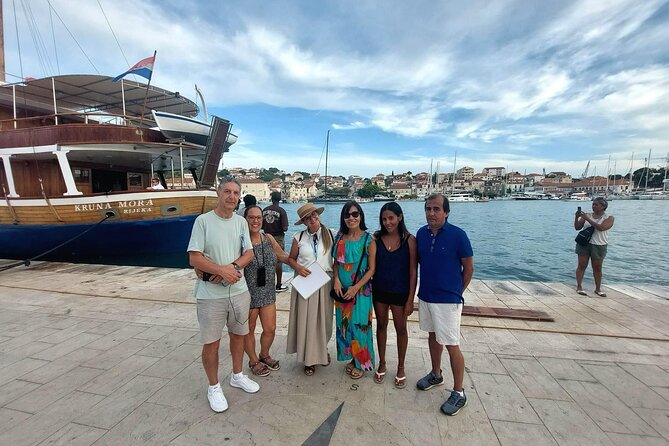
- Small-group feel with a maximum of 15 people, which makes questions and photo stops easier
- St. Lawrence Cathedral + Radovan’s Portal brings medieval art into focus fast
- Venetian-era civic buildings explain how Trogir organized public life
- Riva promenade and Kamerlengo Castle give you the best water views without fuss
- English guide and a mobile ticket make it simple to start and go
Where the walk begins: North Gate energy to Old Town shortcuts
Your tour starts at Ul. Gradska vrata 5, near Trogir’s walled-town approach. From the first minutes, you’ll feel the advantage of a local guide: you don’t just see Old Town—you learn how it’s laid out and why that matters.
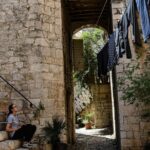
Most of your time is spent moving through tight streets that can feel like a maze on your own. With a guide, the walk becomes logical. You’ll also notice how often Trogir’s most important buildings cluster near the same civic core: cathedral area, squares, town buildings, then down toward the waterfront.
End point: the walk finishes on the waterfront side at Obala bana Berislavića. So it’s a great setup for the rest of your day—coffee, a relaxed lunch, or a slower wander once you’re oriented.
You can also read our reviews of more walking tours in Trogir

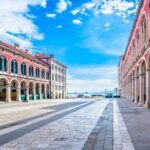
St. Lawrence Cathedral (1213) and Radovan’s Portal: the wow start
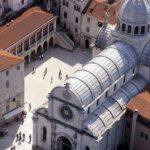
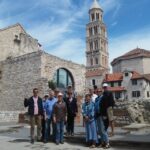
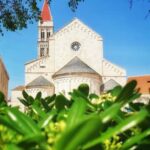
The tour’s first big architectural moment is the Cathedral of St. Lawrence. Construction began in 1213 and stretched across five centuries, which is why the building blends Romanesque and Gothic styles. The cathedral’s size is the point, too: three naves make it feel more substantial than you’d expect from the scale of Old Town streets.
Then your guide steers you to the bell tower for panoramic views over Trogir, the island of Čiovo, the mainland, and out across the Adriatic. This is one of those “stand still for a minute” moments. Even if you’re not the type to stop for photos, do it here—you get the geography of the whole area in one glance.
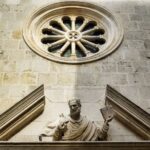
Next comes Radovan’s Portal, the cathedral’s main entrance carved by Master Radovan, a craftsman from medieval Trogir in the early 13th century. This isn’t just decorative. It’s a reminder that Trogir produced artists and stoneworkers locally—not only imported ideas.
Practical tip: if you’re the kind of person who likes details, take 20–30 seconds to look at the sculpted surfaces before moving on. The portal is the kind of work that rewards close attention, even during a short stop.
John Paul II Square: coffee culture with architecture all around
After the cathedral, the tone shifts. You reach John Paul II Square (Trg Ivana Pavla II), which the locals use like an outdoor living room. Expect tables, umbrellas, and the kind of atmosphere that makes you want to sit down and stay awhile.
What I like here is how your guide uses the space. The square looks like a simple pause, but it’s surrounded by important buildings—so while you sip something cold or hot, you’re also learning what Trogir considered central enough for daily life.
If you’re visiting in a warmer part of the day, this is a smart spot to slow down. The tour moves fast through several exterior stops, so this square gives you a chance to reset your legs and your eyes.
Town Hall and Venetian stair drama: why civic buildings matter
Next up is Trogir’s Town Hall, a 15th-century stone building with an elegant courtyard decorated with coats of arms. The outside staircase is one of the most striking examples of Venetian architecture in Trogir.
This stop is more than a pretty facade. Civic architecture tells you how power and public decisions worked. The staircase wasn’t only for looks—it directed how people moved through authority spaces. With a guide, you’ll understand what the town halls were for beyond paperwork.
If you like photo angles, this is a good place to take a few shots from different heights. The exterior staircase is the feature, but the surroundings give you context for Trogir’s Venetian influence.
St. Sebastian, the Town Loggia, and Palace Cipiko: from plague relief to courts

This stretch covers three connected ideas: community gratitude, legal gatherings, and elite residence.
You can also read our reviews of more guided tours in Trogir


St. Sebastian’s Church and Clock Tower
St. Sebastian’s Church was built in 1476 by the citizens of Trogir, grateful for deliverance from the plague. That cause-and-effect is part of what makes the building feel meaningful, not just old. The architect is noted as Niccolò di Giovanni Fiorentino (Nicolas of Florence).
Watch for how your guide ties the church’s presence to the town’s survival instincts. It’s a reminder that monuments often record fear, relief, and resilience.
Town Loggia
Next is the Town Loggia, dating to the 13th century. This covered space was where citizens gathered to talk about issues of the day. It also served as a place where the local court met on certain days to proclaim laws and handle cases.
The big takeaway: Trogir wasn’t only about churches and palaces. It had a working civic rhythm, and the loggia helped keep that rhythm in the open—while still offering shelter.
Palace Cipiko (Great Cipiko Palace)
Finally, you’ll see Palace Cipiko, described as a group of Romanesque buildings that took on a Venetian Renaissance look between the 15th and 17th centuries after extensive remodeling. Niccolò di Giovanni Fiorentino is also tied to this complex, including work on the south portal.
Palace Cipiko helps you connect the dots: the same periods and craftsmen shaping public buildings also shaped elite spaces. Your guide often uses these connections to make it feel like one story instead of separate stops.
Practical note: these are mostly exterior-focused moments. If you want to go inside any building, plan to add that on your own after the walk, because this tour is designed for getting the overview.
Our Lady of Mount Carmel: fishermen’s church and a 16th July tradition

One of the more distinctive stops is the Church of Our Lady of Mount Carmel, founded in the Middle Ages. This is historically the church of Trogir’s fishermen, craftsmen, and laborers.
That matters. When a church is tied to working people, the atmosphere changes. It’s not only the grand arc of cathedral history; it’s the daily faith of the town’s main workforce.
If your visit lines up with 16th July, your guide will point you toward the traditional evening procession featuring the statue of Our Lady. Even if you’re not there that day, it’s worth hearing how a specific date and ritual keep the church meaningful year after year.
A bas-relief with a lesson: Kairos and the right moment

During the walk you’ll also see a bas-relief that tells a story through imagery. It shows a young man standing on tiptoe, ready to fly away, arms outstretched, holding a pair of scales. His long tuft of hair falls over his forehead while the crown is bald—an old visual cue tied to the idea of timing and opportunity.
The explanation around this artwork is about Kairos: when the right moment comes, you have to seize it, because it won’t wait forever.
I like stops like this because they prevent the tour from becoming only a parade of famous names. It’s a quiet reminder that Trogir’s stonework carries everyday wisdom too.
Riva promenade to Kamerlengo Castle: sea views without leaving Old Town
Your final stretch moves toward the water.
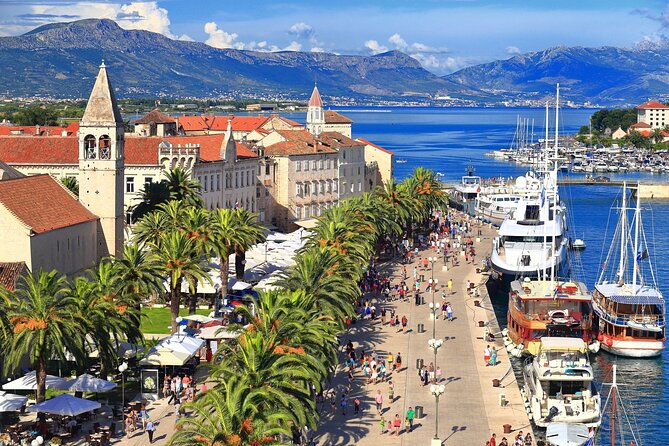
Riva, Trogir’s palm-fringed promenade
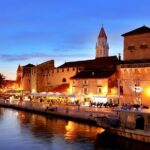
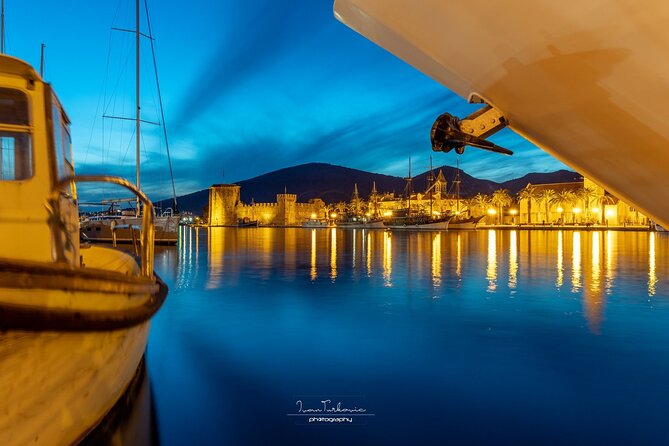
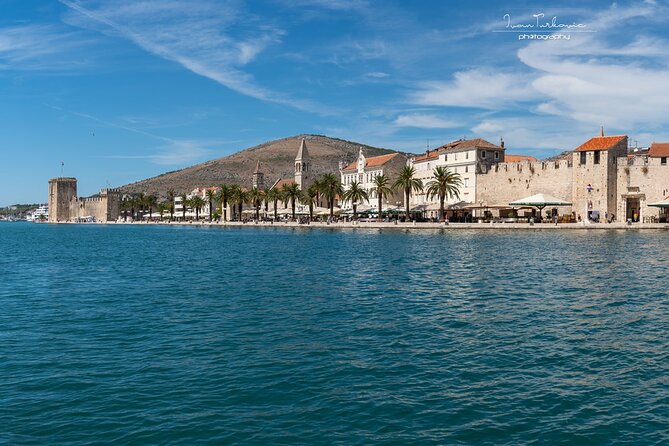
Riva is what locals call the promenade. It’s wide, flat, and straight, running along the water edge, and it delivers splendid views across the sea channel to Čiovo. This part of the tour is perfect for catching your breath. It’s also where you get the most immediate sense of how the town lives with the sea.
If you’re traveling in the warmer months, this is also where you can feel the breeze. Do yourself a favor and take a minute just looking, not filming. The light off the water changes fast.
Kamerlengo Castle
At the end sits Kamerlengo Castle, an early 15th-century fortress at the end of Trogir’s promenade. It’s positioned at the corner of the tiny island that holds the Old Town.
Right nearby you’ll see small local life details: a local football pitch, a playground for kids, and stalls run by tour operators. That mix is useful—it helps you see Trogir as a functioning town, not only a postcard.
This is a good finish point because the views give closure to the walking route. After so many buildings, the waterfront helps your brain reset.
Price and timing: does $18.14 make sense for a first look?
The price is $18.14 per person for about 1 hour 30 minutes, offered in English with a mobile ticket. It’s often booked around 16 days in advance, which tells you something simple: people treat this as a smart first-day orientation in Trogir.
Here’s how I’d judge the value:
- You’re paying for interpretation, not just movement. The standout feature is that you’re not only shown Radovan’s Portal and the cathedral—you understand why they matter.
- The group size cap of 15 makes the tour feel personal enough that you can ask questions when something clicks.
- The pacing works if your schedule is tight. You’ll hit the major sights in Old Town without spending half a day bouncing between locations.
Where it may not fit: if you want to spend a long time inside buildings or you’re more interested in slow wandering than guided context, you might feel slightly rushed. In that case, treat the walk as a kickoff, then return to your favorite places for extra time.
What you’ll remember most (and why guides like Daniela matter)
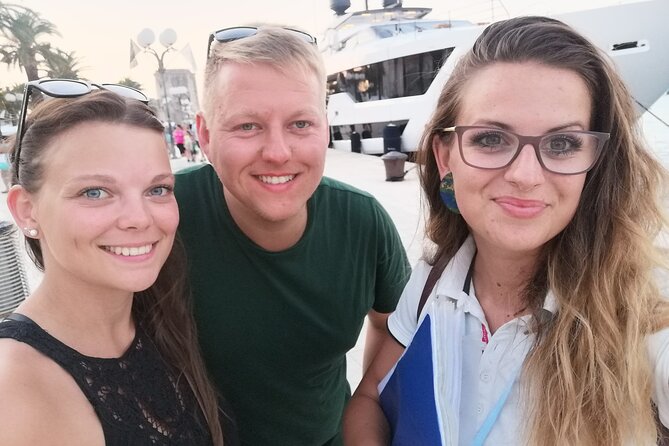
A big reason this tour gets such strong praise is the way local guides bring Trogir to life. Names you might hear around the experience include Daniela, Blanka, and Kristina, and the common theme is personal connection to the town.
Some guides share family history tied to the area for generations, and you might even hear perspectives shaped by Croatia’s 20th-century experiences, including the Homeland War. One guide, Daniela, also reportedly shared her plan to move into history teaching—so the storytelling feels intentional, not rehearsed.
You’ll notice the effect quickly: facts don’t sit alone. They become part of a narrative about why Trogir looks the way it does, and why people built what they built.
Also, small practical perks pop up. In past groups, the guide has recommended what to do after the walk, including a beach suggestion. That’s a useful bonus because Trogir is small—where you go next matters.
Who this tour fits best
This is a strong choice if:
- You have limited time and want a guided way to prioritize Trogir’s top sights
- You like architecture, civic life, and how daily needs shape monuments
- You’d rather get context up front than spend hours researching on your phone
It’s also a good plan if you’re staying in or near Old Town, because the tour ends on the waterfront side and naturally sets you up for a relaxed follow-on walk.
Should you book this Trogir walking tour?
If it’s your first visit to Trogir and you want to understand what you’re looking at, I think this is worth booking. For the money, you’re buying orientation plus interpretation, and the St. Lawrence Cathedral + Radovan’s Portal start is a great way to kick off Old Town.
Book it early in your trip rather than late. The reason is simple: once you know where everything is and how the pieces connect, you’ll explore more efficiently the rest of your stay.
If you’re the kind of traveler who only wants quiet time and hates structured stops, then maybe skip the guide and self-wander. But if you want a short, high-impact route through the essentials—this is the kind of tour that pays off for days.
FAQ
How long is the Trogir walking tour?
It’s about 1 hour 30 minutes.
Is the tour available in English?
Yes, it’s offered in English.
What does the tour cost?
The price is $18.14 per person.
Where does the tour start and end?
It starts at Ul. Gradska vrata 5, 21220, Trogir, Croatia and ends at Obala bana Berislavića, 21218, Trogir, Croatia.
Are there admission tickets for the stops?
The tour information marks the listed stops as admission ticket free.
What happens if the weather is poor?
The experience requires good weather. If it’s canceled due to poor weather, you’ll be offered a different date or a full refund.