REVIEW · SPLIT
Walking tour of Split with an Art Historian
Book on Viator →Operated by Aspalathos Guided Tours · Bookable on Viator
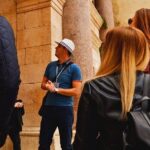
Split’s Roman streets feel oddly personal here. Josipa, an art historian guide, ties the stones of Diocletian’s palace to the way people live in Split today. You’ll get a walk that’s part architecture lesson, part local stories, and part practical route-finding.
What I really love is how the tour starts with meaning, not trivia. The water story at Strossmayer Park (Đardin) sets the tone, then the walk through gates and streets like Cardo and Decumanus gives you a map you’ll actually use later. I also like the small-group pace, which makes it easy to ask questions and linger for photos at the right moments.
One heads-up: this tour doesn’t enter paid sites or museums, so you’ll admire key spaces from the outside and focus on interpretation instead of indoor tickets. If you want cathedral interior time, plan for that separately.
In This Review
- Key things you’ll get from this Split walking tour
- Starting at Strossmayer Park’s fountain (Đardin): where Split begins
- Diocletian’s palace without the confusion: gates and the Roman street grid
- The Iron Gate’s story: why one entrance mattered so much
- Gregory of Nin and the toe ritual: art history as local culture
- The Golden and Eastern gates: small detours that change your view
- Peristyle and the open-air palace core: the Robert Adam moment
- Cathedral of Saint Domnius: you’ll see it, not enter it
- Let Me Pass Street and the physics of human scale
- Vestibule photo spot and klapa-friendly acoustics
- Substructures shortcut to Riva: quieter air, then the waterfront
- The old-town model at the end: how to keep exploring after the tour
- Pacing, comfort, and practical value for your money
- Who this Split art historian walk is best for
- Should you book this Split walking tour with Josipa?
- FAQ
- How long is the Split walking tour with an art historian?
- What language is the tour offered in?
- Where does the tour start and end?
- Does the tour include entry to museums or paid sites?
- Will we enter the Cathedral of Saint Domnius?
- Is the tour small group size limited?
- Does the tour run in rain or bad weather?
- Is the tour suitable for people who need to watch their walking pace?
- Can I bring a pet or service animal?
- Is the tour waiting policy strict?
Key things you’ll get from this Split walking tour
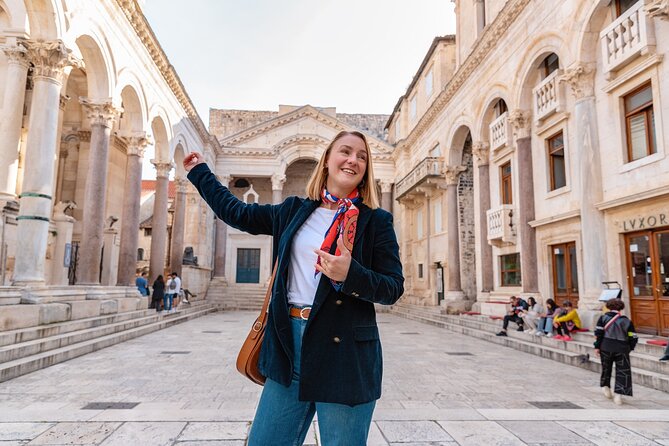
- Art-historian storytelling by Josipa: clear connections between Roman design, later medieval use, and modern Split.
- A “no extra-ticket” route: you see major palace highlights without entering paid venues.
- Photo stops with purpose: gates, courtyards, and passageways that actually frame great shots.
- Split folklore embedded in real spots: Gregory of Nin’s toe for luck, plus today’s local references.
- A small group (up to 10): quieter than the big crowd tours, with time to talk.
Starting at Strossmayer Park’s fountain (Đardin): where Split begins
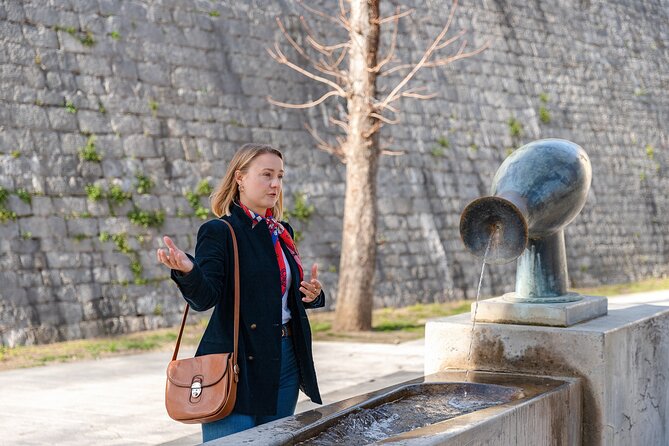
Most Split tours jump straight into the palace. This one starts outside the walls, in Strossmayer Park, locally called Đardin, by the central fountain. It’s a smart opener because water is the first practical reason the palace location worked for centuries.
From there, you’re not just looking at buildings. You’re learning how a peninsula city solved everyday life: access to water, movement of people, and the way power used the landscape. The tone is calm and historical, but it never feels like a lecture.
If you’re arriving by foot from your hotel, this starting point also helps you reset your bearings before you enter the maze-like palace lanes. And since the tour is rain or shine, it’s worth arriving a little early so you don’t start out rushing.
You can also read our reviews of more walking tours in Split

Diocletian’s palace without the confusion: gates and the Roman street grid
Once you’re inside the palace zone, Josipa guides you through the structure that makes Split make sense. The story goes beyond names on walls. You’ll learn how the gates and street lines were planned, and why those choices still shape your walking today.
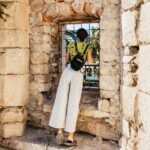
You start with a straightforward but revealing view from a palace tower area. It’s not the glamor shot. That’s the point. Seeing the less-photogenic edge first helps you understand how unusual Split’s “ancient retirement home” really is: not just grand spaces, but a working urban organism.
Then comes the sequence of entrances and main thoroughfares:
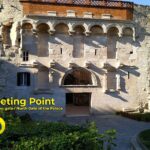
- You’ll get the Golden Gate area, the northern entrance to the palace complex.
- From there you walk along the Roman street axis named Cardo, the main north–south line.
This is where the tour earns its value. You’re learning the logic of the place, not just memorizing points. Once you understand Cardo and the way it leads you inward, you’ll navigate old town streets with far less guesswork later.
The Iron Gate’s story: why one entrance mattered so much
You’ll also reach the Iron Gate from the north-west corner area. Josipa frames it as the city’s “platinum” gate through history, and that kind of comparison makes the place feel like a living system. Gates weren’t just decorations. They were security, status, and control.
Even if you’re not a hardcore history person, this kind of interpretation helps you notice details you’d otherwise skip, like why certain passages feel more important than others.
Gregory of Nin and the toe ritual: art history as local culture
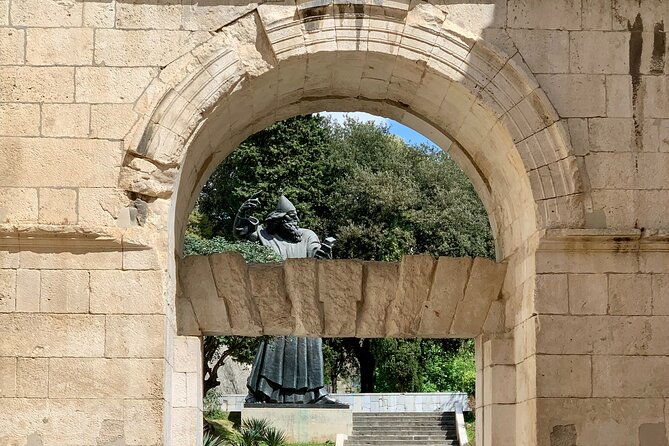
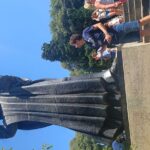
Before you go deep into the palace proper, you stop at the 7-meter bronze statue of Gregory of Nin, created by the Croatian sculptor Ivan Meštrović. This is one of the fastest ways to turn the art history up from “interesting” to “I get why people care.”
Yes, there’s the famous toe-rubbing for good luck. But Josipa also gives you the context that makes it more than a silly tourist habit. You’ll learn what this monument became in popular culture, and why it stuck in locals’ memory.
This stop is a great “mental reset” if you’ve been walking since breakfast. It’s also a useful pause for photos because it’s a clear, iconic focal point before the palace crowds and narrow lanes set in.
The Golden and Eastern gates: small detours that change your view
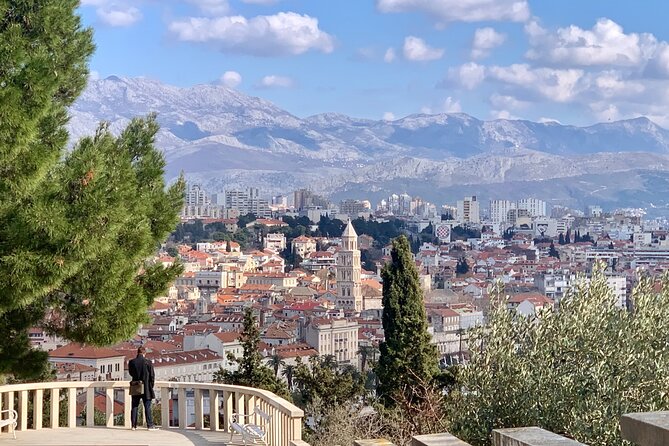
Inside the palace, you’ll pass through and along the main internal routes until you reach the next big visual moment: the grand open space at the center of the complex.
Along the way, there’s a short detour toward the Eastern (Silver) Gate. It’s brief, but it matters. These side stops train your eye. You start noticing how entrances act like hinges, redirecting movement and turning a broad courtyard into a sequence of framed scenes.
If you’ve ever gotten lost inside an old monument complex, you’ll appreciate this. The tour’s structure keeps you oriented, even when streets get tight.


Peristyle and the open-air palace core: the Robert Adam moment
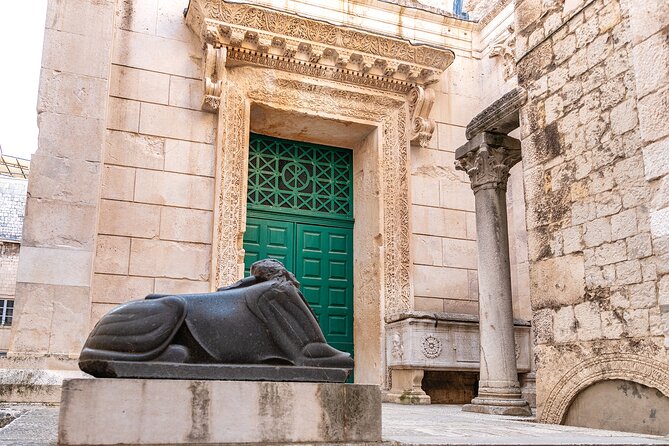
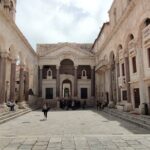
As you approach the Peristyle of Diocletian’s Palace, the scale shifts. This is the “okay, now I understand why people travel here” space. The palace isn’t just ruins and walls; it’s planned grandeur.
Josipa talks about its origin and the stories it holds, and you’ll also hear a detail connected to the 18th century: the architect Robert Adam listed a major palace attraction as one of the most beautiful European monuments. Hearing that while you’re standing in the actual space makes it feel less like a random fact and more like a signal that this site was admired long before selfie culture.
You’ll also be in the right place to see how power expressed itself in stone—then how later generations reused that same spine for a different faith and a different life.
Cathedral of Saint Domnius: you’ll see it, not enter it
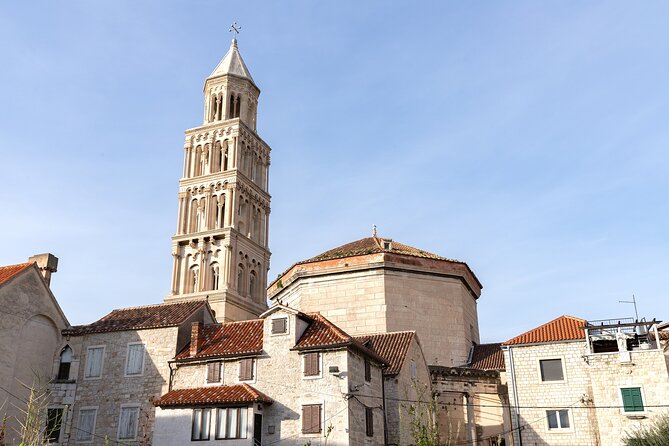
While you’re on the Peristyle, you’ll get the story of what is now the Cathedral of Saint Domnius—originally a mausoleum for the Roman Emperor, later repurposed as a Christian cathedral.
Important practical note: the tour does not enter paid sites, so you won’t go inside the cathedral here. You still get the essential background and the “why this matters” context, but for interior time you’d need a separate ticket plan.
Let Me Pass Street and the physics of human scale
Some stops are about big empires. This one is about tiny measurements.
You’ll reach Let Me Pass (Pusti me da prodjem) Street, famous for being under 10 meters long and only 57 centimeters wide. That’s narrow enough that you feel the engineering and the humor of it instantly.
Josipa connects it to local memory, including a related public monument elsewhere in town. The effect is that you start seeing Split as more than Roman architecture. You start seeing it as a place where people adapted old structures and kept them meaningful.
This is also a good place to pause if you need a short, low-effort stop. It’s quick, it’s memorable, and it doesn’t require museum time.
Vestibule photo spot and klapa-friendly acoustics
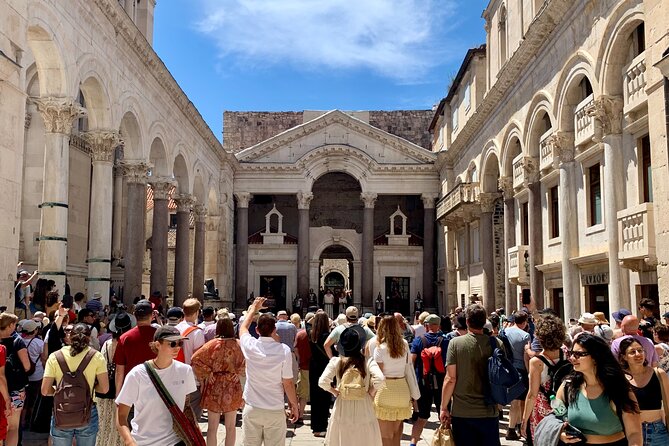
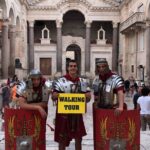
Next you’ll pass through the Vestibulum area, once the entry point to the emperor’s quarters. Today it’s one of those open-air spaces where people gather for photos because the angles work and the background is dramatic.
Josipa also points out why the area can be good for singing—klapa performances are often associated with acoustic richness in places like this. Even if you don’t hear a performance during your walk, the tip helps you know what to listen for later.
I like this stop because it’s practical. It teaches you where the best sound-and-view spots are, without pretending you can predict when a full singing group will show up.
Substructures shortcut to Riva: quieter air, then the waterfront
From the palace interior you’ll take a “shortcut” through Diocletian Palace substructures, heading toward the Riva waterfront. This section changes the mood. The palace gives way to a darker, more enclosed feel, then suddenly you’re back in open air by the sea.
You won’t explore the substructures in full because of additional admission requirements and time constraints, but you do get the key idea: these are part of the palace that still shape how Split breathes, walks, and meets along the water.
Then you emerge onto Riva Harbor, which functions as a street, promenade, and square. The walk is purposeful but relaxed here. You’ll keep heading toward Fruit Square, which helps you connect your palace learning to the daily rhythm of the city.
The old-town model at the end: how to keep exploring after the tour
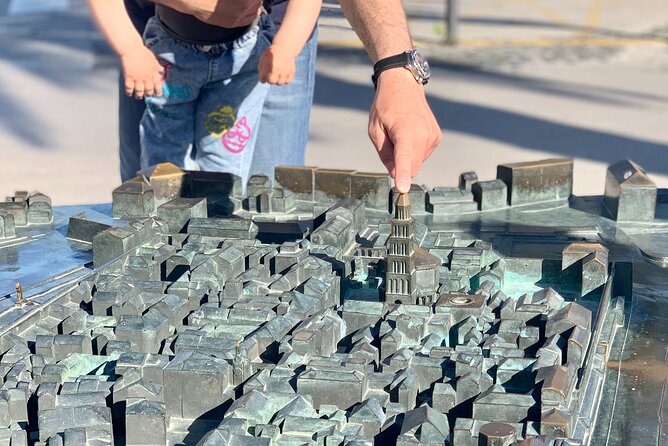
The tour finishes at a bronze model of Split’s historical core on the Riva waterfront. This final stop is a smart way to lock in the map in your head. You get a recap of what you just saw and where it all sits in relation to each other.
If you have time, you may also get additional guidance for further exploring. Even if your schedule is tight, you’ll leave with enough structure to keep walking in the right direction.
Pacing, comfort, and practical value for your money
At $30.23 per person for roughly 1 hour 40 minutes to 2 hours, you’re paying for interpretation, not tickets. Most stops have free admission, and the tour is designed around outdoor spaces. That means your money goes into the guide’s time and storytelling.
This is also a tour with maximum 10 travelers, which matters more than it sounds. In a crowded palace complex, being able to hear the guide and see what she points to is half the experience. The reviews you can read online strongly reinforce this small-group comfort, and the way Josipa handles timing and photo locations supports it.
A few practical notes to plan around:
- The tour takes place rain or shine, so bring a light layer or a compact umbrella if that’s your style.
- Most of the walking is manageable, but the route includes unavoidable steps and some areas can be uneven.
- Hot weather can be a real factor, so wear sun protection and bring water.
- The guide will wait for up to 10 minutes past the scheduled departure time at the meeting point.
And because it ends on the Riva waterfront, it’s easy to transition to lunch or a simple wandering route afterward. You won’t feel like you just paid to be dropped at the edge of town.
Who this Split art historian walk is best for
This tour is a great fit if you:
- Want the palace explained in a clear, art-and-architecture way
- Like outdoor walking routes over museum hopping
- Prefer smaller groups where questions don’t get swallowed by noise
- Want practical orientation so Split’s old town doesn’t feel random
It may be less ideal if you:
- Need indoor museum time during your palace visit (this tour does not enter paid sites)
- Have limited mobility and need a fully step-free experience
Should you book this Split walking tour with Josipa?
If you’re spending more than half a day in Split and you want a strong foundation for the rest of your trip, this is an excellent place to start. The price feels fair for a structured walk that covers the palace’s key streets and gates while adding cultural details you won’t get from a guidebook alone.
I’d book it if you care about how Roman planning still shapes modern Split, and if you want photos at the right moments without fighting massive tour crowds. Skip it only if you’re mainly hunting for indoor, ticketed attractions, because this experience is intentionally built around seeing and understanding the place from the outside.
In short: book this when you want your first day in Split to click fast. Then use the map in your head (and the waterfront finish) to keep exploring on your own.
FAQ
How long is the Split walking tour with an art historian?
It lasts about 1 hour 40 minutes to 2 hours.
What language is the tour offered in?
The tour is offered in English.
Where does the tour start and end?
It starts at Strossmayerova Fountain, Ul. kralja Tomislava 12, Split. It ends on the Riva waterfront at the bronze model of Split Old Town, Obala Hrvatskog narodnog preporoda 23.
Does the tour include entry to museums or paid sites?
No. The tour does not enter any paid sites or museums.
Will we enter the Cathedral of Saint Domnius?
No. You’ll learn about it from the Peristyle area, but you won’t enter the cathedral because it is a paid site.
Is the tour small group size limited?
Yes. The group size is maximum 10 travelers.
Does the tour run in rain or bad weather?
It takes place rain or shine.
Is the tour suitable for people who need to watch their walking pace?
Most travelers can participate, but the route includes unavoidable steps and some uneven areas. If you have difficulty walking, consider your comfort and safety before booking.
Can I bring a pet or service animal?
Service animals are allowed. Pets are allowed if you contact before booking to discuss details so everyone is comfortable.
Is the tour waiting policy strict?
The tour waits for a maximum of 10 minutes beyond the scheduled start time before departing from the starting point.