REVIEW · SPLIT
Walking Tour of Split and Diocletian’s Palace
Book on Viator →Operated by Ancient Tours · Bookable on Viator
Split’s ruins feel like a living neighborhood. Diocletian’s Palace gives you that UNESCO wow-factor fast, and I really like how the route turns into a usable map of the palace. My main caution: it can be hard to hear your guide at busy times, and you’ll be walking uneven steps.
I also like that the stop-by-stop flow makes the palace’s layout click—Peristyle first, then the Golden Gate, then the harbor views where the city’s story spills out beyond the walls. You’ll also get a mobile ticket for easier check-in. The one drawback to plan around is that this is not a paid-museum tour, so if you were hoping to enter every extra room, you’ll need to add that on your own after.
In This Review
- Key points before you go
- Diocletian’s Palace in 90 minutes: the quick win
- Your route starts where it matters: Peristyle and the layout
- Vestibulum stop: emperor Diocletian’s “front room”
- Substructures: where the palace worked, not just posed
- Golden Gate and Gregory of Nin: the palace meets Croatian identity
- Riva Harbor and the bronze model: see Split’s waterfront story
- Fruit’s Square (Trg Brace Radic): Venetian influence you can spot
- Passing the Split Synagogue: Jewish Split in a short stop
- Group size, stairs, and the real-world sound check
- Tickets and what you’ll pay for (and what you won’t)
- Value for money: why this can be a smart first booking
- Who should book this walking tour
- Timing tip: pick a start time that matches your energy
- Practical details that help on the day
- Should you book?
- FAQ
- How long is the Walking Tour of Split and Diocletian’s Palace?
- How much does the tour cost?
- Is the tour offered in English?
- What group size should I expect?
- Where does the tour start?
- Does the tour include admission tickets?
- Will I visit the museum part of the substructures?
- Is the tour suitable for people with mobility issues or high steps?
- Are service animals allowed?
- What is the cancellation policy?
Key points before you go
- Small group (max 20) means more chance for your guide to actually answer questions.
- 90 minutes is a smart length for seeing the palace without burning your whole day.
- Free entry areas on most stops keep the cost down, while the paid museum bits stay off-route.
- A practical orientation route: Peristyle to Golden Gate to the waterfront so you know where you are.
- Sound can be a challenge at peak hours, since headsets aren’t included.
- Expect uneven steps and stairs—this isn’t ideal if high steps are a problem for you.
Diocletian’s Palace in 90 minutes: the quick win
Split’s old town can feel like a maze when you first arrive. This walking tour gives you a strong starting point inside Diocletian’s Palace, so the rest of your self-guided exploring makes more sense. Think of it as orientation with stories, not a rushed highlight reel.
I like that you’re not just staring at stones. Your guide connects the palace’s purpose to what you’re standing in and walking through—especially at the Peristyle and around the Golden Gate.
And yes, this place is UNESCO World Heritage for a reason. The palace isn’t an isolated ruin; it helped shape what Split became, so the city still grows around its bones.
You can also read our reviews of more walking tours in Split

Your route starts where it matters: Peristyle and the layout
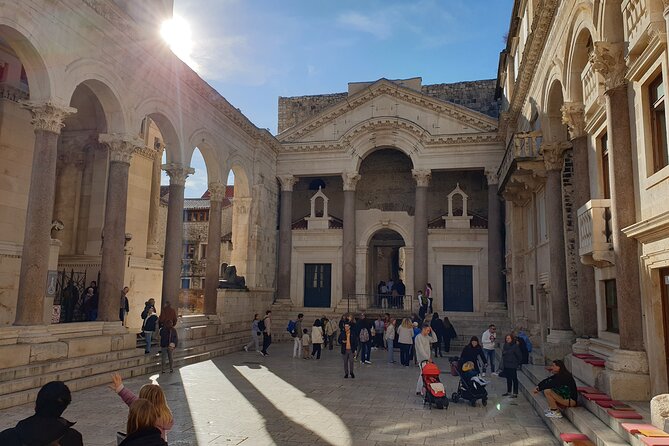
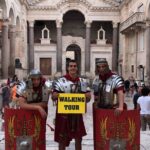
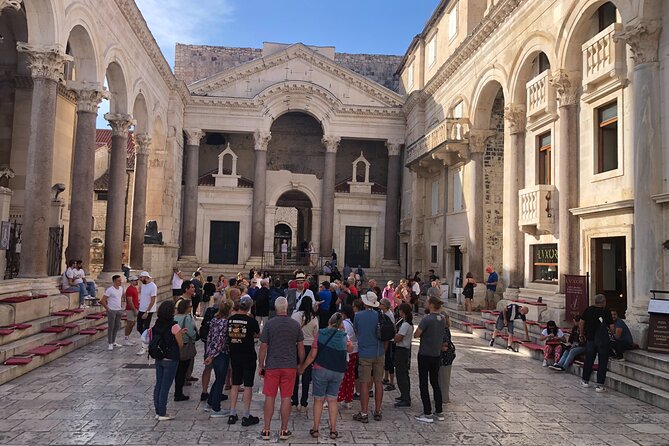
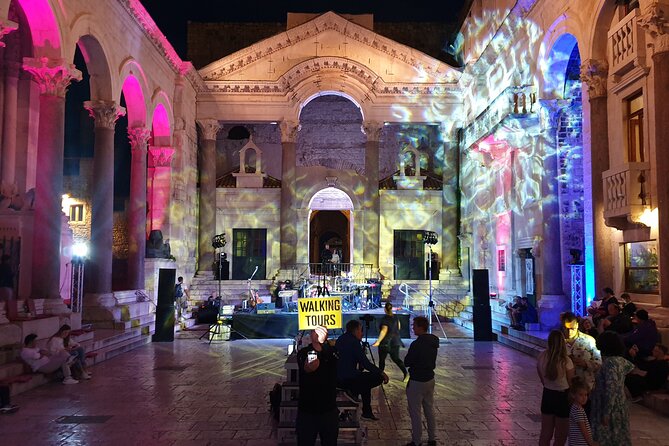
Most people enter Diocletian’s Palace and immediately feel tiny. The tour fixes that by putting you at the Peristyle, the central square that acts like the palace’s main hub. From here, you can connect to many other areas, so your brain starts building a map.
At this stop, you get a strong visual anchor before you move into smaller, more specialized spaces. It’s a great move because the palace is complex—once you understand the center, everything else becomes less confusing.
The timing works too. With about 15 minutes here, you’re not stuck for ages at the most crowded square, but you also get enough time for the big-picture explanation.
Vestibulum stop: emperor Diocletian’s “front room”
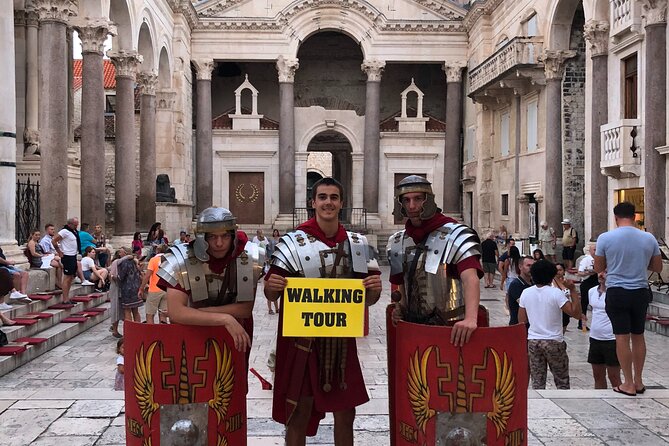
Next up is the Vestibulum—the vestibule area associated with Emperor Diocletian. This is where you hear the palace story in a more personal way, not just through architecture.
One cool detail you might encounter: traditional Dalmatian singing may happen here. Even if it doesn’t, the guide’s explanation adds context that you likely won’t pick up wandering on your own.
This is also a good “listen carefully” moment. The tour moves on soon after, so paying attention here helps you understand how the palace functions beyond the obvious public squares.
Substructures: where the palace worked, not just posed

Then you walk through the Diocletian Palace substructures. This part is about function—how the complex was built and what roles those spaces served over time.
Here’s the key practical point: the tour doesn’t include the museum part of the substructures. You’re still learning about the structure, but if you want to go into the paid sections, plan to do that separately after the walk.
This makes the tour more valuable for first-timers. You get the big storyline and spatial clues without paying extra for every indoor ticket on day one.
Golden Gate and Gregory of Nin: the palace meets Croatian identity
The Golden Gate is where the palace really flexes. It’s the main entrance, and your guide ties the setting to the statue of Gregory of Nin—including why he matters in Croatian history and even language.
This stop is one reason I recommend the tour early in your Split trip. It’s an easy bridge between ancient Roman architecture and the culture you’re experiencing today.
You’ll come away not just with facts, but with a sense of why people still point at these landmarks. The palace isn’t museum-only. It’s embedded in modern identity.




Riva Harbor and the bronze model: see Split’s waterfront story
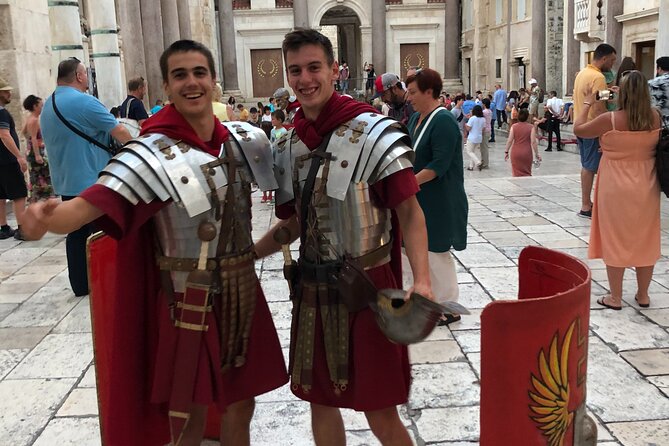
After the gate, the walk shifts toward the city’s pulse. At Riva Harbor, you’ll see a bronze model of Diocletian’s Palace and get a handle on how the palace connected to the waterfront.
This is a helpful reality check. The palace doesn’t sit alone on a hill like some fortress you only visit from afar. It relates to the promenade you’ll probably walk later that afternoon.
You also learn about the history of Riva—the promenade that’s become a social spine for Split. Even if you’re not big on waterfronts, this stop makes the layout feel logical.
Fruit’s Square (Trg Brace Radic): Venetian influence you can spot
Then you reach Fruit’s Square, officially Trg Brace Radic. This area points you toward the later layers that formed around the older Roman core.
You learn about a 15th-century Venetian citadel and about Marko Marulić, described as the father of Croatian literature. It’s a reminder that Split’s story keeps moving long after Diocletian.
This stop also helps you stretch beyond the palace. If your plan is to explore further on foot, you’ll know where you are and why the streets feel the way they do.
Passing the Split Synagogue: Jewish Split in a short stop
The tour includes a pass-by of the Split Synagogue, a 16th-century site. You’ll learn about the history of the Jewish community in Split, and the guide keeps it connected to the city’s layers.
Important note: since it’s a pass-by, you’re not getting a full interior visit from this tour. If your interest runs deeper, you can treat this as a teaser for further research or a separate visit.
This is still a valuable stop. It adds balance to the Roman-and-Venetian focus so you see Split as a multi-community city, not a single-era theme park.
Group size, stairs, and the real-world sound check
The tour runs with a maximum of 20 travelers and is led by an educated guide. In practice, that size is usually comfortable for questions and for staying together.
Still, two real-world things can affect your experience:
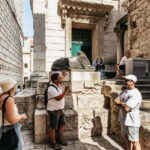
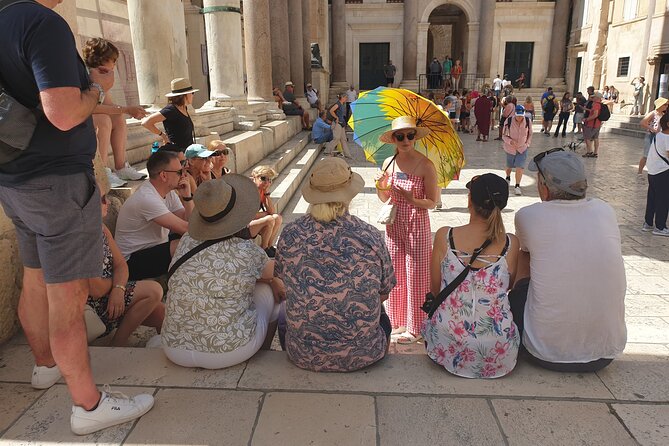
First, audio. Several guides have been praised for their delivery—names like Leo, Mario, Professor Marino, Anton, Antonio, and Antonela/Antonella show up in the mix. But at busy times, it can get hard to hear because there aren’t headsets, and multiple groups can be talking at once. If you’re sensitive to poor audio, arrive a little early to stand in a clear spot and keep an eye on where your guide is positioning.
Second, walking surface. This isn’t a stroll on flat ground. You should expect uneven steps and stairs. It’s explicitly not recommended if you have issues with high steps.
If you want a smooth tour, wear solid walking shoes. Split’s old streets look charming—right up until you’re climbing slightly awkward steps in the wrong footwear.
Tickets and what you’ll pay for (and what you won’t)
The tour price is $48.37 per person for about 1 hour 30 minutes. That’s not just for wandering—the included value is your guide and the way the route makes the palace’s layout understandable.
Now the fine print that matters: no admission tickets are included. Some stops are in areas that are free to access, but your tour is not covering paid indoor sections across the board.
The biggest “pay later” candidate is the museum part of the substructures, which you won’t visit on this walk. If you’re the type who loves museum rooms, you’ll want to set aside time afterward so you don’t feel like you missed the best bit.
Value for money: why this can be a smart first booking
At roughly $48 for 90 minutes, you’re paying for interpretation. In Diocletian’s Palace, that matters. Without guidance, it’s easy to see impressive stonework and still miss why each space feels the way it does.
I especially like the structure: Peristyle to establish the center, then vestibule details, then substructures for function, then Golden Gate for cultural meaning, and finally harbor and squares for Split outside the palace walls.
You also get flexible timing. The tour offers several start times to fit your schedule, and it’s often booked about 13 days in advance. If you’re traveling in peak season, grabbing a slot early is a good move.
Who should book this walking tour
This is a strong fit if you:
- want a first introduction to Split’s old town and Diocletian’s Palace
- like learning through a guided route rather than reading signs on your own
- enjoy small-group walking where you can ask questions
You might consider another option if:
- you need step-free routes
- you’re very audio-sensitive and can’t handle crowded, noisy conditions
- you planned to enter every paid area as part of the tour (this walk won’t cover that)
Timing tip: pick a start time that matches your energy
Because the palace gets busy, your experience depends on when you go. If you can choose, I’d aim for a time when you won’t be pressed against a wall of other groups. That’s the difference between hearing the guide clearly and just catching keywords over the crowd.
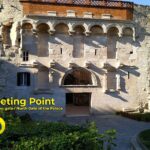
Also give yourself a little cushion around the meeting point. The start is at Peristil ul., 21000 Split. Finding your exact spot is easy once you’re there, but arriving right on time can add stress.
Practical details that help on the day
- The tour uses a mobile ticket.
- It ends back at the same meeting point.
- It’s offered in English.
- Service animals are allowed.
- It’s near public transportation—use that to keep the day simple.
- Confirmation comes at booking time.
On a walking tour like this, small comforts add up. Bring water, wear shoes you trust on uneven steps, and don’t plan to sprint to another paid attraction immediately afterward.
Should you book?
Yes, I’d book it—especially as your first palace experience in Split. The route is efficient, the stop order helps you build a map, and the guide brings the site into focus fast.
Just go in with the right expectations: you’re getting a guide-led walk through key palace and nearby city landmarks, not a tour that includes every paid museum area. If you want to go deeper into the paid sections, use this walk to decide what’s worth your time next.
If audio is a concern for you, pick a quieter start time and position yourself where you can see and hear the guide.
FAQ
How long is the Walking Tour of Split and Diocletian’s Palace?
It lasts about 1 hour 30 minutes.
How much does the tour cost?
The price is $48.37 per person.
Is the tour offered in English?
Yes, the tour is offered in English.
What group size should I expect?
The tour has a maximum of 20 travelers.
Where does the tour start?
The meeting point is Peristil ul. (Peristil ulica), 21000 Split, Croatia.
Does the tour include admission tickets?
No admission tickets are included. Some stops are in areas that don’t require tickets, but paid sections (like the museum part of the substructures) are not included.
Will I visit the museum part of the substructures?
No. The tour goes through the substructures but won’t include the museum part.
Is the tour suitable for people with mobility issues or high steps?
It’s not recommended for travelers who have issues with high steps.
Are service animals allowed?
Yes, service animals are allowed.
What is the cancellation policy?
Free cancellation is available up to 24 hours in advance for a full refund. If you cancel less than 24 hours before the start time, the amount paid isn’t refunded.