REVIEW · SPLIT
Split Walking Tour with Professor of History
Book on Viator →Operated by Split Walking Tour with History Professor · Bookable on Viator
Split’s Roman ruins are even better with a professor. This is a 2 hours 20 minutes walking tour that threads together everyday life, imperial power, and modern Split as you move through the historic center with a history specialist, typically in a small group of up to 17. You start at the Brass Gate (Porta Aenea) and work your way into the living rooms of Diocletian’s world—then out again into today’s streets.
I especially like the professor-style storytelling—the kind that explains what you’re seeing and also clears up common myths. I also like the tight route focus: you get a clear run from Riva Harbor to the Peristyle and the other key landmarks without feeling lost in a sea of other tours.
One thing to plan for: the pace can run longer than the stated time. A few people reported it stretching to around 3 hours, usually because the guide has lots of great stories to follow.
In This Review
- Key highlights at a glance
- Meeting at Porta Aenea: Start where Split’s story enters
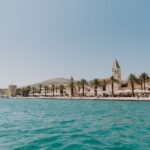
- Riva Harbor: Where Split’s everyday pace meets the ancient plan
- Diocletian Palace substructures: The best-preserved basement you didn’t know you needed
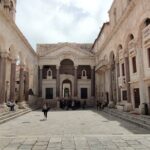
- The Peristyle: The palace’s central square and the emperor’s stage
- The Vestibul (Rotonda): A Roman hall built for select audiences
- Cathedral of Saint Domnius and the Temple of Jupiter: The outside view that still pays off
- Cathedral of Saint Domnius (outside only)
- Temple of Jupiter (outside only)
- Golden Gate, Gregory of Nin, and Marmontova Ulica: Small details with big cultural pull
- The Golden Gate
- Grgur Ninski statue
- Marmontova Ulica
- Prokurative and Fruit Square: Politics, literature, and food stories in one loop
- Prokurative
- Fruit Square (Trg Brace Radic)
- Price and value: Why $24.19 can make sense here
- Who should book (and who might skip)
- Should you book this Split history walking tour?
- FAQ
- FAQ
- How long is the Split Walking Tour with a History Professor?
- Is the tour in English?
- Where does the tour start?
- How big is the group?
- Are tickets for all stops included?
- What if the weather is bad?
- Can I cancel for a refund?
Key highlights at a glance

- Small group size (max 17) so you can ask questions and keep your bearings
- Diocletian Palace substructures + Peristyle set the stage for everything else in Split
- Outside-view Roman landmarks (Cathedral of Saint Domnius and Temple of Jupiter) with added context
- Old Town details that feel personal, like Let me pass street and the narrow alley lore
- Local culture stops at Marmontova Ulica, Prokurative, and Fruit Square, not just monuments
- Optional private upgrade if you want a more tailored pace and Q&A
Meeting at Porta Aenea: Start where Split’s story enters
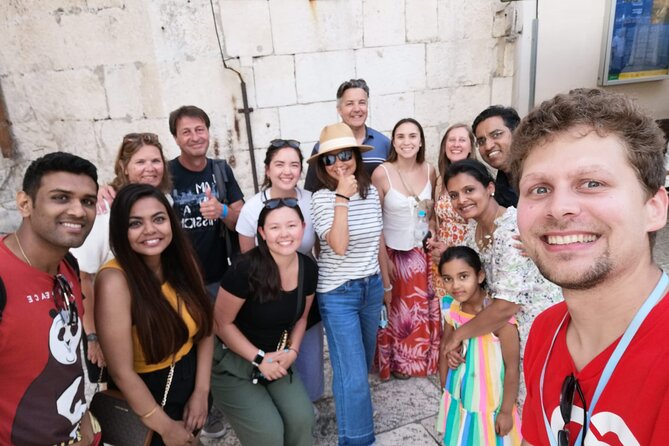
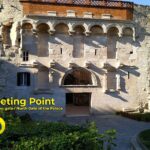
Your tour begins at the Brass Gate (Porta Aenea) on Obala Hrvatskog narodnog preporoda 22. That matters more than it sounds. This gateway sits at the edge of the action, so you’re not starting with a random church or a souvenir shop. You’re starting at a threshold—literally—between the city’s street life and the Roman core that shaped Split.
From the start, the guide sets the tone: you’ll get explanations you can actually use while you walk. This kind of tour works best when you stop treating ruins like museum pieces and start seeing them like architecture built for real people—soldiers, emperors, ambassadors, and later, residents who kept reusing the space.
You’ll also appreciate the practical rhythm. The stops are short (often around 10–15 minutes). That keeps the tour moving, but it also gives you time to look back up at details—arches, stonework, and layouts—without getting rushed.
If you like guidance that’s part history lesson and part smart city orientation, this is the sweet spot. Guides such as Mario and Anita are mentioned specifically for mixing scholarship with humor and for staying tuned to the group’s needs—so you’re not just reciting facts while everyone stares at the ground.
You can also read our reviews of more walking tours in Split
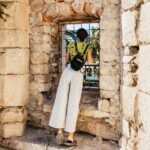
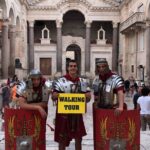

Riva Harbor: Where Split’s everyday pace meets the ancient plan
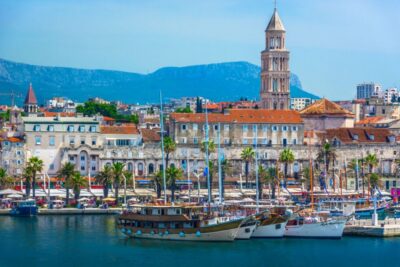
The first stop is Riva Harbor on the Riva promenade, right by a model of the Palace. This is where locals drift for coffee, sun, and public life. It’s a useful opener because it reminds you that Split never stopped being a working city. Roman stone isn’t just a backdrop here—it’s part of the daily scene.
Riva is also where you can get your bearings fast. You’ll see the energy of the seafront and understand why the palace layout made sense. People gathered by water. Power sat close to where the city traded, traveled, and displayed itself.
This stop is brief, but it does its job: it turns you on to the idea that you’re not touring an abandoned place. You’re walking through a city that kept building, adapting, and living around its old foundation.
If you’re the type who likes to know where you are before you zoom in on details, you’ll get a lot out of this first leg. And if you’re tired from travel, a quick coffee-adjacent promenade start can feel like a gentle launch instead of a sprint.
Diocletian Palace substructures: The best-preserved basement you didn’t know you needed
Next comes the Diocletian Palace substructures, the basement halls of the palace. These are often described as one of the best-preserved complexes from classical antiquity, and they’re a huge reason the historic center of Split earned UNESCO World Heritage status in 1979.
Here’s why this stop is so valuable: the substructures explain the palace as a system, not just a set of pretty sights. You’re looking at the structure that helped the palace function, support, and endure. When a guide walks you through how these spaces connected to the larger palace, Split stops being “Roman ruins you take photos of” and becomes a real plan you can picture.
The tour keeps this time tight—around 15 minutes—but you’ll still come away with a clearer mental map. That makes later stops like the Peristyle feel less random. You’re already warmed up on the palace’s layout, so the architecture doesn’t hit you like a wall of names.
Practical note: this is a stone-heavy stop. Wear shoes you trust, and keep your eyes up and down. The “main attraction” details are often on both levels.
The Peristyle: The palace’s central square and the emperor’s stage
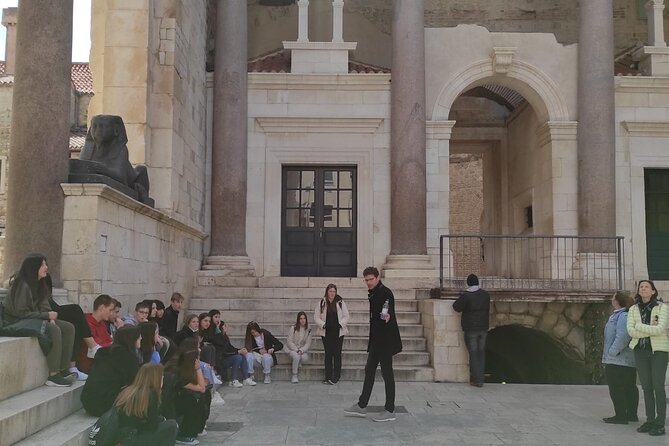
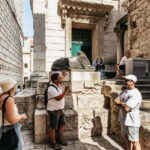
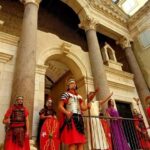
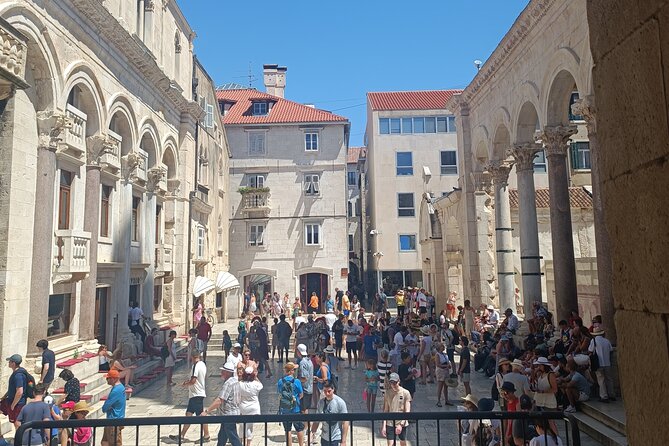
Then you reach the Peristyle of Diocletian’s Palace, the central square. This is where the palace acted like a stage. The guide explains how the Emperor Diocletian was presented and how the surrounding temples and design helped control the flow of people—who approached, where they stood, and what role the space played in ceremony.
What I like about this stop is that it doesn’t treat the Peristyle like a static courtyard. It turns it into a performance space. You’ll hear descriptions of the Emperor appearing under the architrave of the central part of the Protyron, with people approaching on bended positions—kneeling and the symbolic gestures that matched the power structure of the time.
This is also where you get context that helps with other sights in Split. When you understand the palace as an official center of imperial life, you start noticing similar patterns—how buildings align, how entrances emphasize status, and how public space gets used for authority.
The time here is short (about 10 minutes), but it’s also the moment where most people start to feel the scale and ambition of the complex. It’s the kind of stop that makes the rest of the walk click.
The Vestibul (Rotonda): A Roman hall built for select audiences
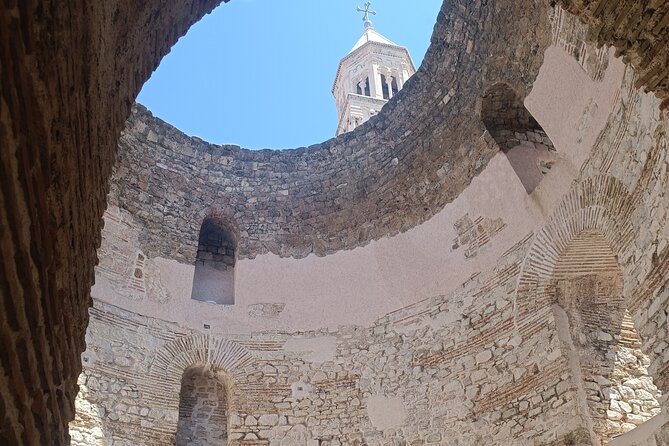
Right after the Peristyle, you visit the Vestibul, also called the Rotonda. This is the first section of the imperial corridor leading from the Peristyle into the emperor’s apartments.
You’ll learn the basic dimensions and what those numbers mean. The hall was built up to the beginning of the 4th century, and it was once topped with a dome. The height is about 17 meters, and the diameter is about 12 meters. The guide frames it as a grand meeting hall for selected audiences—think ambassadors and high-ranking visitors.
This stop can be a little abstract if you walk past it alone. With a guide, it becomes concrete. You start to understand sightlines, approach routes, and why circular halls carried status in imperial design.
Also, it’s a smart pacing moment. After open spaces and ceremonial squares, this offers a contained architectural focus. You get to slow your brain down for a minute and really “read” the space.
You can also read our reviews of more historical tours in Split

Cathedral of Saint Domnius and the Temple of Jupiter: The outside view that still pays off
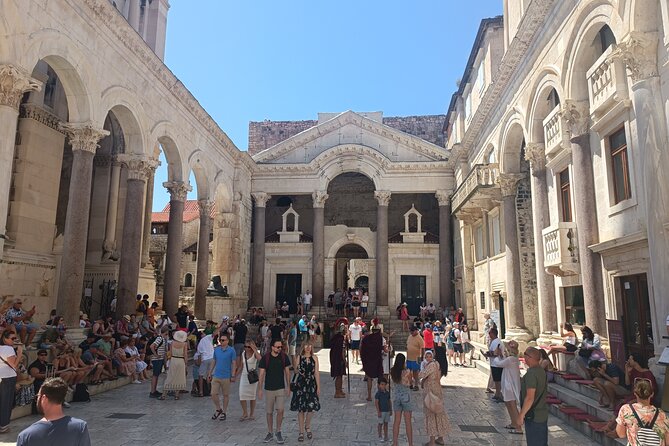
Not every stop includes an entrance ticket, and that’s actually part of the logic here. Two major sites are handled as outside-focused viewpoints with detailed explanations:
Cathedral of Saint Domnius (outside only)
You’ll see the Cathedral of Saint Domnius from the exterior. The guide explains its layered identity as a Roman temple, mausoleum, and church, depending on how you look at it. The key point for planning: entrance is not included, but the guide gives context and can point you toward what to look for if you decide to visit later on your own.
If you want to keep the tour flowing, this is ideal. If you’re the type who wants “everything inside,” you’ll need a second stop on your own schedule.
Temple of Jupiter (outside only)
Next is the Temple of Jupiter, visited from the outside. The guide also shares how it was converted into a baptistery dedicated to St. John the Baptist. That shift—pagan worship to Christian use—is one of the big through-lines in Mediterranean history, and Split shows it clearly.
You’ll also walk through a small street between the ancient temple and a medieval building. Locals have a fun belief that it’s the narrowest street in the world, called Let me pass street. Even if you treat the claim as legend, it’s still a great micro-moment: you’ll feel how tight urban space can be in the old town fabric.
This section of the tour is a good reminder that outside viewing can still be satisfying when a guide ties it to the big story. You’re not missing out on meaning—you’re just choosing a different pace.
Golden Gate, Gregory of Nin, and Marmontova Ulica: Small details with big cultural pull
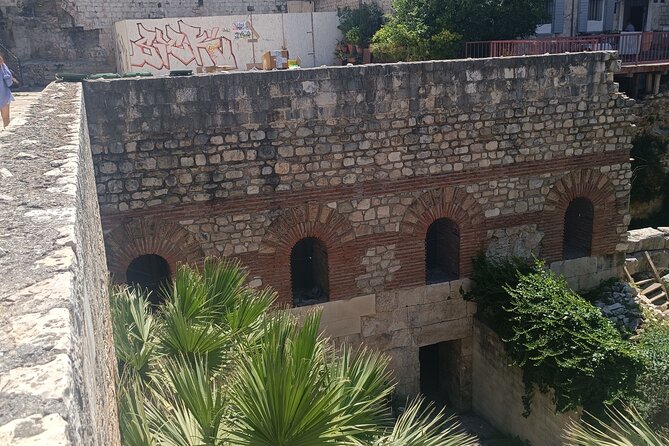
As you move forward, the tour shifts from “imperial center” to “how people made Split their own.”
The Golden Gate
The Golden Gate (also called the Northern Gate) is one of the four principal Roman gates into the old town. You’ll learn how it served as the main entry point for the Emperor and how it was decorated for that status. Later, it was sealed off in the Middle Ages and lost columns and statuary, then reopened and repaired in modern times. Now it’s a tourist attraction—and a strong example of how older city structures keep getting reinvented.
Grgur Ninski statue
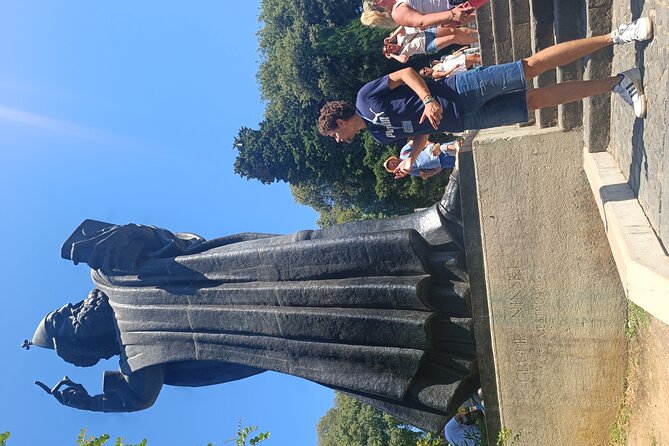
You’ll also stop at the tall statue of Gregory of Nin by Ivan Meštrović. The famous detail is the toe: rubbing it is said to bring good luck. The toe is worn shiny because people keep doing it. It’s one of those charming street customs that makes a history tour feel human, not clinical.
Marmontova Ulica
Then comes Marmontova Ulica, named after Napoleon’s marshal Marmont. The guide explains the connection to his role in the urbanization of Dalmatian cities, and then—more importantly—how Split returned the favor by naming one of its most beautiful streets after him.
These stops matter because they show continuity. History here isn’t only ancient. It’s layered: Roman gates, medieval changes, and Napoleon-era influence all sit in the same walking circle.
Prokurative and Fruit Square: Politics, literature, and food stories in one loop
The tour finishes in a way that feels practical: you exit the heaviest Roman architecture and step into the public squares where modern Split hangs out.
Prokurative
At Prokurative, you’ll see Republic Square, an open space surrounded by neo-Renaissance buildings. The architecture is showy, but the purpose is simple—you’re looking at a social stage, a place where the city gathers. The guide uses it to connect older power structures to newer ones, so you don’t feel like you skipped eras.
Fruit Square (Trg Brace Radic)
The last stop is Fruit’s Square (Trg Brace Radic), a small square with stories that land closer to daily life. You’ll hear about women who used to sell fruits there and learn how the square connects to important figures like Marko Marulić, described as the father of Croatian literature.
This is also where the tour naturally turns to Croatian history and gastronomy. That blend is useful. It means you’re not only leaving with a better understanding of the past; you’re leaving with a sense of what kinds of food to chase next and where the day can go from history to eating.
The tour ends back at the meeting point, so you’re not stranded far from your starting area. It’s a clean circle, and it helps if you’re planning dinner soon after.
Price and value: Why $24.19 can make sense here
At $24.19 per person, this tour isn’t trying to sell you “exclusive access.” It’s selling clarity.
You get:
- A structured walk through major Roman and historic-center landmarks
- Explanations tied to layout, function, and change over time
- A small group limit (max 17) that keeps it interactive
- A mobile ticket
- English language delivery
The best value part: many of the key stops are free to view during the tour. The Cathedral of Saint Domnius and the Temple of Jupiter are outside-only, with entrance not included, which keeps costs controlled. If you want to go inside later, you can decide based on your time and interest.
How long should you plan? The official duration is about 2 hours 20 minutes, but build in extra time. If the guide has a habit of taking questions, the tour can run closer to 3 hours. That’s not a problem if you planned your day with a little slack.
Overall, I think this price works well if it’s your first real walk through Split’s old center. If you already know the city well, you might want a shorter route. But if you want a guided “story map,” the cost feels fair.
Who should book (and who might skip)
This tour is ideal if:
- You want a history professor style guide and enjoy context, not just photo stops
- You like small-group attention and question-friendly pacing
- You’re visiting Split for the first time and want a coherent route across Roman and medieval layers
- You want practical tips mixed into the walk (including food and local recommendations that can help after the tour)
It might not be the best fit if:
- You hate walking for stretches through old streets and want frequent sit-down breaks
- You only want ticketed interior access (since some major sites are viewed from outside)
- You’re on a strict timetable where an extra 20–40 minutes would ruin your day
If you care about the story behind the stone, this hits the right tone. And if you’re the type who likes humor and myth-busting mixed in, you’ll likely enjoy the guide approach—people specifically mention Mario and Anita for being lively and for keeping groups engaged.
Should you book this Split history walking tour?
Yes—if this is your first visit and you want to understand why Split’s old center is special, not just what it looks like. The route is efficient. The stops are iconic without being generic. And the small-group format makes it feel like a conversation with the city, not a hurried checklist.
I’d book it early in your stay. You’ll get a mental map that helps with everything after: where to wander next, what to revisit for more time, and how to spot the meaning in the details.
If you’re deciding between this and a self-guided approach, the guided version wins for one reason: you get the explanations that turn the same buildings into something you can actually interpret while you’re standing there.
FAQ
FAQ
How long is the Split Walking Tour with a History Professor?
It runs about 2 hours 20 minutes.
Is the tour in English?
Yes, it’s offered in English.
Where does the tour start?
The meeting point is at the Brass Gate (Porta Aenea), Obala Hrvatskog narodnog preporoda 22, 21000 Split, Croatia.
How big is the group?
The maximum group size is 17 travelers.
Are tickets for all stops included?
All fees and taxes are included, but entrance is not included for the Cathedral of Saint Domnius and the Temple of Jupiter (you visit them from outside).
What if the weather is bad?
The experience requires good weather. If it’s canceled due to poor weather, you’ll be offered a different date or a full refund.
Can I cancel for a refund?
Yes. You can cancel up to 24 hours in advance for a full refund.