REVIEW · SPLIT
Private History and Trivia Walking Tour by a Local Guide
Book on Viator →Operated by Lingua Tours · Bookable on Viator
Split’s old stones come with punchlines; this private guide walking tour strings together Split’s key sights in about 1 hour 45 minutes, with history plus genuinely useful city tips. I like the tight focus on Diocletian’s Palace so you get the big picture fast, and it’s small-group enough to ask questions without shouting. One drawback: the pace is brisk, so if you want a slow, linger-at-every-stone kind of day, this may feel like a sprint.
I also like the storytelling style—more trivia and “how things changed” than dry dates—so places like the Cathedral of Saint Domnius and the Temple of Jupiter start making sense in your head. With a licensed guide and a maximum of 15 people, you’ll get clear explanations and local context you can carry into the rest of your stay.
In This Review
- Key Things I’d Prioritize on This Split Walk
- Why This 90-Minute Private Walk Feels Like a Local Crash Course
- Price and What You Get for $53.95 Per Person
- Starting at Riva Harbor: Get Oriented Before You Enter the Old City
- Bronze Gate Substructures: Touring the Palace Through Its Actual Nerve Center
- Peristyle Square: The Central Room That Explains Everything
- Cathedral of Saint Domnius and the Temple of Jupiter Baptistery Story
- Fruit’s Square (Trg Brace Radic) and Pusti me Proć: The Perfect Short Detour
- Narodni trg: Split’s Main Square and the Palaces That Define the Feel
- Zeljezna Vrata to Golden Gate: Two Entrances, Two Ways to Read the Palace
- Papalic Palace and the City Museum of Split: A Quick Stop for Film Fans
- Grgur Ninski Statue and the Bell Tower of St Arnir: Art and Early Christianity in One Finish Line
- Marmontova Ulica: The View That Brings the Whole City Back Into Focus
- Is This Tour Right for You?
- Should You Book This Private History and Trivia Walking Tour of Split?
- FAQ
- How long is the Private History and Trivia Walking Tour in Split?
- Where does the tour start and end?
- Is this tour actually private?
- What’s the maximum group size?
- What languages do the guides speak?
- What major landmarks will we see?
- Are entrance tickets included?
- Is there a mobile ticket?
- When does the tour operate?
- What’s the cancellation policy?
Key Things I’d Prioritize on This Split Walk
- Bronze Gate entry into Diocletian’s Palace substructures: you see the parts most tour buses skip.
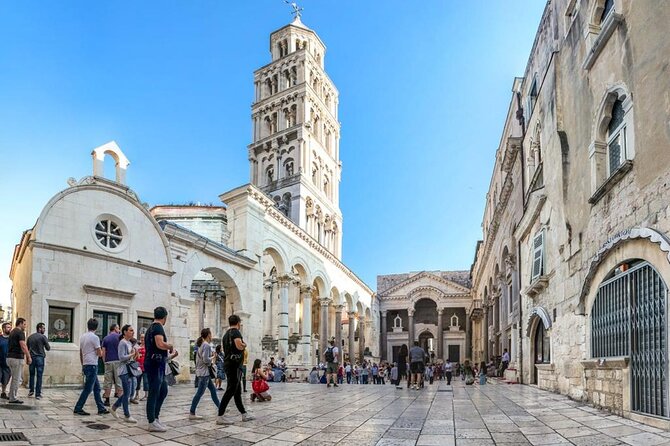
- Peristyle Square as your historical anchor: it’s the central reference point for understanding the whole complex.
- Christianity-on-top-of-Rome details: the Cathedral of Saint Domnius and the Temple of Jupiter/baptistery story connect the dots.
- Narrow-street stop at Fruit’s Square (Trg Brace Radic) and Pusti me Proć: a quick detour that adds real character.
- Iron Gate to Golden Gate contrasts: two different palace entrances, explained like an architectural timeline.
- Marmontova Ulica payoff viewpoint: the tour finishes high enough to re-orient you with the Croatian National Theater and nearby church complex.
Why This 90-Minute Private Walk Feels Like a Local Crash Course
Split can be confusing at first. You walk around and think: Is this Roman? Is this medieval? Why does everything feel connected? That’s exactly why this tour works for time-tight travelers. It’s designed as a whistle-stop history route that still gives you context, not just photo stops.
It’s also private in the real sense: your group only, with a max of 15 people. That matters because Split’s historic center is full of narrow streets and small architectural details. With a guide keeping the pace manageable, you can actually hear what you’re seeing.
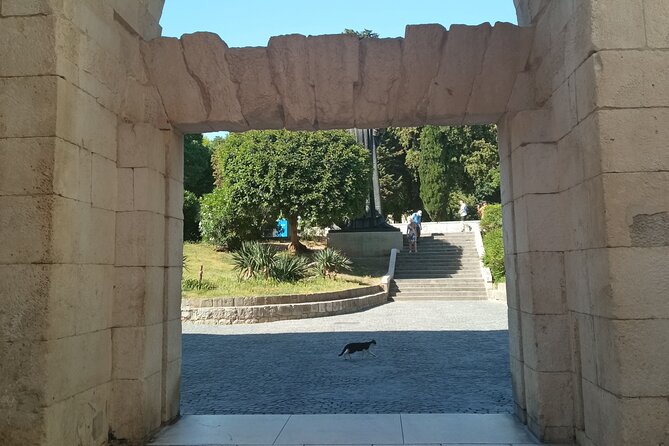
Another practical win: you’re walking where bigger coaches can’t get to easily. You don’t just “pass by” the landmarks—you’re placed near doorways, entrances, and the palace’s interior spaces so you can connect the physical layout to the story.
And yes, the experience leans into trivia and humor, which can make the dense material feel lighter. If you end up with a guide like Ivan (a name that comes up with praise for humor and friendliness), you’ll likely get answers to follow-up questions rather than a rushed monologue.
You can also read our reviews of more walking tours in Split

Price and What You Get for $53.95 Per Person
At $53.95 per person, you’re paying for a licensed local guide and a structured route through Split’s top historic zones. The duration—about 1 hour 45 minutes—keeps it efficient, especially if you’re trying to fit major highlights between meals, beaches, or day trips.
The best part for value is that the stops on this route are marked as admission ticket free. That means you can avoid the “pay, queue, wait, lose the afternoon” feeling that can happen on sightseeing-heavy days.
Also, the tour includes multilingual guidance (English, French, German, Spanish, Italian), which is a big deal in Croatia. When your guide can switch languages and explain clearly, you spend less energy translating in your head and more time actually understanding what you’re looking at.
One more detail that affects value: the format is set up for tips and local customs. By the end, you’re not only able to say where things are—you’ll understand the logic behind them, which helps you make better choices the rest of your trip.
Starting at Riva Harbor: Get Oriented Before You Enter the Old City
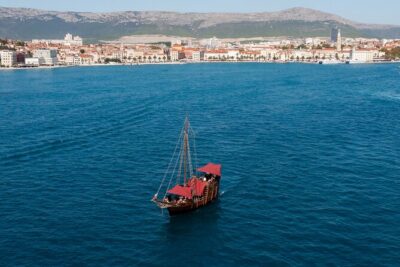
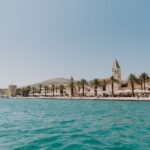
You begin at the promenade at Obala Hrvatskog narodnog preporoda 22, right where you can take in the water-facing side of Split. This is the smart first move. Standing at Riva Harbor lets you see the Diocletian’s Palace southern wall and the harbor’s layout, so the complex doesn’t feel like a random maze once you start walking.
Your guide points out the southern palace wall plus the harbor area and both eastern and western promenade/coast directions. That orientation is more than a warm-up—it sets up the rest of your visit, because the palace’s position relative to the sea is part of how it functioned.
If you’re arriving during warmer hours, you’ll also appreciate starting in open-air before heading into tighter palace passages. Just bring basic comfort items like water and sun protection if you’re touring in the midday range.
Bronze Gate Substructures: Touring the Palace Through Its Actual Nerve Center
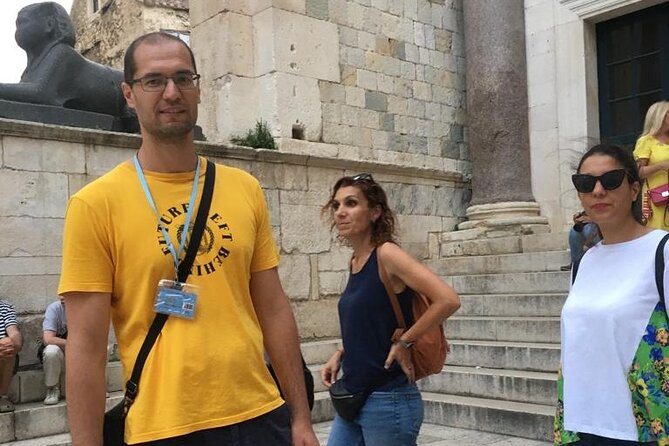
One of the strongest reasons to book a walking tour is access. Here, you go into the Diocletian’s Palace substructures through the southern entrance known as the Bronze Gate. That’s not just a “look from outside” moment.
At this stage, the guide explains the specific role of the substructures across history as you pass through the main passage areas. Even if you don’t remember every term, you’ll leave with an understanding of how the palace worked as more than a pretty ruin.
This is the kind of stop that pays off later when you’re wandering on your own. Once you’ve seen the substructure space and heard what it was meant to do, the palace layout starts to make sense in your head.
A small practical consideration: these are still historic spaces, so wear shoes that handle uneven ground. Your feet will be your best friend for the rest of the walk.
Peristyle Square: The Central Room That Explains Everything
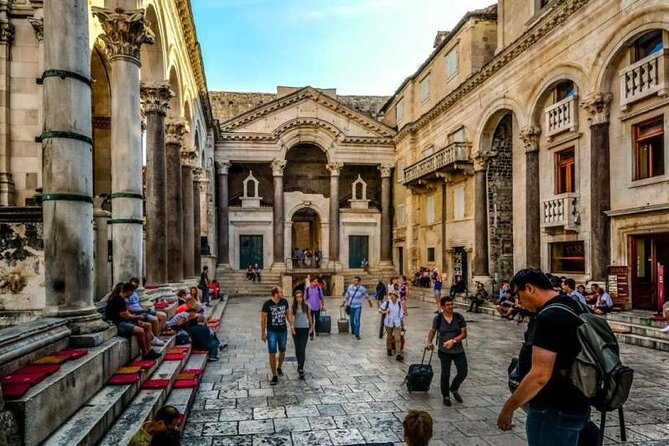
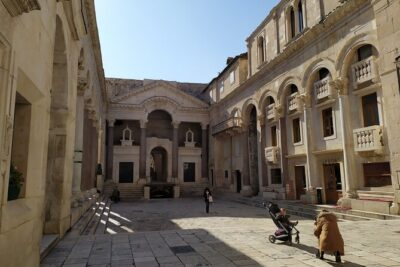
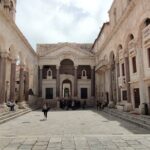
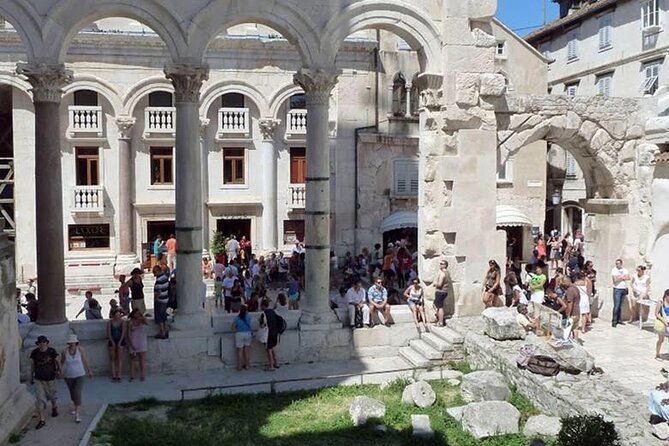
Next comes the Peristyle of Diocletian’s Palace—the main ancient square at the heart of the complex. Think of it like your “control center.” When you stop here, your guide can lay out the historical and cultural background in a way that’s easier to remember because you’re standing in the center of the whole layout.
Peristyle Square is where the palace stops feeling like separate sights and starts feeling like one organized world. You’ll understand why the space is central, and why so many major stories (Roman power, later Christian adaptation, the palace’s long afterlife) connect back to this exact spot.
If you like trivia, this is often where it clicks best: your guide can tie symbolism and architectural choices to real life, not just academic facts.
You can also read our reviews of more guided tours in Split





Cathedral of Saint Domnius and the Temple of Jupiter Baptistery Story
After the Peristyle, the tour moves into the Cathedral of Saint Domnius. This stop is special because you’re not looking at a standalone cathedral story. Your guide explains what role the Mausoleum of Emperor Diocletian had—and how it was turned into a cathedral as Christianity took hold.
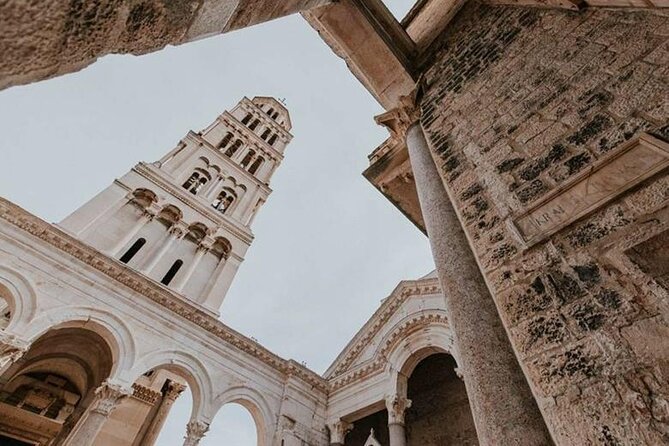
That’s a big theme in Split: layers of belief and power built on top of each other. The Cathedral stop helps you see those layers physically, including details of construction style and the adjacent bell tower area.
Then you move on to the Temple of Jupiter. As you leave the Peristyle Square, you visit this temple area where the guide explains how it was turned into a baptistery as Christianity spread within the palace walls. There’s also a sphinx in front, used as a visual reminder that not everything in this story was purely local or purely Roman in a simple way.
If you enjoy understanding how religions evolve from the ground up, this pairing—Cathedral of Saint Domnius plus the Temple of Jupiter—gives you a clear, walkable explanation.
Fruit’s Square (Trg Brace Radic) and Pusti me Proć: The Perfect Short Detour
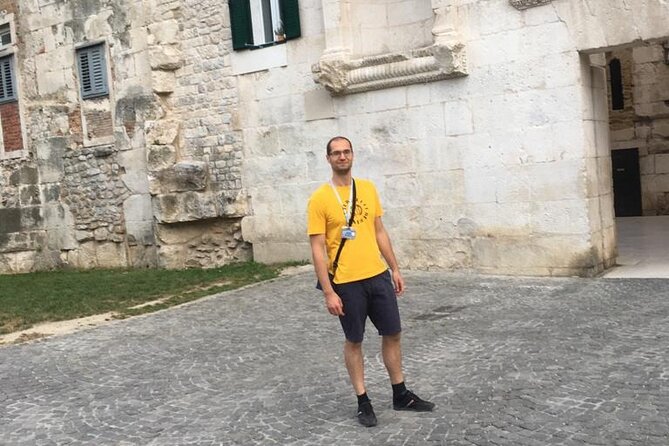
Now the tour shifts from big monumental spaces to city texture. Fruit’s Square (Trg Brace Radic) is reached after passing through one of the narrowest streets in Split, tied to the famous name Pusti me Proć. You feel the change as soon as you step into those tighter lanes—less grand, more human scale.
This is where your guide talks about the development of Split, including the sense of growth versus stagnation at different moments in its past. It’s also one of the stops where the tour can feel most “alive,” because you’re in a place people would recognize even today.
You’ll also pass the statue of Marko Marulić, described as the father of Croatian literature. It’s a quick moment, but it adds a cultural layer beyond the Romans and Christians.
Right behind the statue area, you’ll see the palace of the Milesi family from the 17th century. These little “pause-and-name” moments are what turn a highlight tour into something you remember later.
Narodni trg: Split’s Main Square and the Palaces That Define the Feel
From Fruit’s Square you head to Narodni trg, Split’s main square. This stop is about how the city’s social center evolved—how it became the primary square for Split as the town expanded.
Your guide also points out key buildings around the square, including a recently renovated palace at one end. You’ll pass the old City Hall and additional palaces tied to noble families.
This stop works well because squares are where you can compare eras quickly. You can look across the open space and understand how power, government, and wealth shaped the city’s center over time.
If you’ve had trouble connecting “what you see” to “what it meant,” this is one of the places that fixes that. The guide’s explanations give you a framework for reading the surrounding structures, even if you don’t study architecture.
Zeljezna Vrata to Golden Gate: Two Entrances, Two Ways to Read the Palace
As you head eastward, you reach Zeljezna Vrata—the iron gate area. Your guide highlights the history of this entrance and the different kinds of activities that took place there. You’ll also see the oldest parts associated with this gate zone as explained during the walk.
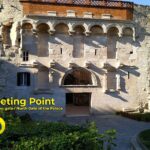
Then you continue into another palace entrance: the Golden Gate. It’s described as the northern entrance to Diocletian’s palace and noted as the most beautiful and decorated entrance, built with impressive Roman building expertise.
What makes these entrances worth including isn’t just that they’re pretty. It’s that they give you a comparative lesson. Two gates, two visual styles, and a guide’s commentary that helps you see them as part of one larger Roman design system.
Along this stretch, you also pass palaces from different centuries, including one linked to the Cindro family (17th century) and another linked to an Italian family (Augubio, 15th century). These aren’t long museum detours, but they keep the city’s timeline moving.
Papalic Palace and the City Museum of Split: A Quick Stop for Film Fans
Next up: the City Museum of Split, located in Papalic Palace. This is a short pause, but it adds a modern way to connect with the past.
Your guide explains the palace’s historical significance and points out a connection for Game of Thrones fans, including an interesting—described as bloody—scene that takes place in front of the palace in the show.
Even if you’re not a fan, this is still a useful checkpoint. Museums often feel like “extra.” Here, the museum stop gives you a sense of where to go next if you want to keep studying—without forcing you to commit to a full indoor block.
Grgur Ninski Statue and the Bell Tower of St Arnir: Art and Early Christianity in One Finish Line
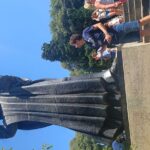
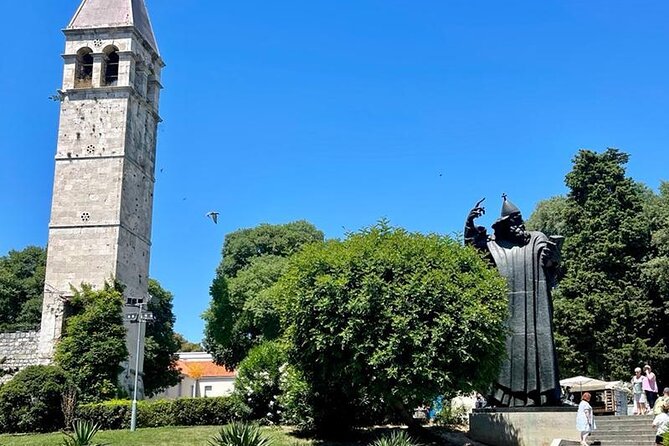
Just opposite the northern gate, you’ll see the statue of Bishop Grgur of Nin, created by Croatian sculptor Ivan Meštrović. Your guide explains why Grgur represents such an important figure for Croatian identity. It’s a meaningful shift from Roman architecture toward local cultural memory.
Then the tour moves to the bell tower of St. Arnir, alongside the chapel of Saint Arnir and remnants of an early Christian church. Here, the guide’s short commentary ties architecture to the deeper “how beliefs changed” theme you’ve been hearing all along.
This section works because you’re not just looking upward at a tower—you’re getting context for what that tower represents in the city’s layered religious story.
Marmontova Ulica: The View That Brings the Whole City Back Into Focus
The walk finishes on Marmontova Ulica, at a viewpoint above the Croatian National Theater and near the Monastery and Church of Our Lady of Health. This last stretch is a practical way to end a dense history tour.
Once you look out over the theater and the church complex, the city stops being only ruins and cathedral interiors. You see where the “old” sits inside a living modern city.
Your guide also covers a final historical aspect tied to this street area, leaving you with something to carry forward when you continue exploring Split after the tour ends back at the meeting point.
Is This Tour Right for You?
Book this if you:
- Want major Split highlights in a tight time window (about 1 hour 45 minutes).
- Prefer a walking route where you get access and proximity, not just quick roadside views.
- Like explanations tied to what you’re standing next to—especially Roman-to-Christian transitions.
- Appreciate humor and a guide who answers questions clearly (the guide Ivan is repeatedly praised for friendliness and in-depth answers).
Skip or adjust your expectations if you:
- Need a slow pace with lots of sitting time.
- Want purely indoor museum time rather than street-level architecture and city context.
If you’re the type who likes to understand the city instead of just collecting photos, this is the kind of tour you’ll feel good about choosing first.
Should You Book This Private History and Trivia Walking Tour of Split?
Yes, if your priority is getting your bearings and learning how Split’s most important landmarks connect. For $53.95 per person, you get a licensed multilingual local guide, a structured route through Diocletian’s Palace core areas, and stops that are marked ticket-free on this walk—so you’re not constantly paying entry fees to keep the day moving.
It’s also a smart choice if you’re planning more sightseeing right after. A good local guide doesn’t just show you where to go; they help you understand what you’re seeing while you’re there.
If you want, tell me your travel dates and what else you’re planning in Split (beach time, Marjan Park, day trips, museums). I can suggest how to slot this tour into your schedule for the best flow.
FAQ
How long is the Private History and Trivia Walking Tour in Split?
It runs for about 1 hour 45 minutes.
Where does the tour start and end?
It starts at Obala Hrvatskog narodnog preporoda 22, 21000, Split, Croatia, and ends back at the same meeting point.
Is this tour actually private?
Yes. It’s private, meaning only your group participates.
What’s the maximum group size?
The tour has a maximum of 15 persons.
What languages do the guides speak?
The guide is available in English, French, German, Spanish, and Italian.
What major landmarks will we see?
You’ll pass and stop at key sights such as Diocletian’s Palace (including substructures and entrances), the Cathedral of Saint Domnius, the Temple of Jupiter, Fruit’s Square (Trg Brace Radic), Narodni trg, the City Museum of Split (in Papalic Palace), the Golden Gate, the statue of Grgur of Nin, the Bell Tower of St. Arnir, and the Marmontova Ulica viewpoint.
Are entrance tickets included?
Admissions for the listed stops are marked as free on this tour route.
Is there a mobile ticket?
Yes, it includes a mobile ticket.
When does the tour operate?
The opening hours shown are Monday through Friday from 8:00 AM to 1:30 PM.
What’s the cancellation policy?
You can cancel for a full refund up to 24 hours in advance. If you cancel less than 24 hours before the start time, the amount paid is not refunded.