REVIEW · SPLIT
Chill Private Walking Tour of Diocletian’s Palace
Book on Viator →Bookable on Viator
Roman power still walks here.
This private walking tour of Diocletian’s Palace in Split turns the big stone landmarks into a clear story—how a late Roman palace became a working neighborhood, with religious sites and Croatian history layered right on top. You’ll move at a human pace, see the palace from the key angles, and get comparisons using 3D reconstructions of what these spaces looked like centuries ago.
I really like two things about this experience. First, the tour is built around “you can see it right now” architecture—Peristyle, substructures, cathedral, and gates—so the history lands fast. Second, the guide delivery (including humor and sharp explanations) helps the palace feel understandable, not just impressive. If your guide is Mili, you’ll also get extra context that can connect to pop culture like Game of Thrones, without leaving non-fans behind.
One consideration: several highlights have optional paid interiors. If you add those ticketed parts (like going inside the cathedral or the museum portion of the substructures), the tour can stretch toward the longer end of the time range, and you’ll need to plan a little extra.
In This Review
- Key highlights you’ll feel immediately
- Why Diocletian’s Palace is easier to understand on foot
- Meeting at the Silver Gate and finishing at the Golden Gate
- Stop 1: The Peristyle of Diocletian’s Palace
- Stop 2: Diocletian Palace substructures (free part first)
- Stop 3: Cathedral of Saint Domnius (and what changes when faith moves in)
- Stop 4: Temple of Jupiter (and the power of repurposed interiors)
- Stop 5: Triklinij and a partial reconstruction you can almost walk into
- Stop 6: Papalićeva ulica (north half details in alley form)
- Stop 7: Fruit’s Square (Trg Brace Radic) and the Croatian timeline
- Stop 8: The Golden Gate and how fortifications change
- Stop 9: Grgur Ninski statue and tying Roman construction to Croatian identity
- The value of the optional interiors (and how to decide)
- Price and group size: what $107.84 really buys
- Weather, pacing, and the small stuff that matters
- Who this tour fits best
- Should you book this Chill Private Walking Tour of Diocletian’s Palace?
- FAQ
- How long is the walking tour?
- Where does the tour start and end?
- Is this a private tour?
- What’s included in the tour fee?
- What language is the tour offered in?
- What happens if the weather is bad or I need to cancel?
Key highlights you’ll feel immediately
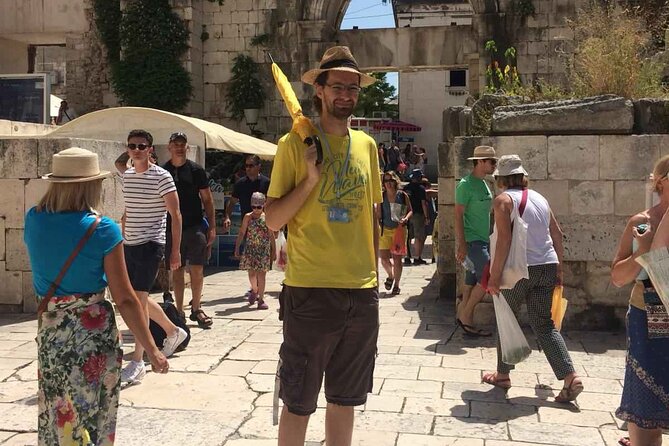
- Peristyle as the starting line: you begin in the palace’s heart, with Diocletian’s story explained before you start walking.
- Free substructures first: you get the main architectural walk-through without paying up front.
- Roman-to-Christian conversion at Saint Domnius: one of the best-preserved Roman structures gets explained in plain terms.
- Temple of Jupiter outside + optional interior: you see why it’s still so well preserved, then decide if you want more.
- 3D reconstructions you can compare to real stone: you’ll hold the past in your head while looking at the present.
Why Diocletian’s Palace is easier to understand on foot
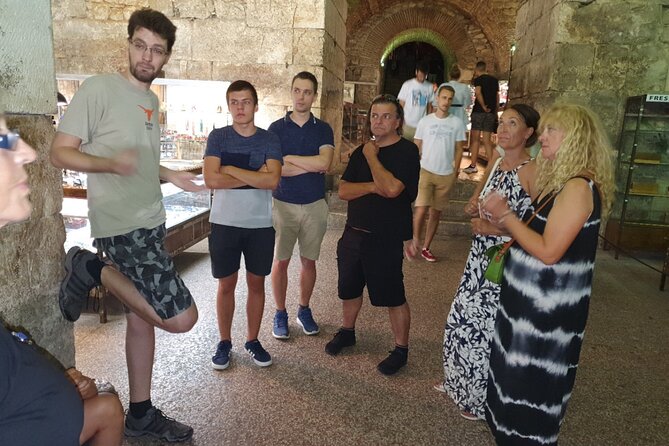
Diocletian’s Palace is one of those places where the setting does half the explaining. You look at walls and gates you can still see, then you start noticing where later buildings and religious changes took root. The trick is knowing what you’re looking at—and this tour is built for that.
Instead of doing a “see everything” checklist, the pace is timed around how long it takes to connect each location to the overall palace layout. You’re not guessing at the palace’s logic. You get the why behind the what: why spaces were placed where they were, how power was displayed, and how later communities kept using the bones of the original site.
That is also where the 3D reconstructions matter. When the guide compares what you see now with what stood there roughly 17 centuries ago, it’s like putting on a short “history lens.” The stones make more sense, and the palace stops feeling random.
You can also read our reviews of more walking tours in Split

Meeting at the Silver Gate and finishing at the Golden Gate
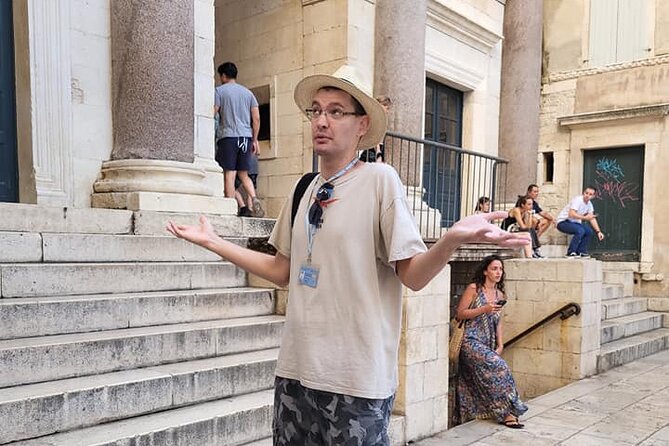
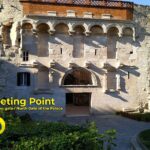
This tour is designed as a route you can follow without backtracking. You meet at the Eastern (Silver) Gate area (Poljana kraljice Jelene 5). Then you work your way through the palace’s key interior/exterior corridors and end near the northern gate by the bronze statue of Grgur Ninski (Dioklecijanova 7).
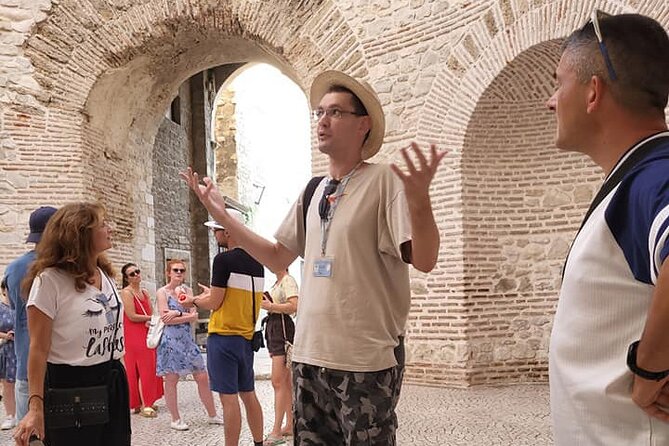
The whole experience is private, so you’re not stuck timing your questions around a crowd. It also helps if your group moves at a slightly faster or slower walking pace. One of the strongest impressions from past guests is that the guide checks whether you want more detail or less, and can adjust the flow.
Expect about 1 hour 30 minutes to 2 hours. The exact length depends on whether you choose optional interiors—and that choice is easy to make on the spot.
Stop 1: The Peristyle of Diocletian’s Palace
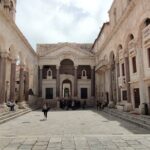
You begin at the Peristyle, and that’s a smart move. This is the palace’s central public space—where the palace’s power and planning become obvious. The guide sets the stage for Diocletian himself, and you get a grounding in how this palace came to exist.
What I like here is that the tour doesn’t start with trivia. It starts with structure: what this place was meant to be, who it served, and how its layout shaped everyday movement. After that first orientation, every later stop clicks into place more quickly.
Potential drawback: If you’re arriving already exhausted from travel or you just want quick “pretty views,” you may find yourself wanting to skip some of the setup. But the payoff is that the rest of the route reads better because you know where you are.
Stop 2: Diocletian Palace substructures (free part first)
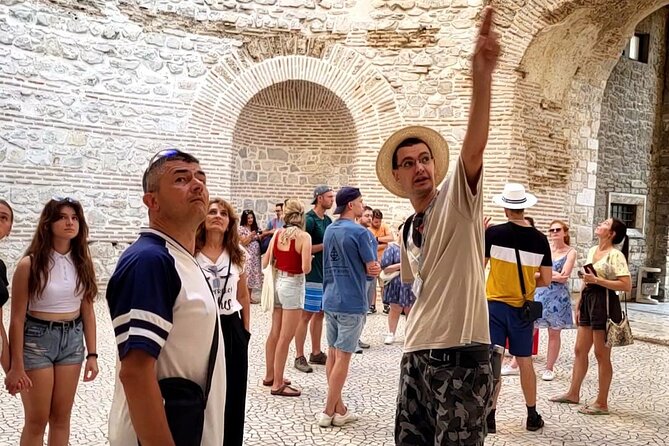
Next you head into the palace substructures for the free part. Even from the outside, the palace feels layered. Underneath, that layering becomes even more real. You’ll walk through spaces that connect to the palace’s architecture and function, and you get a feel for how Roman construction supported life above.
You’ll also hear that the museum portion is optional. If you want more, you can buy tickets and extend the visit by roughly 20 more minutes, then see the rest of the substructures.
When this stop is worth adding extra tickets: If you enjoy physical spaces—stonework, layout, and how the building was engineered—then the paid museum part can turn this from a highlight into a deeper experience. If you mainly want surface-level orientation and photos, sticking to the free section keeps the tour on the comfortable side of the time range.
Stop 3: Cathedral of Saint Domnius (and what changes when faith moves in)
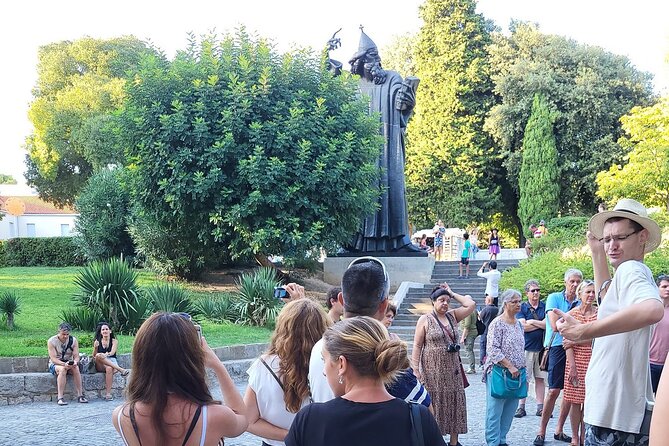
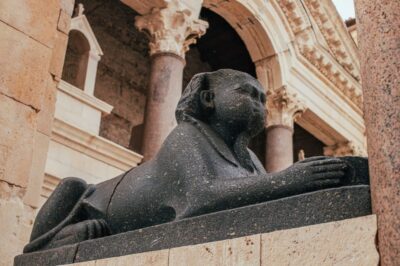
At the Cathedral of Saint Domnius, you get one of the best-preserved Roman structures tied to the palace. The key story is how a Roman setting becomes a Christian cathedral—essentially, how one era repurposed another era’s space.
This stop is where you’ll likely appreciate an experienced guide most. You’re not just looking at old stone. You’re learning how the layers were adapted and how the building’s identity shifted over time.
You can also choose to go inside if you have a ticket, adding about 10 minutes. If you’re the type who likes to see how faith, art, and architecture reshape earlier structures, it’s a good add.
Quick consideration: If you’re short on time or you prefer mostly outdoor viewing, you can keep it exterior-focused and still leave with a solid understanding.
You can also read our reviews of more private tours in Split






Stop 4: Temple of Jupiter (and the power of repurposed interiors)
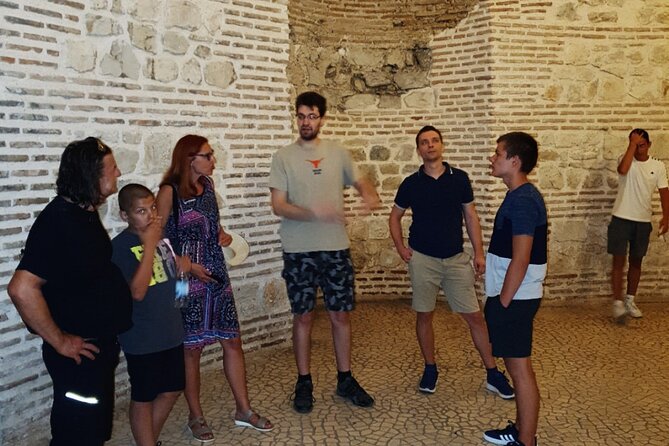
The Temple of Jupiter is another location where the preservation is part of the lesson. It’s still remarkably intact, and the guide ties it to the palace’s religious and political world—why Jupiter mattered and how the temple fit the broader complex.
Like Saint Domnius, it’s been repurposed by the church. Even if you don’t go inside, the exterior still offers plenty to understand. If you do have tickets, you can visit the small interior as well, typically adding around 10 minutes.
Who should add the interior here? If you like seeing the “small but specific” spaces where later use left marks, the interior option is usually satisfying. If your priority is maximum palace viewpoints and gate-and-corridor understanding, the exterior coverage alone may feel enough.
Stop 5: Triklinij and a partial reconstruction you can almost walk into
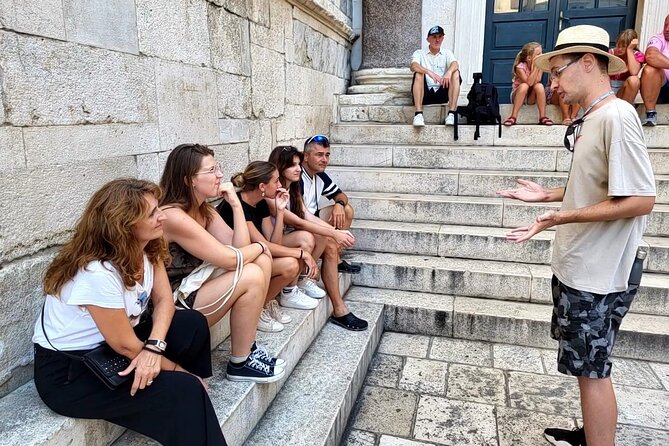
The south eastern corner of the palace is mostly destroyed, but the guide explains how a partial reconstruction brings the space back in a meaningful way. Triklinij is your chance to imagine how Diocletian might have lived, based on reconstruction accuracy and the way the palace was built.
This stop is less about perfect survival and more about interpretation—how historians and archaeologists use remaining evidence to rebuild what can reasonably be understood. The result is that you get an impression of daily life instead of only political grandeur.
Tip: Take a moment here to slow down your photos. The “why this corner matters” explanation tends to land more when you let the guide talk you through it.
Stop 6: Papalićeva ulica (north half details in alley form)
From the reconstructed living-space idea, the tour shifts into a more street-level feel on Papalićeva ulica. It’s an alleyway stop, but that doesn’t mean it’s filler. This is where details of the palace’s north half come into view, and you learn how the layout influences what feels like a normal neighborhood street today.
These small corridor moments are often what make the palace feel real instead of museum-like. You see how people move through space that used to be designed for an imperial complex.
If you hate crowds: the private format helps. Still, you’ll be in a popular historic area, so you should expect some pedestrian traffic in the general vicinity.
Stop 7: Fruit’s Square (Trg Brace Radic) and the Croatian timeline
Outside the palace, you shift to a square experience: Fruit’s Square (Trg Brace Radic). Here the guide connects the palace to an important period of Croatian history, and you see how Diocletian’s Palace is integrated into newer buildings while still being clearly itself.
This stop helps you answer a big question: how does Roman Split become the Split you walk through today? The square is where that “continuity with change” becomes visible.
If you’re trying to understand the palace as a living place rather than an ancient set, don’t rush this moment.
Stop 8: The Golden Gate and how fortifications change
Near the end, you reach the Golden Gate (the northern gate). You’ll learn about palace fortifications and how they were changed between construction and the present day.
This is a strong “wrap-your-mind-around-it” stop. After you’ve seen the inside-facing spaces, the gate gives you the defensive logic behind why the palace was built the way it was. It also helps explain how the palace interacted with the outside city over time.
Practical note: If you’re doing this tour in warmer months, this area can feel open and exposed. Bring water.
Stop 9: Grgur Ninski statue and tying Roman construction to Croatian identity
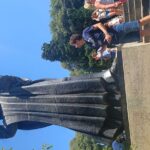
Your final stop is outside the northern gate by the bronze statue of Grgur Ninski. The guide uses this point to consolidate what you learned about Roman construction, then connects it to Croatian history so far.
It’s a good landing pad for the whole experience. You don’t leave only with Roman dates. You leave with a sense of how different eras claimed, repurposed, and interpreted the same physical place.
The value of the optional interiors (and how to decide)
This tour is mostly built around what you can access without paying extra. But the optional ticketed parts are there for a reason. They add short bursts of “see inside” context at the moments where inside access would change your understanding.
Here’s the decision logic I’d use:
- If you’re the type who wants indoor structure: consider the cathedral interior (about 10 extra minutes) and the Jupiter interior option.
- If you love engineering and archaeology layouts: consider the substructures museum portion (about 20 extra minutes).
- If you’re on a tight schedule or your group prefers quick viewing: stick with the free sections and use optional tickets only if you feel you’re craving more depth.
This is one of those tours where choosing extra time feels optional, not mandatory. That makes it better value for more kinds of travelers.
Price and group size: what $107.84 really buys
The price is $107.84 per group up to 15 people. That’s the big reason to consider this tour even if you’re traveling as a couple or solo: you’re not paying per head.
If you fill the group (15 people), the math makes it around $7 per person. If you’re only two people, it’s more like $54 each. Either way, you’re paying for a guide and a private route, not a mass-group experience.
So the value depends on your group size:
- Best value: families and small groups who can share the cost.
- Still reasonable: couples who want a focused, low-stress explanation of a complex site.
- Worth comparing: if you only want a quick walk past the highlights and you’re comfortable reading on your own.
Weather, pacing, and the small stuff that matters
This tour requires good weather. If conditions are poor, you’ll be offered a different date or a full refund. That matters because you’ll be outside for most of the walk.
One more practical advantage from past experiences: guides can be flexible if weather turns suddenly. That means you’re not simply stuck in the rain with no plan. Still, pack for damp or sun, depending on the season.
As for pacing, the tour is structured but not rigid. A good guide will steer the conversation based on what your group wants—especially if teens or mixed interests are in the group.
Who this tour fits best
This is a great match if you want:
- a clear, guided understanding of Diocletian’s Palace layout without getting lost
- architecture and layered repurposing stories (Roman to Christian, imperial to neighborhood)
- an English guide who can explain with humor and keep it moving
- a private experience that fits your group’s energy level
It’s also a good pick if you’re a Game of Thrones fan and want context tied to the setting—just know it’s history first, pop-culture context second.
Should you book this Chill Private Walking Tour of Diocletian’s Palace?
Book it if you want the palace to make sense in a short window. The route hits the crucial structures, and the guide’s use of 3D reconstructions helps you understand how the past connects to what you’re seeing now.
Skip or rethink if you only care about a quick visual tour, or if your schedule is so tight that you can’t handle optional ticketed stops and a possible slightly longer finish. Also consider your weather tolerance since it’s mostly outdoors.
If you’re trying to choose between self-guided wandering and a guided “get it all to click” walk, this private format is the smarter move for most people—especially those who want real explanations, not just signage.
FAQ
How long is the walking tour?
It runs about 1 hour 30 minutes to 2 hours, depending on whether you choose optional interior ticket stops.
Where does the tour start and end?
You start at the Eastern (Silver) Gate area (Poljana kraljice Jelene 5, Split). The tour ends outside the northern gate by the bronze statue of Grgur Ninski (Dioklecijanova 7, Split).
Is this a private tour?
Yes. It’s private, so only your group participates.
What’s included in the tour fee?
The tour includes the guide and the walking route through the main palace areas. Some interiors (like parts of the substructures, the cathedral, and the Temple of Jupiter interior) are optional and may require separate tickets.
What language is the tour offered in?
The tour is offered in English.
What happens if the weather is bad or I need to cancel?
The experience requires good weather. If it’s canceled due to poor weather, you’ll be offered another date or a full refund. You also get free cancellation up to 24 hours in advance for a full refund.