Split can feel like a maze at first. This guided walk turns the old streets into a clear Roman timeline, with just enough time at each site to actually notice details. With an English-speaking local guide (Nikol), plus admission tickets included for the main sights, you get more than a quick look-you-see.
I especially loved how the walk starts in Diocletian’s Palace and then clicks forward to the cathedral, so the stones feel connected instead of random stops. The second thing I liked: you get the kind of explanation that makes the Peristyle courtyard and Saint Domnius treasury make sense on the spot, not later back in your hotel room.
One possible drawback: it’s a focused 90-minute route with some steps along the way. If you dislike stairs or uneven old-town surfaces, you’ll want to plan for that.
In This Review
- Key things to know before you go
- Start Point And Timing: 90 Minutes That Actually Feels Manageable
- Diocletian’s Palace Peristyle: The Courtyard That Still Runs The City
- Cathedral of Saint Domnius: A Mausoleum, a Bell Tower, and a Treasury
- Temple of Jupiter: When Roman Gods Still Cast A Shadow
- The Guide Factor: Nikol Turns Facts Into a Route You Can Remember
- Pace, Steps, And What To Wear In Old Town Split
- Price And Value: What $41.70 Gets You (And Why It Adds Up)
- Who Should Book This Tour, And Who Might Want Another Option
- Should You Book This Split Walking Tour?
- FAQ
- How long is the Discover Split’s Hidden History guided walking tour?
- What is the price per person?
- What language is the tour offered in?
- Is a mobile ticket included?
- Where does the tour start and end?
- How big is the group?
- Are admission tickets included?
- What’s included in the tour besides the sites?
- What if the weather is poor?
Key things to know before you go
- Peristyle first: start inside Diocletian’s Palace at its most important courtyard area
- Saint Domnius inside-and-out: you’ll see the bell-tower emblem and learn what the church holds, including its treasury
- Temple of Jupiter: a 3rd-century Roman temple still standing as part of the palace complex
- Small group size: up to 15 people, so questions don’t disappear
- Admissions included: ticketed access is built into the stops, not tacked on later
Start Point And Timing: 90 Minutes That Actually Feels Manageable
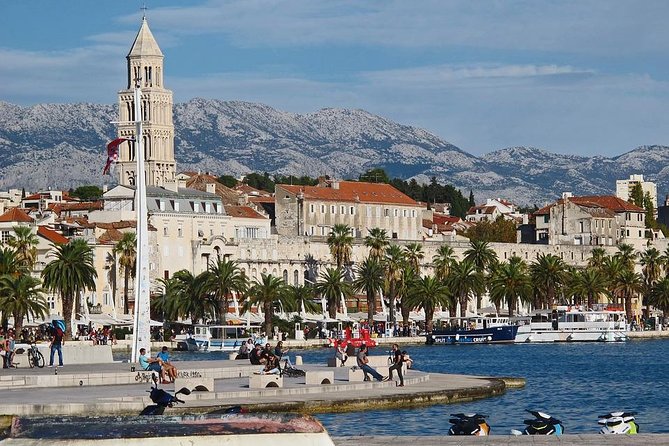
This is a short walk. About 1 hour 30 minutes on foot, with a clear structure and a simple goal: help you “read” Split’s Old Town fast. The tour starts at 9:00 am at Obala Lazareta 3, 21000, Split, and it ends back at the same place, so you don’t have to figure out a late-day transit puzzle.
Because the route is tight, you’ll want comfortable shoes and a bit of patience with narrow streets. Split’s old core can be physically crowded even on a calm morning, but the small group size (maximum 15 travelers) keeps things from turning into a shuffle-line. It’s not a slow museum crawl either. It’s a walk where you stop often enough to understand what you’re seeing, then move on before you lose momentum.
If you’re juggling a day full of choices—cathedral, waterfront, maybe a ferry later—this one fits well. You don’t need a half-day just to get your bearings.
You can also read our reviews of more walking tours in Split

Diocletian’s Palace Peristyle: The Courtyard That Still Runs The City
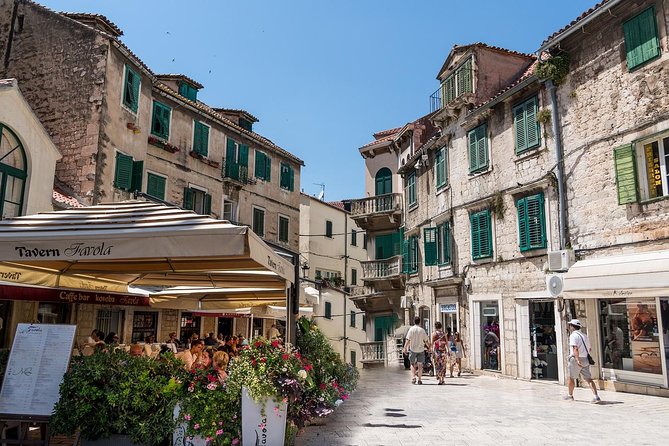
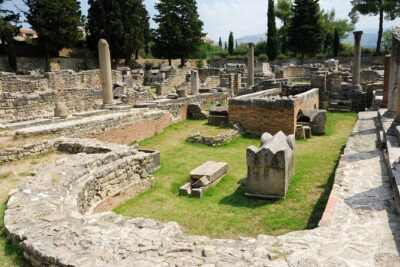
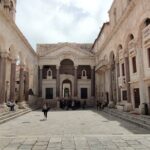
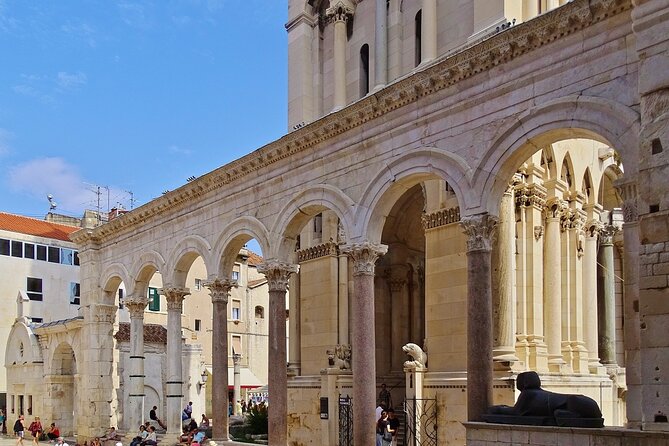
The tour begins at the Peristyle of Diocletian’s Palace, often described as the beating heart of Split. That’s not just marketing language. This is the kind of space where you can feel the original purpose: a fortified Roman palace built around movement, ceremony, and control.
Here’s what makes this stop special. The Peristyle was originally the courtyard of Diocletian’s fortress—built by one of the last Roman emperors—and it still holds the atmosphere of a Roman compound. You’re not just looking at old columns; you’re seeing the framework that once organized life inside the walls. When you understand that, Split’s modern layout feels less random. It’s like the city has been re-used so many times the story kept evolving, layer after layer.
This courtyard stop also sets the tone for the rest of the tour. You’ll learn to spot how “Roman palace” and “Christian city” aren’t separate worlds here. They overlap. That matters because Split’s best feature is the contrast—pagan and Christian eras written into the same physical space.
Practical note: this is the first stop, so go in with a curious mindset. Ask your guide what changed as the palace became part of a lived-in city. You’ll get more from the columns once you know what they once meant.
Cathedral of Saint Domnius: A Mausoleum, a Bell Tower, and a Treasury
Next comes the Cathedral of Saint Domnius, which is arguably the most popular attraction in Split. It’s popular for a reason, but the real value of this stop is what you learn while you’re looking.
Saint Domnius is built as a mausoleum for Diocletian—connected to the story of the last famous Roman emperor linked with the persecution of Christians. That sounds heavy, but your guide helps turn it into something you can picture. The important part for you is the transformation: a Roman political-religious structure becomes a Christian cathedral presence, still standing in the same general area.
Then there’s the bell tower. It’s described as the cathedral’s emblem, and you’ll see how closely Split’s identity is tied to this vertical landmark. Even if you’ve only glanced at Split from a distance, this tower is one of those features that makes the city recognizable on sight.
The most “wow” element here is the treasury. The cathedral houses a collection rich in reliquaries, icons, church robes, illuminated manuscripts, and documents in Glagolitic script. That last detail is the key for me: it’s proof this place isn’t only about Roman stonework. It connects to Slavic writing traditions too, which gives you a bigger sense of the region’s cultural crossroads.
What I’d watch for: you’ll likely spend time both outside and in areas connected to the cathedral experience. If you like documents and artifacts, this is the stop where you’ll feel the tour is doing more than pointing at famous buildings.
Possible consideration: the stop is timed and ticketed, so don’t expect this to be a long sit-down visit. The payoff comes from the guide’s context as you move through.
Temple of Jupiter: When Roman Gods Still Cast A Shadow
The last major stop is the Temple of Jupiter. This is one of those sights that can surprise people because it feels so “complete,” even after centuries of changing control and religion.
The temple was constructed in the 3rd century as part of Diocletian’s Palace. It’s dedicated to the ancient Roman king of gods, Jupiter. Your guide explains a crucial cultural detail: Diocletian believed he was the reincarnation of Jupiter. That belief helps make the temple feel personal, not just ceremonial.
Another big idea you’ll hear is how Jupiter worship shifted as the Roman Empire transitioned to Christian rule. It’s the same theme you saw at Saint Domnius: the physical structures remain, while beliefs around them change. The temple sits there as evidence of what once mattered most to the people running this complex.
Why this stop is worth your time even if you’ve seen Roman temples elsewhere: the location. It’s not a standalone ruin far from everything. It’s part of the palace system, meaning it fits into the story you started with at the Peristyle. By the time you reach Jupiter’s Temple, you’re reading the palace like a single design, not three separate attractions.
This is the shortest segment (about 15 minutes), so come ready to absorb what you can quickly. Take in proportions and materials, and listen closely to the story you’re given. This is where a good guide really helps.
The Guide Factor: Nikol Turns Facts Into a Route You Can Remember
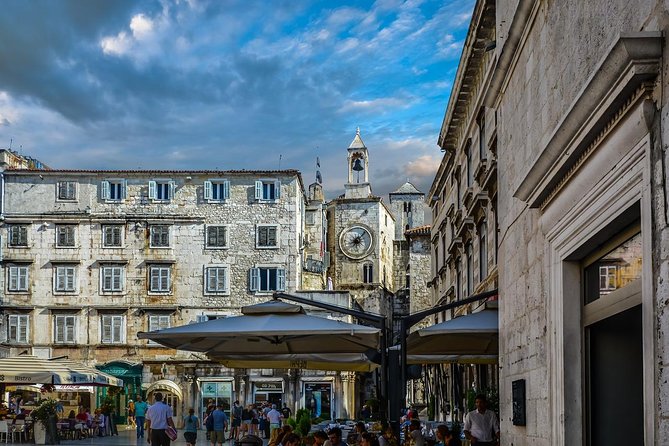
You’re not just paying for access. You’re paying for orientation and interpretation. Nikol’s style, based on the experience you’ll likely get on the day, is clear and responsive—she answers questions and keeps a pace that doesn’t feel rushed.
I like guided walking tours most when the guide gives you “hooks” you can carry later. Here, those hooks are built into the structure of the walk:
- start at the palace courtyard
- move to the cathedral’s Roman-Christian transformation
- end at a Roman temple tied directly to Diocletian’s beliefs
So when you’re later taking photos or crossing plazas on your own, the buildings aren’t just pretty. They’re meaningful. You’re more likely to notice colonnades, changes in use, and why certain sites became symbols for the city.
If you’re the type who forgets names easily (I am), you’ll still benefit. The tour’s logic is strong enough that even if a detail slips, you can connect the overall timeline.
You can also read our reviews of more guided tours in Split





Pace, Steps, And What To Wear In Old Town Split
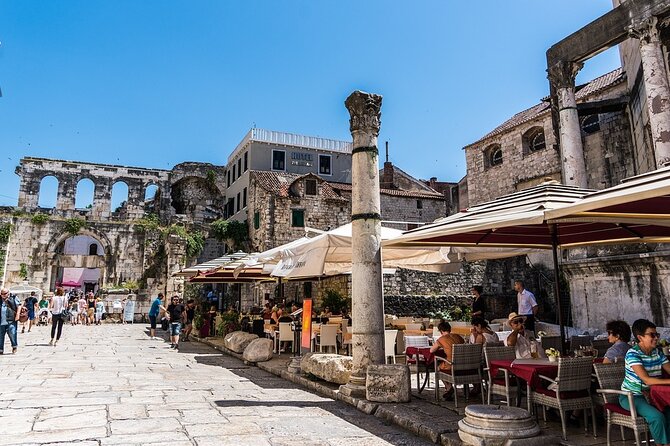
This walk is short, but it’s still real walking in stone-and-cobble territory. You may encounter some stairs, though it’s described as not extreme. Plan for that reality. Wear shoes you trust. Skip anything that pinches your toes.
Also, because the tour depends on good weather, bring a light layer. Split mornings can change fast, and you don’t want to cut a great experience short just because you’re cold or uncomfortable.
The group size helps here too. With up to 15 travelers, you won’t feel lost in a crowd. Still, you should be ready to follow the guide’s pace. This isn’t a “wander and chat” style tour. It’s structured, and that structure is what makes it efficient.
Price And Value: What $41.70 Gets You (And Why It Adds Up)
At $41.70 per person, this tour can be a strong value because it bundles three things that DIY usually separates:
1) a certified English-speaking local guide
2) guided time at multiple major historic sites
3) admission tickets included for the key stops
You’re also buying the advantage of not having to figure out how long to spend at each place. For most people, that’s the hard part. They either rush and miss context, or they spend too long and end up tired. This tour is built to be the right length: about 90 minutes that keeps you energized.
A quick reality check: the tour doesn’t include coffee or tea. It also notes that optional entrance fees may be extra. So if you’re the kind of traveler who loves adding extra layers on the spot, set aside a bit of spending freedom. But for the core sights, the tour covers the main entry pieces.
In short: if you want a guided orientation to Split’s historic center without losing half your day (or burning your legs on too many solo ticket lines), this is the sort of price that makes sense.
Who Should Book This Tour, And Who Might Want Another Option
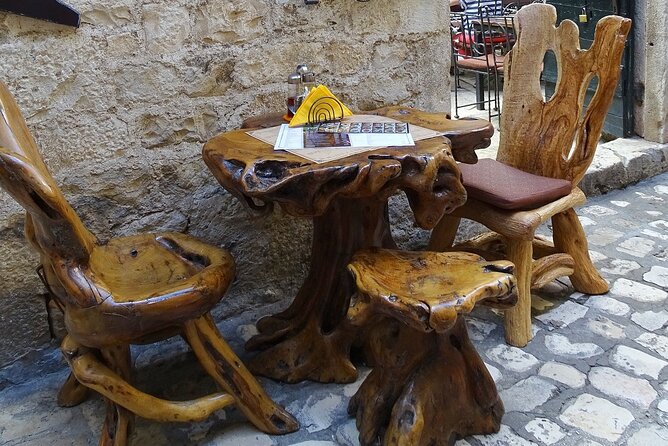
This is ideal if:
- you want a fast orientation to Split’s Old Town and its Roman-to-Christian evolution
- you prefer guided context over reading signboards
- you’re okay with a short route and a bit of stairs
- you like small-group dynamics where questions actually get answered
It’s also a great choice for first-time visitors. You’ll leave with a “map in your head” that makes the city feel easier to navigate afterward.
You might look for a different experience if:
- you want a long, slow visit with lots of free time inside each site
- you dislike structured group timing
- you need fully step-free access (some stairs are part of the route)
For most people, though, this hits the sweet spot: focused, informative, and not exhausting.
Should You Book This Split Walking Tour?
If your goal is to understand Split quickly—how Diocletian’s Palace became the city’s beating heart, how Saint Domnius symbolizes Split, and how Roman Jupiter still echoes through the streets—then yes, I’d book it. The price feels fair because the guide and admissions are built in, and the route is short enough to fit into a busy travel day.
If you’re comfortable with a bit of walking and a few stairs, you’ll probably love how the stops connect. And if you’re hoping for something that turns stone monuments into a story you can remember, this tour is exactly that kind of day.
FAQ
How long is the Discover Split’s Hidden History guided walking tour?
The tour runs for about 1 hour 30 minutes.
What is the price per person?
The price is $41.70 per person.
What language is the tour offered in?
The tour is offered in English.
Is a mobile ticket included?
Yes, you get a mobile ticket.
Where does the tour start and end?
It starts at Obala Lazareta 3, 21000, Split, Croatia, and ends back at the same meeting point.
How big is the group?
The maximum group size is 15 travelers.
Are admission tickets included?
Admission tickets are included for the main stops on the route (Peristyle of Diocletian’s Palace, Cathedral of Saint Domnius, and Temple of Jupiter). Optional entrance fees are not included.
What’s included in the tour besides the sites?
You’ll have a certified English-speaking local guide and a guided tour of Split Old Town.
What if the weather is poor?
The experience requires good weather. If it’s canceled due to poor weather, you’ll be offered a different date or a full refund.