REVIEW · SPLIT
Private History tour – small group
Book on Viator →Operated by Ivan Fistanić · Bookable on Viator
Split’s palace walls teach you to look differently.
What makes this tour click is the way Diocletian’s Palace becomes a story you can follow on foot, not a pile of stones. I like the tight focus on the best-preserved and most important Roman-to-Christian transitions, and I especially like that your guide Ivan Fistanić has a Master’s Degree in History—you can ask questions and get clear, grounded answers. One possible drawback: you won’t go inside every monument, and for St. Domnius and the Temple of Jupiter, the tour specifically notes that admission is not included.
You also get a smart pace for a short stay in Split. This is a private experience for up to 10 people, lasts about 1.5 to 2 hours, and uses a mobile ticket, so you’re not wasting time hunting paperwork. The route is mostly walking, so wear shoes you trust on old stone.
You’ll start at a central meeting spot on Ul. kralja Tomislava 15 and finish right back there, which is handy after a day of beaches or ferry hops. Costs are per group (up to 10), and most stops are free while a couple are not, so the value depends a bit on how many people you have with you.
In This Review
- Quick take: what stands out in this Split private history walk
- Why this short tour works for first-time Split visits
- Golden Gate: the Roman entrance that sets the direction
- Peristyle and the Palace heart: colonnades, imperial space, and religion shifts
- Cathedral of Saint Domnius: what to notice without going inside
- Temple of Jupiter: the late Roman temple that became Christian space
- Vestibulum and Triclinium: the private-chamber zone you can feel
- Riva Harbor: the promenade that still runs the city
- Fruit’s Square (Trg Brace Radic): a picturesque pause with Venetian traces
- Pjaca: the medieval town square you can understand in minutes
- Gregory of Nin statue: a landmark with a story and a superstition
- Price and value: when $238.28 per group makes sense
- Who this tour suits best
- Should you book this Private History tour in Split?
- FAQ
- How long is the Private History tour in Split?
- What’s the group size for this private tour?
- Where do we meet, and where does the tour end?
- Do I need to buy tickets for all the stops?
- Is the tour ticket mobile?
- Will we enter the Cathedral of Saint Domnius?
- What happens if the weather is bad?
Quick take: what stands out in this Split private history walk
- A history-focused guide (Ivan Fistanić): Master’s-level context without the lecture vibe.
- Cellars to Peristyle: you connect Palace functions to what you see above.
- No inside cathedral pressure: St. Domnius is explained from the right vantage points.
- Late Roman to Christian reuse: Temple of Jupiter becomes a baptistery story you can actually visualize.
- Local-life stops: Riva Harbor plus city squares, not just palace walls.
- A fun folklore detail: the Gregory of Nin statue toe-rub for good luck.
Why this short tour works for first-time Split visits
Split can feel like two cities at once: the modern promenade and everyday life, and then the Roman engine under everything. This tour helps you connect the dots fast, using the Palace as your main timeline and then stepping out into the medieval and later layers around it.
I like that it’s not trying to cover everything. Instead, it picks the parts that explain why Split looks the way it does, and why locals still treat these spaces like common ground.
You can also read our reviews of more private tours in Split
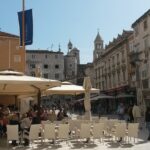


Golden Gate: the Roman entrance that sets the direction
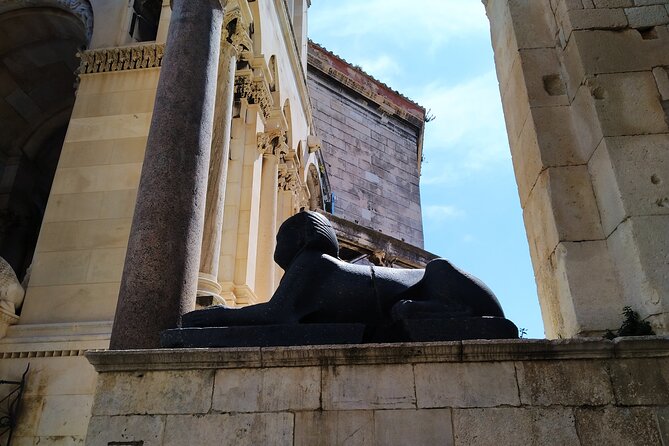
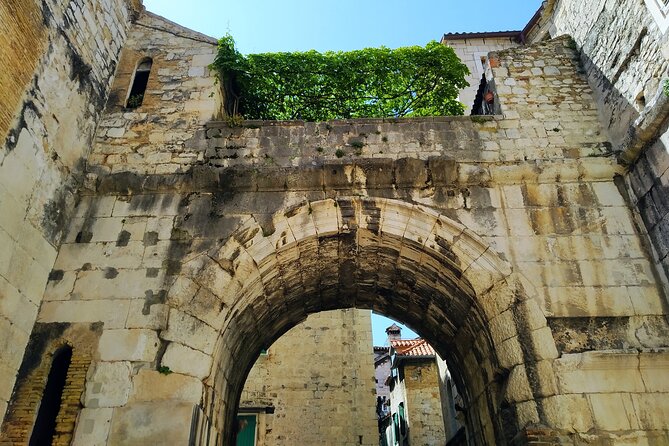
You begin at the Golden Gate, the main entrance to the Palace and one of the four key Roman gates in Diocletian’s complex. The guide’s framing matters here: it’s not just a pretty archway. It’s a road marker pointing north toward Salona, the capital of the Roman province of Dalmatia and Diocletian’s birthplace.
This stop also gives you a useful geography trick. You’ll look out toward the area where the Gregory of Nin monument is known in Split, so the tour links architecture to real city landmarks instead of treating them as separate attractions.
Peristyle and the Palace heart: colonnades, imperial space, and religion shifts
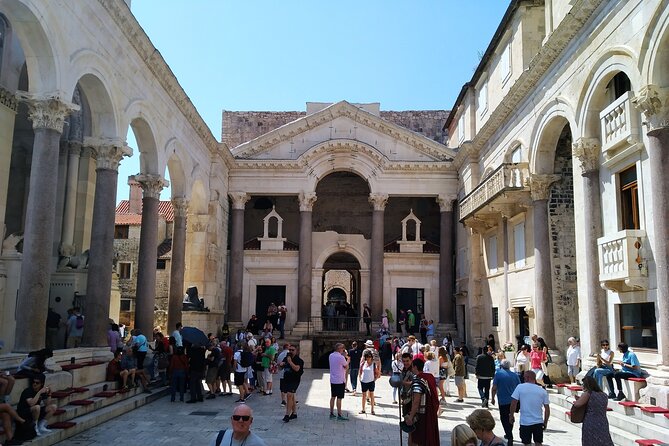
Next you move into the central core of Diocletian’s Palace. From the Riva side, you enter the cellars and hear how the Palace spaces were used over time. That small detour underground makes what comes next easier to understand: you’re not just viewing stone—you’re getting the function first, then the visual payoff.
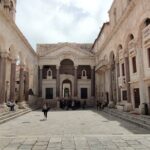
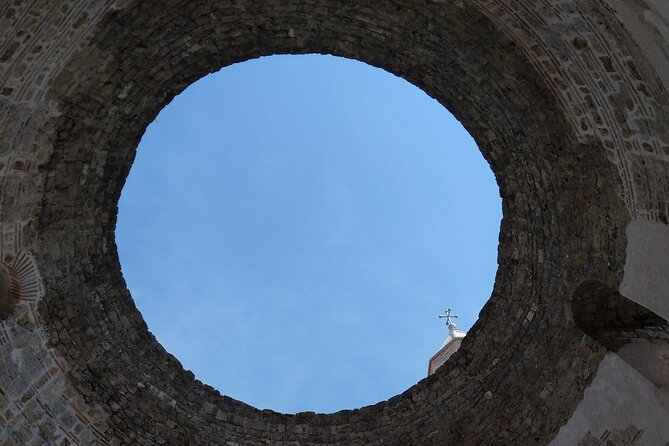
Then you step out into the Peristyle, the open imperial square framed by monumental arcades and oriented toward the imperial loggia. This is one of those places where your brain starts to read the building as a stage: power, ceremony, and later changes all leave clues in the layout.
One of the more interesting points you’ll hear is how the expansion of Christianity affected transitions in the buildings and how people used the area. Even if you’re not a history buff, the guide keeps it tied to what you can see.
Cathedral of Saint Domnius: what to notice without going inside
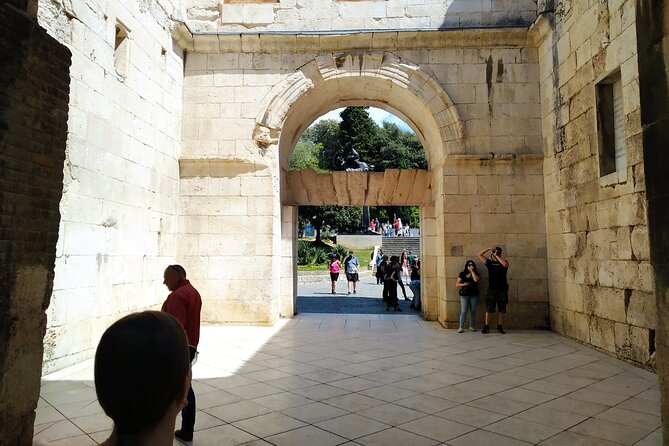
At the Peristyle, the Cathedral of St. Domnius is hard to miss. The tour keeps you outside—there’s no interior entry—but you still get the essentials: what parts are significant and the story behind them.
Why I think this is a smart choice for a short tour: you still get the “Roman survivor” feeling, but you don’t lose time waiting, paying, or trying to rush through an interior when you’re already seeing the Palace’s big picture. The Cathedral is described as one of the best-preserved Roman structures in Split and still in use today, so you’re looking at living heritage, not just ruins.
Temple of Jupiter: the late Roman temple that became Christian space
The Temple of Jupiter is a standout because it’s described as one of the best-preserved late Roman temples in the world. It also has a clear symbolism: its placement was meant to show a divine link between Emperor Diocletian and Jupiter.
The guide points out the Roman connection to Jupiter as the god of the sky and thunder and as king of the gods. That matters, because it explains why the site looks the way it does. Then you get the later transformation: during the Middle Ages, the temple was converted into a baptistery dedicated to St. John the Baptist.
You’ll learn how the same structure can carry different meanings across centuries—and you’ll see why Split’s “layers” are more than a tourist phrase.
You can also read our reviews of more historical tours in Split

Vestibulum and Triclinium: the private-chamber zone you can feel
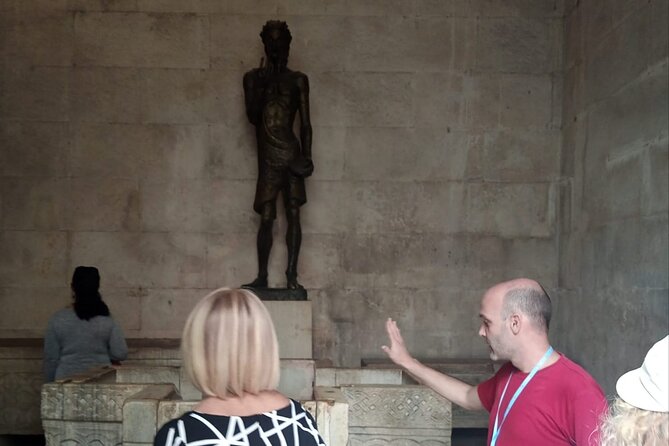
From the Temple area, you head to the Vestibulum, the pre-entrance of Diocletian’s private chambers. This is one of those stops that’s easy to skip if you’re wandering alone, because it doesn’t always look like a headline sight.
But the tour explains what it looked like and what its function was. Then you check up the Triclinium, the space tied to dining and social life in the Palace. This is where you start to grasp that emperors weren’t living in one giant monument—they lived in a working home with controlled access and designed transitions between public and private areas.
If you like architecture that has a job (not just a view), this part delivers.
Riva Harbor: the promenade that still runs the city
After Palace zones, the tour shifts gears to the real public heartbeat of Split: Riva Harbor. This is the meeting point of locals and visitors and the main promenade—exactly the kind of place you’ll want to know well once your tour is over.
The guide talks about how Riva was built over centuries and why it became central for everyday city life. You also get a strong visual moment: from here, you see the southern wall of Diocletian’s Palace in a way that connects the promenade to the monumental architecture behind it.
Practical tip: if you’re taking photos, this is a good spot to pause and check your angles before you move deeper into streets and squares.
Fruit’s Square (Trg Brace Radic): a picturesque pause with Venetian traces
Next comes a quieter, photogenic breather outside the Palace: Fruit’s Square (Trg Brace Radic). Here, you’ll hear about the important monument in the middle of the square and what surrounds it.
It’s also dominated by remains of a 15th-century Venetian fort. That detail helps explain why this area doesn’t feel purely Roman. Split keeps layering its political and cultural influences, and the square shows it without needing a museum ticket.
Even if you only take a short walk through, this stop helps you feel the neighborhood scale of history—small spaces where everyday life keeps happening.
Pjaca: the medieval town square you can understand in minutes
Then you reach Pjaca, situated in front of the old Town Hall outside the western wall of the Palace. The guide frames it as the main square of Split since medieval times, which makes sense once you stand there and notice how it pulls people in.
You’ll see the 14th-century Town Hall and other interesting structures around it. This stop works well right after Fruit’s Square because it broadens your view from smaller palace-adjacent spaces into the civic center.
If you want a simple mental map of Split—Palace walls, then civic squares—that’s what Pjaca locks in.
Gregory of Nin statue: a landmark with a story and a superstition
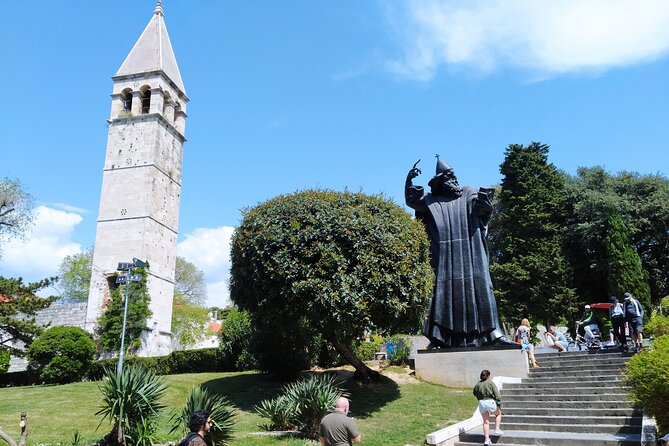
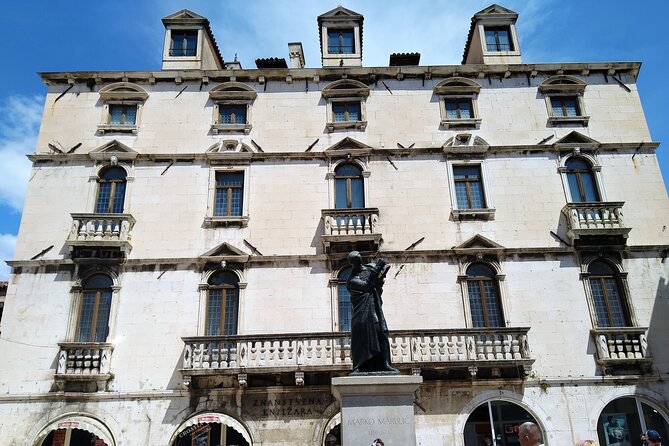
Every Split walk seems to include Gregory of Nin, and this one gives you the why. The Grgur Ninski Statue is a dominant landmark, and you’ll hear interesting facts about Gregory of Nin—along with the story of the highest monument in Split dedicated to him.
The guide also explains who sculpted it: Ivan Mestrovic. Then comes the famous little ritual: rub its toe for good luck.
That toe-rub detail may sound like silly fun, but it’s also a good example of how history becomes shared by normal people—not locked behind rope barriers.
Price and value: when $238.28 per group makes sense
The tour is priced at $238.28 per group up to 10. That’s not cheap on paper, but for a private, history-focused walking tour of this specific area, it can be strong value—especially if you’re traveling with friends or family and splitting the group cost.
Most stops have free admission, and the ones that don’t (St. Domnius and the Temple of Jupiter) are clearly identified upfront in the tour’s structure. For you, that means fewer surprises and better planning time. In a city where tickets and entry fees can add up fast, clarity helps.
If you’re traveling solo, it may feel less like a bargain and more like paying for a private guide’s time. If you’re in a small group, it starts to look more like a smart local experience.
Who this tour suits best
This tour is a good match if you:
- want a focused introduction to Split without sprinting across the city,
- enjoy architecture and want the meaning behind it (Roman functions, later conversions, and civic life),
- prefer a guide who can answer questions clearly in real time.
It’s less ideal if you:
- only want big-ticket interior entries and long museum time,
- hate walking on stone for an hour or two.
Should you book this Private History tour in Split?
If your goal is to understand Split quickly—how the Roman Palace turned into a living city—you’ll likely be happy booking. The combination of Palace spaces (Golden Gate, Peristyle, Vestibulum/Triclinium) and public-life anchors (Riva, Fruit’s Square, Pjaca) keeps the story grounded in real street life.
One more practical thought: the experience is noted as requiring good weather. If forecasts look sketchy, plan to be flexible, because outdoor walking is the whole point.
If you want a short, well-structured history walk with a real expert and a group size that stays personal, this one makes a lot of sense.
FAQ
How long is the Private History tour in Split?
It lasts about 1 hour 30 minutes to 2 hours.
What’s the group size for this private tour?
It’s a private tour for your group, with a maximum of up to 10 people.
Where do we meet, and where does the tour end?
You meet at Ul. kralja Tomislava 15, 21000, Split, and the tour ends back at the same meeting point.
Do I need to buy tickets for all the stops?
Most stops list admission as free, but the Cathedral of Saint Domnius and the Temple of Jupiter note that admission is not included.
Is the tour ticket mobile?
Yes, it includes a mobile ticket.
Will we enter the Cathedral of Saint Domnius?
No. The tour says you will not be entering the cathedral, but you will be shown significant parts and hear the key facts.
What happens if the weather is bad?
The tour requires good weather. If it’s canceled due to poor weather, you’ll be offered a different date or a full refund.