REVIEW · SPLIT
History Split Walking Tour in French -Small group
Book on Viator →Operated by Ancient Tours · Bookable on Viator
Diocletian’s Palace turns Split into a living history book. This French small-group walk helps you read the big shapes and small details of the palace, and it also zooms out to the wider city so you can connect the dots fast. What I like most is the way the guide makes the palace feel understandable, plus the stop-by-stop pace that keeps you moving without feeling rushed.
The only real catch is physical: it’s a walking route inside a stone complex, so it’s not recommended if you struggle with high steps. If you’re steady on your feet, you’ll get a lot out of seeing the palace’s “why” behind the scenes—power, politics, and everyday life—without needing to be a Roman history nerd.
In This Review
- Key things you’ll notice on this French Palace Walk
- Why Diocletian’s Palace Makes Split Make Sense
- Where You Start in Split’s Old Core (And Why It Matters)
- The Peristyle: The Palace’s Main Square, Explained
- Vestibulum and the Small Details That Make It Human
- The Substructures: How the Palace Functioned Over Time
- The Golden Gate and Gregory of Nin’s Role in Language
- Riva Harbor: The Palace’s Shadow Falls on the Waterfront
- Fruit’s Square (Trg Brace Radic) and Marko Marulić
- Passing the Split Synagogue: A Quick Look at Jewish History
- Guides in French: What the Best Ones Do With This Tour
- Price and Value: Is $69.14 Worth It?
- What to Bring and How to Prep for a Stone-Palace Walk
- Who This Tour Is Best For
- Should You Book This French Split Walking Tour?
- FAQ
- How long is the History Split Walking Tour in French?
- What’s the group size limit?
- Where does the tour start?
- Is there a mobile ticket?
- Are entry tickets included for all stops?
- What language is the tour?
- Is the tour suitable if I have trouble with steps?
- What is the cancellation policy?
- Is the tour accessible to service animals and near public transportation?
Key things you’ll notice on this French Palace Walk

- A guide-led story that links Diocletian’s rise to the palace you’re standing in front of
- Seven focused stops from the Peristyle to Riva Harbor, with clear time blocks
- Real city connections like Gregory of Nin and Marko Marulić
- Small-group feel with a cap of 30 people
- Mobile ticketing and admission details built into the tour stops
- A quick Jewish heritage pass-by at the Split Synagogue area (ticket not included)
Why Diocletian’s Palace Makes Split Make Sense
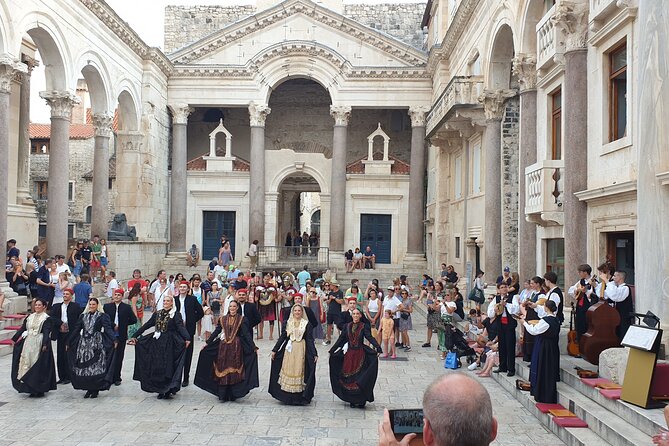
Split can feel like a place you walk through on autopilot—pretty stones, busy streets, seawind. This tour nudges you off autopilot. It helps you see that Diocletian’s Palace isn’t just a landmark; it’s the engine of the city’s layout, and it still shapes where streets, squares, and viewpoints end up.
I like that the tour frames Diocletian as a person with a journey: how someone goes from an outsider to the most powerful man in the world. That human thread makes the architecture easier to understand. You stop seeing random walls and corridors, and you start recognizing the logic behind them.
And because it’s in French, it’s a good fit if you’re comfortable following history in another language. You get the same structure and highlights, just delivered smoothly through stories and guided explanation.
You can also read our reviews of more walking tours in Split


Where You Start in Split’s Old Core (And Why It Matters)
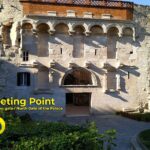
You meet at the Peristil ulica area in Split, which is a smart starting point because it places you right in the palace’s central zone. From there, you’re not bouncing across the city for random photos; you’re learning how the palace works as a system.
The format is built for attention. With a maximum of 30 travelers, it’s big enough that the tour won’t feel empty, but small enough that the guide can actually manage the group. Duration is listed around 1 hour 30 minutes, but some groups run closer to about 2 hours, so it’s reasonable to plan for a slightly longer old-town stroll.
You’ll also want to be ready with your ticket on your phone. The tour uses a mobile ticket, which makes entry/participation smoother than dealing with paper in a crowd.
The Peristyle: The Palace’s Main Square, Explained
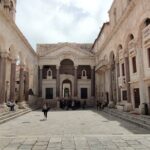
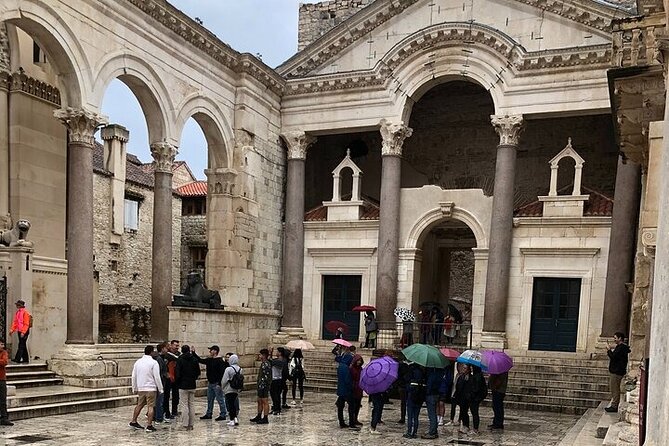
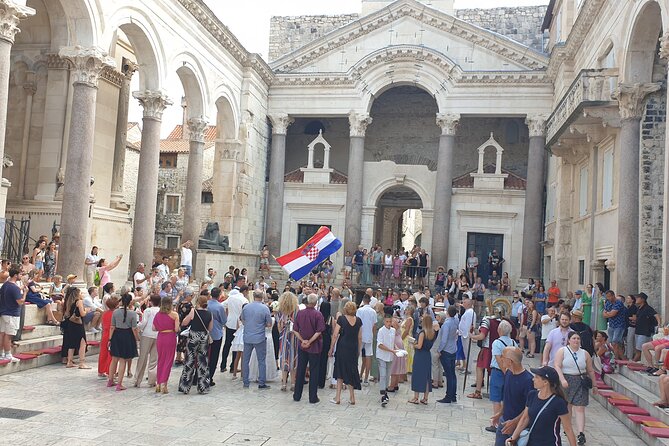
Your first stop is the Peristyle of Diocletian’s Palace, the central square that connects to many other areas inside the complex. This is one of the most important places to understand because it’s where you learn the palace’s “center of gravity.” Once you grasp the Peristyle, the rest of the walk starts clicking into place.
Practically, this is also a good moment to reset your bearings. You’re outside the most maze-like sections, but you’re close enough to feel how the palace is organized. The guide’s explanation here is usually the foundation for everything that comes next.
Admission for this stop is free (as part of the tour arrangement), so you’re not burning time juggling additional payments right away.
Vestibulum and the Small Details That Make It Human
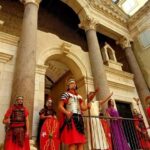
Next you’ll see the Vestibulum of Diocletian’s Palace. This is the kind of stop that could feel minor if you’re only hunting for giant monuments. But it works because the guide turns it into a story moment—history, purpose, and atmosphere.
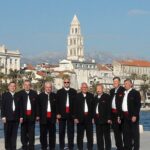
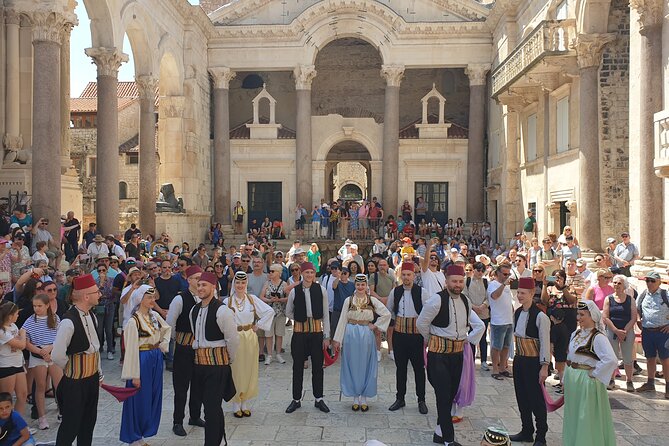
One of the more memorable possibilities here is that you might hear traditional Dalmatian singing. Even if it’s not constant every time, the point is that the tour tries to bring the region’s culture into the architecture, not just lecture at it.
This segment is short (about 5 minutes), which helps the tour avoid a common problem: spending so long on one spot that you lose your momentum.
The Substructures: How the Palace Functioned Over Time
Then you go into the substructures of Diocletian’s Palace. This is where the tour gets more practical and less postcard-like. The guide explains the construction choices and what these areas were for, and you’ll start understanding the palace as infrastructure, not just scenery.
A key detail: you won’t visit the museum part of the substructures during the tour. If you want to go deeper afterward, you can usually visit the museum area on your own, which can be a nice way to control how much time you want to spend indoors.
This stop is about 10 minutes, so it’s not meant to replace a museum visit. Instead, it gives you the “what you’re seeing” knowledge so your later self-guided visit is way more meaningful.
You can also read our reviews of more historical tours in Split




The Golden Gate and Gregory of Nin’s Role in Language
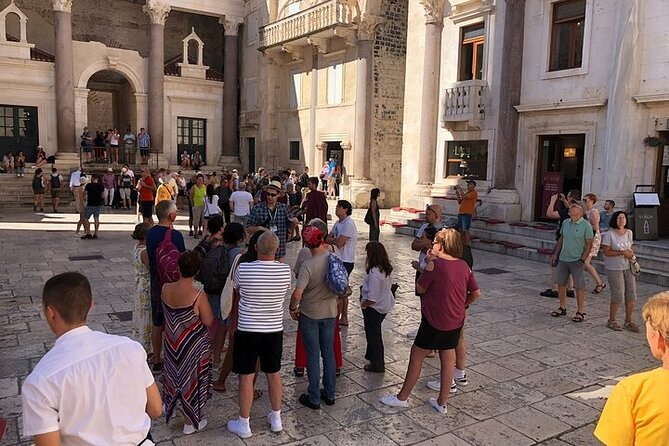
At the Golden Gate, the tour switches from “how it was built” to “what it meant.” The Golden Gate is the main entrance of the palace, and the guide uses it to explain the place’s importance.
You’ll also see the statue of Gregory of Nin. This is one of those moments where a statue becomes more than a photo target. The guide ties Gregory of Nin to history and language—exactly the kind of connection that helps you understand why certain cultural figures still matter in everyday life.
This stop also lasts about 10 minutes, which keeps you moving while giving enough time for the explanation to land.
Riva Harbor: The Palace’s Shadow Falls on the Waterfront
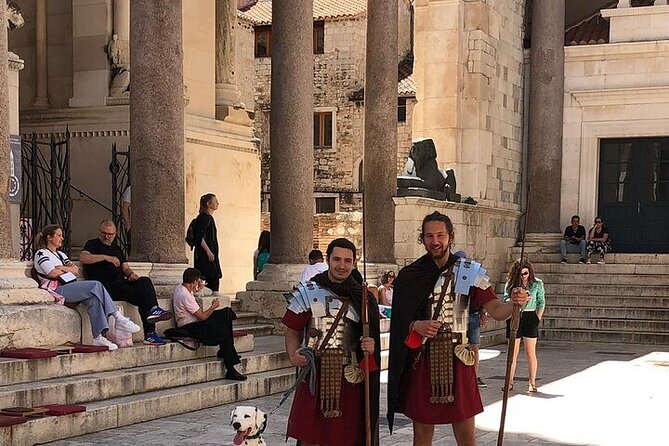
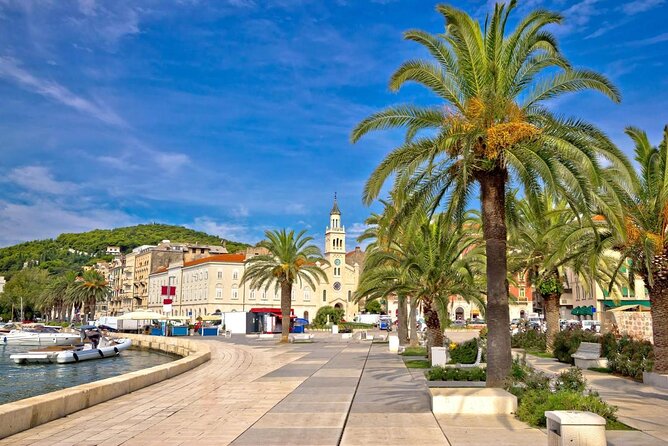
From the palace interior, you head to Riva Harbor, where the tour connects Diocletian’s world to Split’s modern waterfront identity. You’ll see a bronze model of the Diocletian’s Palace, which is useful because models can solve spatial confusion quickly.
Then you get the story of Split’s Riva promenade—how the waterfront became the kind of public space it is today. It’s a smart transition because it prevents the tour from becoming a one-building history lesson. You learn how the palace’s legacy still shows up where people actually walk and spend time.
This stop is about 15 minutes, which feels right for a viewpoint plus an explanation without turning it into a standstill.
Fruit’s Square (Trg Brace Radic) and Marko Marulić
Next is Fruit’s Square (Trg Brace Radic), where the tour adds a different kind of context: civic history and culture. Here you’ll learn about a Venetian citadel from the 15th century and how that layer shaped the area.
The tour also highlights Marko Marulić, described as the father of Croatian literature. That might sound like a detour if you’re only interested in Roman ruins. But it’s actually one of the tour’s strengths: it shows that Split didn’t just inherit old buildings—it developed its own cultural identity over centuries.
This segment is about 10 minutes, so it’s enough to plant the names and themes without eating up your afternoon.
Passing the Split Synagogue: A Quick Look at Jewish History
Near the end, you pass by the Split Synagogue, a 16th-century site. The tour focuses on the history of the Jewish community in Split, which adds an important human layer to the city’s timeline.
One practical note: admission for this stop is not included. That doesn’t mean the stop is pointless—it’s still a guided historical pass-by—but it does mean you won’t be automatically ticketed into any interior spaces during this tour.
If you want more time here, you can plan to return later based on what you’re interested in. The walk itself keeps the pace moving.
Guides in French: What the Best Ones Do With This Tour
This tour lives or dies with the guide, and the overall feedback is strongly positive. Guides are described as friendly, engaging, and very strong in French, and two names come up repeatedly: Antonela and Irene.
Antonela is praised for friendship, knowledge, humor, and answering questions—even unusual ones. Irene is described as fantastic, with a style that made the visit feel special for kids too. One note that stands out is that some guides are described as former diplomat, scholar, and enthusiast, which explains the mix of storytelling and structure you’re getting.
For you, that matters because palace history can get abstract fast. When the guide can switch between big-picture explanation and small detail, the whole walk becomes easier to follow and more fun to remember.
Price and Value: Is $69.14 Worth It?
At $69.14 per person, this isn’t a budget street-walk. The value comes from what you get layered together:
- You’re paying for a French-led guide with strong command of the material and the language.
- Most stops are handled with admission ticket free arrangements inside the tour experience, which reduces friction.
- The route connects Diocletian’s Palace highlights to Split’s later layers—Riva, Venetian influence, and cultural figures like Marko Marulić.
If your goal is to see the palace, take photos, and move on, you could do it on your own. But if you want the city to make sense—why this entrance matters, why certain figures are tied to language, and what “substructures” means—you’re paying for interpretation, not just access.
Also, small-group pacing helps. With a max of 30, you’re not stuck in an endless queue of people with zero attention from the guide.
What to Bring and How to Prep for a Stone-Palace Walk
This is a walking experience inside historic stone settings. That means practical preparation beats fancy gear.
- Wear shoes you trust on uneven surfaces.
- If high steps are a problem for you, this tour is specifically noted as not recommended—so choose a different route or ask about alternatives.
- Bring your mobile ticket so you can participate smoothly.
- Go with an open mind: even the shorter stops (like the Vestibulum and Golden Gate) are meant to give you context quickly.
Language-wise, it’s in French. If you’re not confident in French, you may understand key names and themes, but the deeper storytelling will likely be harder to follow.
Who This Tour Is Best For
I’d recommend this tour if you:
- Want a structured way to see Diocletian’s Palace without getting lost in details.
- Prefer your history tied to people and stories, not just dates.
- Enjoy walking city cores and connecting old monuments to later cultural moments.
- Are traveling with family and want a guide who can keep attention across ages (I’ve seen that pattern mentioned with Irene).
If you only care about major highlights and don’t want explanations, it may feel like too much “listen mode.” And if you struggle with steps, you should skip it.
Should You Book This French Split Walking Tour?
Book it if you want Split to click into place fast. The big selling point is the guide-led storytelling that turns palace architecture into understandable cause-and-effect—Diocletian’s rise, how the palace functioned, and how later Split layers still show up in public spaces.
Skip it if you’re looking for a self-paced photo tour, or if the walking and high steps could be an issue for you. Also think twice if your French is shaky and you mainly want to hear the narration.
If you’re ready to walk, look closely, and learn names and meanings as you go, this is a strong way to spend part of your day in Split’s most important historic footprint.
FAQ
How long is the History Split Walking Tour in French?
It runs for about 1 hour 30 minutes, though some groups report it can last closer to around 2 hours.
What’s the group size limit?
The tour has a maximum of 30 travelers.
Where does the tour start?
The meeting point is Peristil ulica, Peristil ul., 21000, Split, Croatia.
Is there a mobile ticket?
Yes, the tour uses a mobile ticket.
Are entry tickets included for all stops?
Most stops are listed with admission ticket free arrangements. The Split Synagogue stop does not include admission.
What language is the tour?
The tour is conducted in French.
Is the tour suitable if I have trouble with steps?
It’s not recommended for travelers who have issues with high steps.
What is the cancellation policy?
Free cancellation is available up to 24 hours in advance for a full refund.
Is the tour accessible to service animals and near public transportation?
Service animals are allowed, and the meeting area is near public transportation.